
How Does the 1945 Constitution Shape Indonesias Government?
Gusti Ayu Tita P
4 Agustus 2026
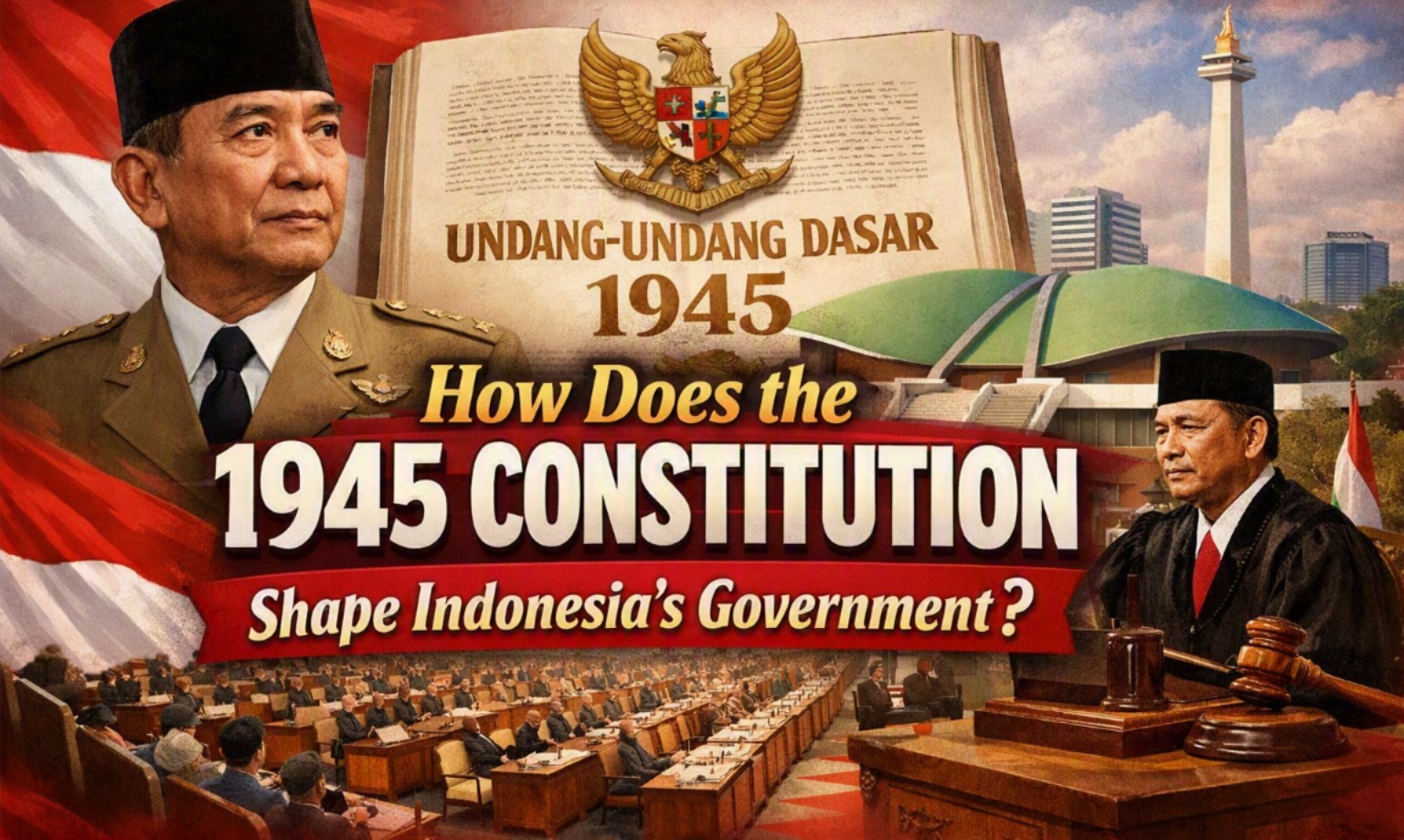
The 1945 Constitution is the highest legal foundation of the Republic of Indonesia. It establishes the structure of the government, defines the powers of state institutions, protects the rights of citizens, and guides the country in achieving its national goals. Since its adoption in 1945 and several constitutional amendments, the Constitution has become more responsive to democratic values, accountability, and the rule of law. Understanding how the Constitution shapes Indonesia's government helps citizens appreciate the importance of constitutional governance and democratic participation. It also provides insight into how Indonesia maintains stability while adapting to modern political and social challenges.
THE ROLE OF THE 1945 CONSTITUTION IN INDONESIAS GOVERNMENT
The 1945 Constitution serves as the supreme law that regulates the organization of the Indonesian government. Every law, regulation, and government policy must be consistent with the principles established in the Constitution. This legal framework ensures that state institutions operate within clearly defined limits and responsibilities. By providing legal certainty, the Constitution helps prevent the misuse of governmental authority. It also reinforces the principle that no individual or institution is above the law.
The Constitution establishes Indonesia as a democratic state based on law rather than absolute power. It outlines how government leaders are selected, how laws are created, and how public administration should function. Through constitutional provisions, Indonesia promotes transparency, accountability, and public participation in governance. The Constitution also acts as a safeguard against unconstitutional actions by government officials. As a result, it strengthens public trust in state institutions.
THE STRUCTURE OF STATE INSTITUTIONS
One of the most important functions of the 1945 Constitution is defining the roles and responsibilities of Indonesia's state institutions. It regulates the authority of the President, the People's Consultative Assembly (MPR), the House of Representatives (DPR), the Regional Representative Council (DPD), the Supreme Court, and the Constitutional Court. Each institution has specific duties that contribute to an effective system of governance. This distribution of authority creates a balanced governmental structure. It also minimizes the concentration of power in a single institution.
The Constitution encourages cooperation among state institutions while maintaining checks and balances. Each institution has constitutional responsibilities that support democratic governance and protect national interests. For example, the legislature creates laws, the executive implements policies, and the judiciary interprets and applies the law. This separation of responsibilities improves government efficiency and accountability. It also ensures that constitutional principles remain the foundation of every governmental decision.
PROTECTING THE RIGHTS OF CITIZENS
The 1945 Constitution guarantees various fundamental rights for Indonesian citizens. These include the right to education, freedom of religion, equality before the law, freedom of expression, and the right to participate in government. Constitutional protection ensures that these rights cannot be arbitrarily restricted without legal justification. Such guarantees promote fairness and strengthen democratic values throughout society. They also encourage citizens to actively contribute to national development.
Alongside rights, the Constitution also emphasizes the responsibilities of citizens. Every citizen is expected to obey the law, respect the rights of others, contribute to national defense when required, and support the nation's unity. This balance between rights and responsibilities creates a healthy democratic environment. Citizens who understand their constitutional obligations are better prepared to participate in public life. Ultimately, this contributes to social harmony and national stability.
CONSTITUTIONAL AMENDMENTS AND DEMOCRATIC DEVELOPMENT
Following the political reforms of 1998, Indonesia introduced several significant constitutional amendments between 1999 and 2002. These amendments strengthened democratic institutions, expanded human rights protections, and clarified the separation of powers among government branches. They also introduced the direct election of the President and Vice President by the people. These reforms made Indonesia's political system more transparent and accountable. They also increased public involvement in democratic processes.
The amendments also enhanced the role of the Constitutional Court in reviewing laws and protecting constitutional principles. This judicial mechanism allows unconstitutional legislation to be challenged and reviewed. As a result, the Constitution has become a more effective instrument for maintaining legal certainty and protecting democratic values. Continuous constitutional development reflects Indonesia's commitment to good governance. It also demonstrates the country's ability to adapt its legal framework to changing societal needs.
CONCLUSION
The 1945 Constitution continues to guide Indonesia through political, economic, and social changes. It provides a stable legal foundation while allowing democratic institutions to evolve. By clearly defining governmental authority, the Constitution helps prevent conflicts between state institutions. It also supports national unity by promoting justice, equality, and respect for diversity. These principles remain essential for maintaining a peaceful and prosperous nation.
As Indonesia continues to develop, the Constitution remains a living document that supports sustainable governance and democratic progress. Citizens, government officials, and public institutions all rely on constitutional principles to make informed decisions. A strong understanding of the Constitution also encourages greater civic participation and legal awareness. By respecting constitutional values, Indonesians contribute to stronger democratic institutions and national resilience. Therefore, the 1945 Constitution will continue shaping Indonesia's government for generations to come.
About the Author
Gusti Ayu Tita P
Author — STEKOM University
An active author focused on academic issues, educational technology, and human resource development in the campus environment.















