
How Ministry Civil Servants Support Bureaucratic Reform and Government Efficiency?
Gusti Ayu Tita P
27 Juli 2026
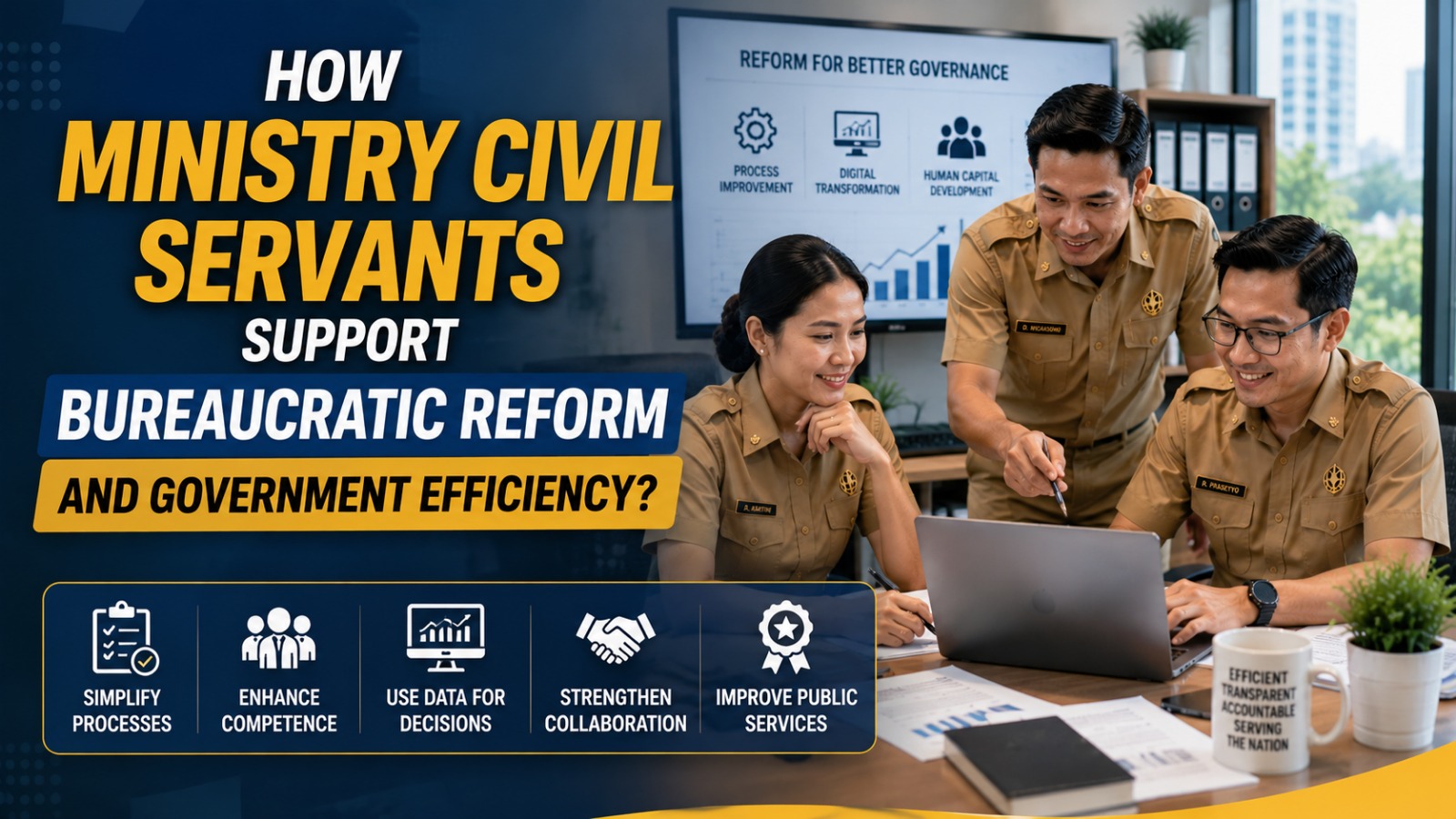
Bureaucratic reform is an important effort to create government institutions that are more effective, efficient, accountable, transparent, and responsive to public needs. The process involves improving organizational structures, work procedures, human resource management, digital systems, and public services. In this process, ministry civil servants play a central role because they are directly involved in implementing government policies and carrying out daily administrative activities.
Government efficiency cannot be achieved only through new regulations or organizational changes. It also depends on the commitment and performance of the people who implement those changes. By improving professional competence, using technology effectively, simplifying work processes, and maintaining integrity, ministry civil servants can make a meaningful contribution to bureaucratic reform and better government performance.
UNDERSTANDING THE ROLE OF BUREAUCRATIC REFORM
Bureaucratic reform aims to improve the way government institutions operate and deliver services. It focuses on creating a public administration system that is more professional, accountable, and oriented toward results. Reform can include improvements in organizational structures, business processes, human resources, digital governance, and public service delivery.
Ministry civil servants need to understand that bureaucratic reform is not simply an administrative project. It is a long-term effort to change the way government institutions work and respond to society. By understanding the objectives of reform, civil servants can participate more actively and ensure that improvements are applied consistently in their daily responsibilities.
IMPROVING PROFESSIONAL COMPETENCE
Competent human resources are essential for successful bureaucratic reform. Ministry civil servants need to have the knowledge and skills required to perform their responsibilities accurately and efficiently. These competencies may include technical expertise, communication, leadership, digital literacy, data analysis, and problem-solving abilities.
Continuous learning allows civil servants to keep up with changes in regulations, technology, and public expectations. Training programs, professional development, mentoring, and knowledge sharing can help employees improve their capabilities. Strong professional competence enables civil servants to complete tasks more effectively and contribute to better organizational outcomes.
SIMPLIFYING WORK PROCESSES
Complex and repetitive administrative procedures can reduce government efficiency. Ministry civil servants can support reform by identifying unnecessary steps and suggesting ways to make processes simpler. This does not mean ignoring regulations but finding more efficient methods while maintaining accountability and compliance.
Process simplification can reduce delays, minimize administrative burdens, and make responsibilities clearer. Civil servants who understand daily workflows are often able to identify practical improvements because they experience these processes directly. Through process improvement, government institutions can save time and resources while delivering services more efficiently.
USING DIGITAL TECHNOLOGY EFFECTIVELY
Digital transformation is an important part of modern bureaucratic reform. Ministry civil servants increasingly use digital systems for document management, communication, data processing, reporting, and public services. Effective use of technology can reduce manual work and improve coordination between different units.
However, digitalization should be implemented responsibly and based on actual organizational needs. Civil servants need to develop digital competence and understand basic principles of information security and data protection. When technology is used properly, it can support faster decision-making, improve transparency, and make government services more accessible.
STRENGTHENING ACCOUNTABILITY AND TRANSPARENCY
Accountability is a key principle of effective government administration. Ministry civil servants need to understand their responsibilities and be able to explain the decisions and actions they take within their authority. Proper documentation, reporting, monitoring, and evaluation can help ensure that government programs are implemented responsibly.
Transparency also helps strengthen public trust. Civil servants should provide accurate information through appropriate channels and follow applicable rules regarding public information and confidentiality. By maintaining accountability and transparency, government institutions can improve oversight and demonstrate that public resources and authority are being managed responsibly.
PROMOTING INTEGRITY AND ETHICAL BEHAVIOR
Bureaucratic reform requires a strong culture of integrity. Ministry civil servants are expected to act honestly, fairly, and professionally while avoiding conflicts of interest and misuse of authority. Ethical behavior is essential because public institutions depend heavily on trust.
Integrity should be reflected in everyday actions, from managing documents and resources to interacting with colleagues and citizens. Civil servants who consistently demonstrate ethical conduct can help create a workplace culture that discourages misconduct and encourages responsible decision-making. Strong integrity also supports the credibility of government institutions.
FOCUSING ON RESULTS AND PERFORMANCE
Government efficiency is closely connected to the ability to achieve meaningful results. Civil servants should not focus only on completing administrative tasks but also consider whether their work contributes to organizational objectives. Clear performance indicators can help employees understand expectations and measure progress.
A performance-oriented culture encourages employees to work toward measurable outcomes and continuously evaluate their effectiveness. Regular performance reviews can identify areas that need improvement and highlight successful practices. This approach helps ministries use their resources more strategically and focus on programs that create real public value.
CONCLUSION
Ministry civil servants play a crucial role in supporting bureaucratic reform and government efficiency. Their contributions can be seen through professional competence, process improvement, digital transformation, accountability, integrity, innovation, collaboration, and quality public services. These efforts help turn reform policies into practical improvements within government institutions.
Ultimately, successful bureaucratic reform depends on the commitment of both organizations and individuals. Civil servants who continuously improve their skills, embrace responsible innovation, and focus on public needs can help create a more efficient and accountable government. Through consistent efforts, ministry civil servants can strengthen public administration and contribute to government institutions that are more professional, transparent, effective, and trusted by society.
About the Author
Gusti Ayu Tita P
Author — STEKOM University
An active author focused on academic issues, educational technology, and human resource development in the campus environment.















