How TKA Helps Students Develop Strong Analytical Thinking Skills?
Gusti Ayu Tita P
13 Agustus 2026
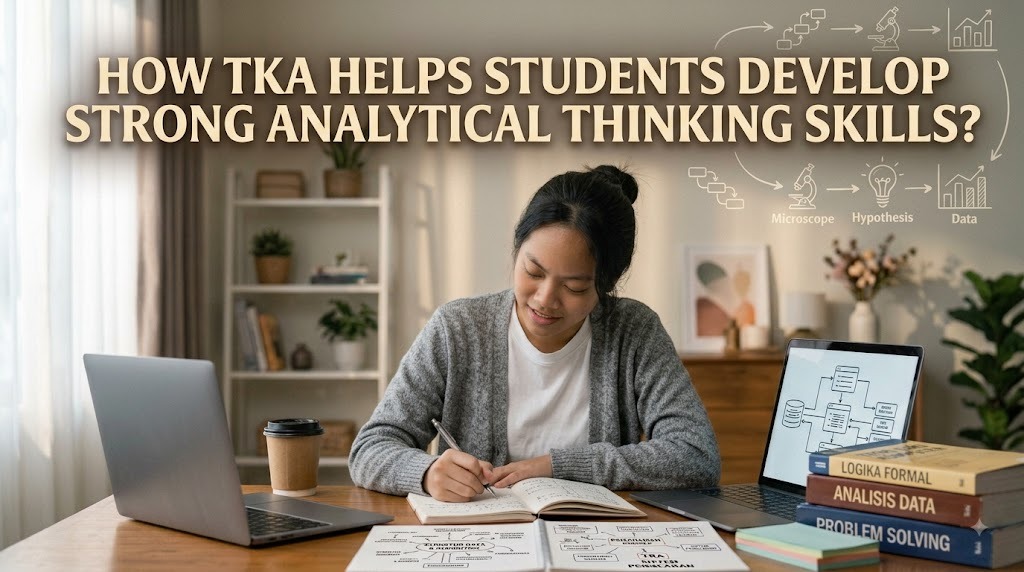
The TKA or Academic Competency Test can encourage students to use more than simple memorization when answering academic questions. Many questions require students to understand information, identify important details, compare possibilities, and reach logical conclusions. These activities are closely related to analytical thinking skills, which are useful in both education and everyday life. By practicing these skills through academic preparation, students can become more careful and systematic thinkers.
Analytical thinking is not something that develops instantly. It grows through repeated practice, exposure to different problems, and reflection on mistakes. TKA preparation can become an opportunity for students to strengthen these abilities while reviewing academic concepts. The more students practice analyzing information, the better they can understand problems and make logical decisions.
UNDERSTANDING ANALYTICAL THINKING
Analytical thinking is the ability to examine information carefully before reaching a conclusion. It involves breaking complex information into smaller parts and identifying how those parts are connected. Students use analytical thinking when they compare evidence, recognize patterns, evaluate arguments, or determine the most logical solution. This skill helps students avoid making decisions based only on assumptions or guesses.
Analytical thinking also requires students to ask meaningful questions. They may ask what caused a situation, what evidence supports a conclusion, or which information is most relevant. These questions encourage deeper understanding rather than surface-level learning. As a result, analytical thinking helps transform information into meaningful knowledge.
USING EVIDENCE TO REACH CONCLUSIONS
Strong analytical thinking requires evidence. Students should learn to base conclusions on information provided in the question rather than personal assumptions. In reading-based questions, for example, the answer should be supported by details from the text. Evidence-based reasoning helps students make more accurate conclusions.
Students can develop this habit by asking themselves where the evidence for their answer comes from. If they cannot identify supporting information, they should reconsider their reasoning. This approach is especially useful when several answer choices appear reasonable. Using evidence makes the decision-making process more objective and systematic.
LEARNING FROM ERRORS AND FEEDBACK
Mistakes are valuable opportunities to develop analytical skills. When students answer a question incorrectly, they can examine the reasoning that led to the mistake. The problem may involve misunderstanding the concept, overlooking important information, or selecting an inappropriate strategy. Understanding why an answer is wrong is often more valuable than simply memorizing the correct answer.
Students can create a simple record of common mistakes during practice. They can note the question type, the incorrect approach, and the correct reasoning. Reviewing this information later can reveal patterns in their thinking. Error analysis helps students identify weaknesses and improve their reasoning strategies.
PRACTICE QUESTIONS AS ANALYTICAL TRAINING
Practice questions are useful because they provide opportunities to apply analytical thinking repeatedly. Students should not only focus on how many questions they answer correctly. They should also consider whether they understood the concept and reasoning behind each solution. Quality of practice is more important than simply completing a large number of questions.
Using different types of questions can make practice more effective. Students may encounter questions that require comparison, interpretation, calculation, classification, or evaluation. Each type can train a different aspect of analytical thinking. Varied practice prepares students to approach unfamiliar problems more confidently.
BUILDING CRITICAL THINKING THROUGH TKA PREPARATION
Analytical thinking and critical thinking are closely related but have different focuses. Analytical thinking involves breaking information into parts and understanding relationships, while critical thinking also involves evaluating the quality and reliability of information. TKA preparation can provide opportunities to practice both skills. Students learn not only to understand information but also to evaluate how it should be used.
For example, students can question whether a conclusion is supported by sufficient evidence. They can also compare different explanations and identify which one is more logical. These habits can improve their ability to make thoughtful decisions. Critical evaluation makes analytical thinking more complete and useful.
MANAGING TIME WHILE THINKING ANALYTICALLY
Analytical thinking does not mean spending unlimited time on every question. Students also need to learn how to analyze information efficiently. They can begin by identifying the main problem and the most important information before considering possible solutions. Efficient analysis allows students to balance accuracy with time management.
During practice, students can use reasonable time limits to improve their speed. If a question becomes too difficult, they can move forward and return to it later when appropriate. This strategy prevents one challenging problem from taking too much time. Good analytical thinkers know when to examine a problem deeply and when to move forward strategically.
HOW STUDENTS CAN STRENGTHEN ANALYTICAL THINKING
Students can develop analytical thinking through simple daily habits. They can summarize lessons using their own words, explain why an answer is correct, compare different viewpoints, and solve problems without immediately checking the solution. Asking why and how can encourage deeper thinking than simply asking what the answer is.
Students should also review their learning regularly. Instead of repeating the same material without reflection, they can identify what they understand and what remains unclear. Discussing difficult topics with teachers or classmates can provide new perspectives. Consistent reflection and active learning can gradually strengthen analytical abilities.
THE BENEFITS BEYOND THE TKA
Analytical thinking is valuable beyond academic assessments. Students can use it when making personal decisions, evaluating information online, solving problems, and planning future goals. These abilities can also support higher education because university learning often requires students to analyze information independently. Strong analytical skills can become a long-term academic advantage.
The workplace also requires people who can understand problems and make reasonable decisions. Employers may value individuals who can examine information, identify solutions, and explain their reasoning clearly. Therefore, developing analytical thinking through academic preparation can have benefits beyond school. TKA preparation can contribute to skills that remain useful in future education and professional life.
CONCLUSION
TKA can help students develop strong analytical thinking by encouraging them to understand information, identify relevant details, compare possibilities, evaluate evidence, and reach logical conclusions. The value of preparation is not limited to achieving a good test result. Students can also develop thinking habits that help them approach academic problems more systematically.
The best way to strengthen these abilities is through conceptual learning, varied practice questions, error analysis, evidence-based reasoning, and consistent reflection. Students should focus not only on whether an answer is correct but also on why it is correct. By developing analytical thinking through TKA preparation, students can become more confident problem solvers and better prepared for future academic and professional challenges.
About the Author
Gusti Ayu Tita P
Author — STEKOM University
An active author focused on academic issues, educational technology, and human resource development in the campus environment.