
How TKA Is Changing Student Learning From Memorization To Critical Thinking?
Gusti Ayu Tita P
13 Agustus 2026
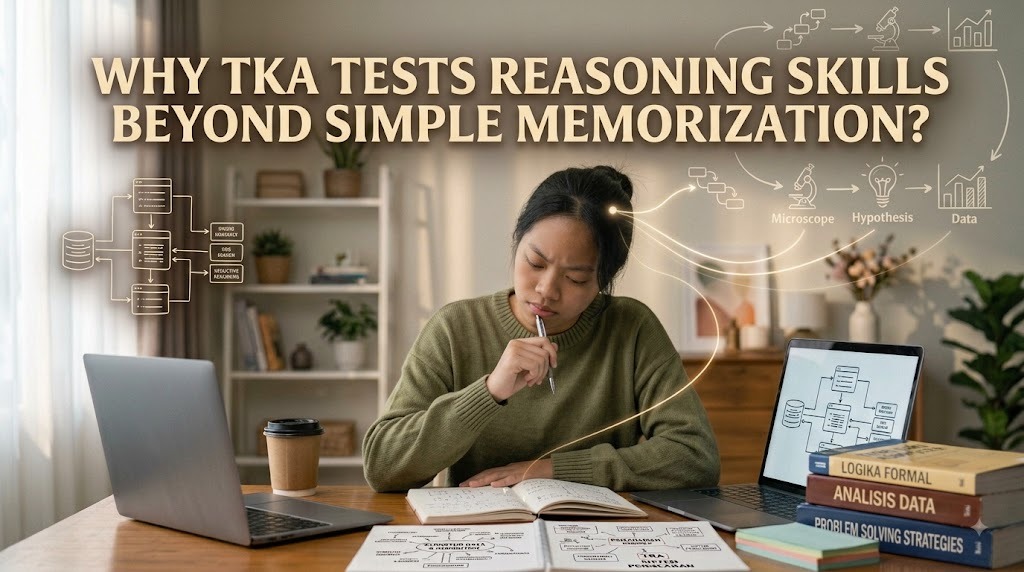
The TKA or Academic Competency Test encourages students to look beyond simply memorizing information. In traditional study habits, students may focus heavily on remembering definitions, formulas, or answers before an examination. However, academic competency also requires students to understand information, apply concepts, analyze problems, and make logical conclusions. This shift places greater value on how students think and use knowledge, not only on how much information they can remember.
The change does not mean memorization is no longer useful. Basic knowledge remains an important foundation for learning because students need information before they can analyze or apply it. The difference is that students are encouraged to go beyond recall and develop critical thinking, problem solving, and analytical skills. This can make learning more meaningful and useful for future academic and professional challenges.
UNDERSTANDING THE SHIFT FROM MEMORIZATION TO CRITICAL THINKING
Memorization allows students to store and recall information when needed. It is useful for learning basic concepts, terminology, formulas, vocabulary, and important facts. However, memorization alone does not always show whether students understand the meaning behind the information. Critical thinking requires students to examine, question, compare, and evaluate information before reaching a conclusion.
This shift encourages students to ask more meaningful questions during learning. Instead of only asking what the answer is, they can ask why the answer is correct and how the concept can be applied in another situation. These questions encourage deeper understanding. Learning becomes an active process rather than simply collecting information for an examination.
HOW TKA ENCOURAGES CONCEPTUAL UNDERSTANDING
TKA preparation can encourage students to understand concepts instead of memorizing isolated answers. When students understand the principles behind a topic, they can apply their knowledge to different situations. This is especially useful when questions are presented using unfamiliar examples or different wording. Conceptual understanding gives students a stronger foundation for solving new problems.
Students can strengthen this ability by explaining lessons in their own words. They can also connect new concepts with topics they have previously learned. When students understand these relationships, information becomes easier to remember and apply. Understanding the connection between ideas is more useful than memorizing disconnected facts.
DEVELOPING ANALYTICAL THINKING
Analytical thinking involves breaking information into smaller parts and identifying relationships between those parts. TKA preparation can encourage students to determine which details are important and which are less relevant. This skill helps students approach complicated questions more systematically. Analysis allows students to understand the structure of a problem before attempting to solve it.
Students can practice analytical thinking by comparing information, identifying patterns, and explaining relationships. They can also create diagrams or concept maps to organize complicated topics. These methods make it easier to see how different ideas connect. Organized information can lead to clearer reasoning.
CHANGING THE WAY STUDENTS STUDY
The shift toward critical thinking can influence daily study habits. Students may spend less time repeatedly reading notes and more time answering questions, explaining concepts, and discussing problems. Active learning encourages students to participate directly in the learning process. The focus moves from passive reading toward active understanding.
Students can also use techniques such as active recall and spaced review. Instead of studying everything in one long session, they can review important concepts regularly. This combination helps strengthen memory while also creating opportunities to apply knowledge. Effective study combines memory with understanding and practice.
THE ROLE OF TEACHERS IN DEVELOPING CRITICAL THINKING
Teachers can support this change by creating learning activities that encourage students to explain their reasoning. Instead of focusing only on the final answer, teachers can ask students how they reached their conclusions. Classroom discussions, case studies, problem solving activities, and analytical questions can encourage deeper thinking. The learning environment can influence how students approach academic problems.
Feedback is also important. When students make mistakes, teachers can help them identify the reasoning problem instead of simply giving the correct answer. This allows students to understand what needs improvement. Constructive feedback can strengthen both knowledge and confidence.
BALANCING MEMORIZATION AND CRITICAL THINKING
The move toward critical thinking does not mean students should stop memorizing completely. Basic knowledge is still necessary because students cannot analyze information they do not understand or remember. Formulas, vocabulary, definitions, and fundamental principles may need to be recalled quickly. Memorization should serve as a foundation for higher level thinking.
The key is to combine both approaches. Students can first learn essential information and then practice applying it to different problems. They can ask questions, compare solutions, and explain concepts in their own words. A balanced study strategy develops both strong knowledge and flexible thinking.
PREPARING FOR TKA WITH A BETTER STUDY STRATEGY
Students can start by identifying important concepts rather than trying to memorize every detail. After understanding the main ideas, they can practice different question types and review their mistakes. Difficult topics should receive additional attention, while familiar topics can be reviewed periodically. Consistent and targeted preparation is more effective than relying on last minute memorization.
Students should also practice managing their time. TKA preparation should include timed practice so students can learn how to think carefully while working within a reasonable limit. However, speed should not become more important than understanding. The goal is to become accurate, efficient, and confident when solving problems.
BENEFITS BEYOND THE TKA
Critical thinking skills are useful beyond academic examinations. Students can use them to evaluate information on the internet, make personal decisions, solve everyday problems, and understand different perspectives. These abilities can also help them become more independent learners. Learning how to think critically can have long term benefits.
Higher education and professional environments also require people who can analyze information and solve problems. Students who develop these skills early may find it easier to adapt to new academic and professional challenges. Therefore, the learning habits encouraged through TKA preparation can extend beyond the test itself. The real benefit is developing a stronger way of thinking.
CONCLUSION
TKA is encouraging a learning approach that places greater emphasis on understanding, critical thinking, analytical thinking, and problem solving rather than relying entirely on memorization. Students still need basic knowledge, but they are also expected to understand how that knowledge can be used. This makes learning more active and prepares students to handle questions in different contexts.
The best strategy is not to completely replace memorization with critical thinking. Instead, students should combine essential memorization with conceptual understanding, practice questions, evidence based reasoning, and error analysis. By developing these habits consistently, students can become more flexible and confident learners. More importantly, the skills gained through this approach can remain useful in higher education, future careers, and everyday decision making.
About the Author
Gusti Ayu Tita P
Author — STEKOM University
An active author focused on academic issues, educational technology, and human resource development in the campus environment.















