
How TKA Questions Can Measure Students' Problem Solving Abilities?
Gusti Ayu Tita P
13 Agustus 2026
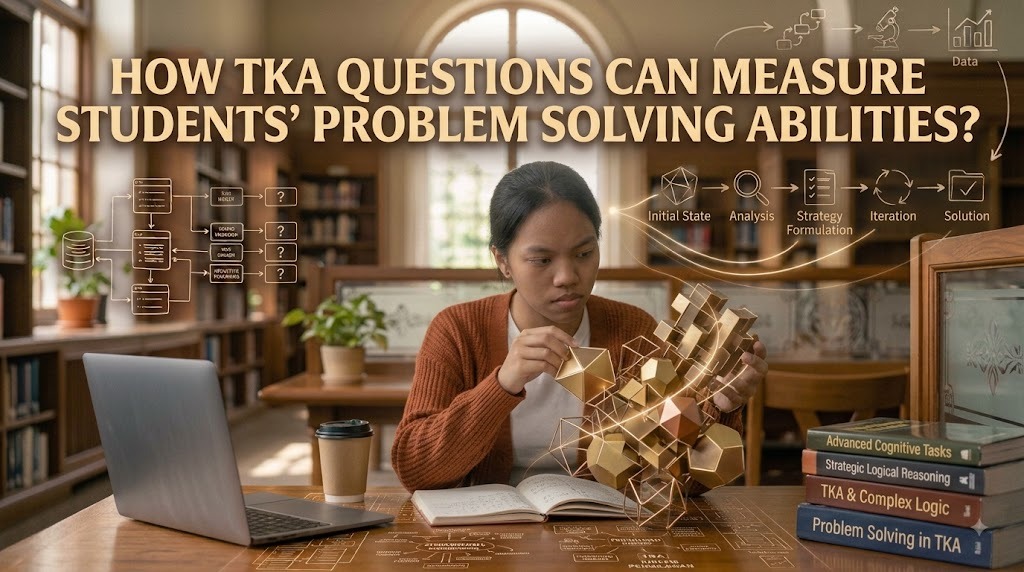
The TKA or Academic Competency Test is not simply designed to see whether students can remember information. Its questions can encourage students to understand concepts, analyze information, and determine suitable solutions. These activities provide opportunities for students to demonstrate their problem solving abilities in an academic context. Instead of focusing only on the final answer, students need to think carefully about how they reach a solution.
Problem solving is an important skill because students may encounter questions that use unfamiliar situations. A student who understands a concept can apply it even when the question is presented differently. This requires logical reasoning, information analysis, and decision making. For this reason, understanding how TKA questions measure problem solving can help students prepare more effectively.
UNDERSTANDING PROBLEM SOLVING IN TKA
Problem solving is the process of identifying a problem, understanding the available information, choosing an appropriate strategy, and reaching a reasonable solution. In TKA questions, students may need to use several of these steps before selecting an answer. The process requires students to connect their academic knowledge with the situation described. Problem solving turns knowledge into practical action.
Students may also need to evaluate whether their solution makes sense. If the result does not match the information provided, they may need to review their reasoning. This encourages students to become more careful and reflective. A good solution is not only about reaching an answer but also about using an appropriate reasoning process.
HOW TKA QUESTIONS PRESENT PROBLEMS
TKA questions can present academic concepts through different situations and contexts. A familiar topic may be introduced through a new example, a short case, a data set, or a particular scenario. This means students cannot always depend on remembering an identical question from their study materials. They need to understand the concept behind the problem.
Different question formats can require different approaches. Some questions may ask students to interpret information, while others may require calculation, comparison, evaluation, or application. Students therefore need to determine what type of reasoning the question requires. Recognizing the nature of a problem is an important first step toward solving it.
IDENTIFYING THE MAIN PROBLEM
Before solving a question, students need to understand what the question is actually asking. They can identify the main task, important information, and expected result. This prevents them from focusing on details that are not relevant. Clear problem identification can make the solving process more efficient.
Students should pay attention to important words and relationships within the question. They can ask themselves what information is already known and what information needs to be determined. If the question is complicated, breaking it into smaller parts can make it easier to understand. A clear understanding of the problem provides a strong foundation for finding the solution.
CHECKING THE FINAL SOLUTION
Checking the final answer is an important part of problem solving. Students can ask whether the result is reasonable and whether it answers exactly what the question asks. In mathematical questions, they can review their calculations, while in reading questions they can compare the answer with evidence from the passage. Verification can help identify errors before the final answer is submitted.
Students should also consider whether they accidentally misunderstood the question. A technically correct calculation may still lead to an incorrect answer if the wrong information was used. Developing the habit of checking can therefore improve accuracy. Careful verification is part of effective problem solving.
LEARNING FROM WRONG ANSWERS
Incorrect answers can reveal weaknesses in the problem solving process. A student may have misunderstood the problem, selected irrelevant information, used an unsuitable strategy, or made an error while applying a concept. Instead of simply memorizing the correct answer, students should identify the source of the mistake. Error analysis can improve future problem solving.
Students can keep a record of common mistakes during TKA practice. They can write down the topic, the mistake, and the correct reasoning. Reviewing these records can reveal patterns in their performance. Understanding recurring errors allows students to focus their preparation more effectively.
PRACTICE QUESTIONS AND PROBLEM SOLVING
Practice questions provide opportunities for students to develop problem solving through repeated application. However, students should not measure progress only by the number of questions they complete. They should also review how they reached each answer. The quality of reasoning matters as much as the final score during practice.
Students should use different question types and levels of difficulty. This prevents them from becoming dependent on one familiar pattern. When questions change, students must decide which concept and strategy are appropriate. Varied practice develops flexibility and adaptability.
DEVELOPING TIME MANAGEMENT
Problem solving requires thoughtful analysis, but students also need to work within a limited amount of time. Spending too long on one difficult question can reduce the time available for other questions. Students can practice identifying the main problem quickly and deciding how much time to spend. Effective problem solving includes both accuracy and time management.
Timed practice can help students become familiar with test conditions. If a question is particularly challenging, students can move to another question and return later when appropriate. This strategy can prevent one difficult problem from affecting the entire test. Good time management allows students to use their reasoning skills more efficiently.
HOW STUDENTS CAN PREPARE FOR TKA PROBLEM SOLVING
Students should begin by strengthening their understanding of fundamental concepts. After that, they can practice applying each concept to different situations. They should explain their reasoning and review mistakes instead of focusing only on the number of correct answers. Conceptual learning and active practice should work together.
Students can also use active recall, practice tests, discussions, and error analysis. Reviewing difficult questions several times can help students understand different approaches to the same problem. Regular practice can make the problem solving process more familiar. Consistent preparation is more effective than relying only on last minute memorization.
WHY PROBLEM SOLVING MATTERS BEYOND TKA
Problem solving is useful in many areas beyond academic testing. Students use it when making decisions, managing daily challenges, evaluating information, and planning future goals. Strong problem solving skills can help students become more independent and confident. These abilities are valuable life skills as well as academic skills.
Higher education and professional environments also require people to solve unfamiliar problems. Students may need to analyze information, evaluate alternatives, and develop practical solutions. Therefore, TKA preparation can contribute to skills that remain useful after the test. Learning how to solve problems can provide long term benefits for education and future careers.
CONCLUSION
TKA questions can measure students' problem solving abilities by requiring them to identify problems, select relevant information, choose appropriate strategies, apply concepts, evaluate answers, and check solutions. These steps show that solving a question involves more than remembering information. Students need to use their knowledge actively and make logical decisions.
The best preparation combines conceptual understanding, problem solving practice, question analysis, error evaluation, and time management. Students should focus on understanding why a solution works instead of simply memorizing the final answer. By developing these skills consistently, students can approach TKA questions with greater confidence and build abilities that remain useful in higher education and future professional life.
About the Author
Gusti Ayu Tita P
Author — STEKOM University
An active author focused on academic issues, educational technology, and human resource development in the campus environment.















