
How to Apply Bhinneka Tunggal Ika Values in Daily Life?
Gusti Ayu Tita P
4 Agustus 2026
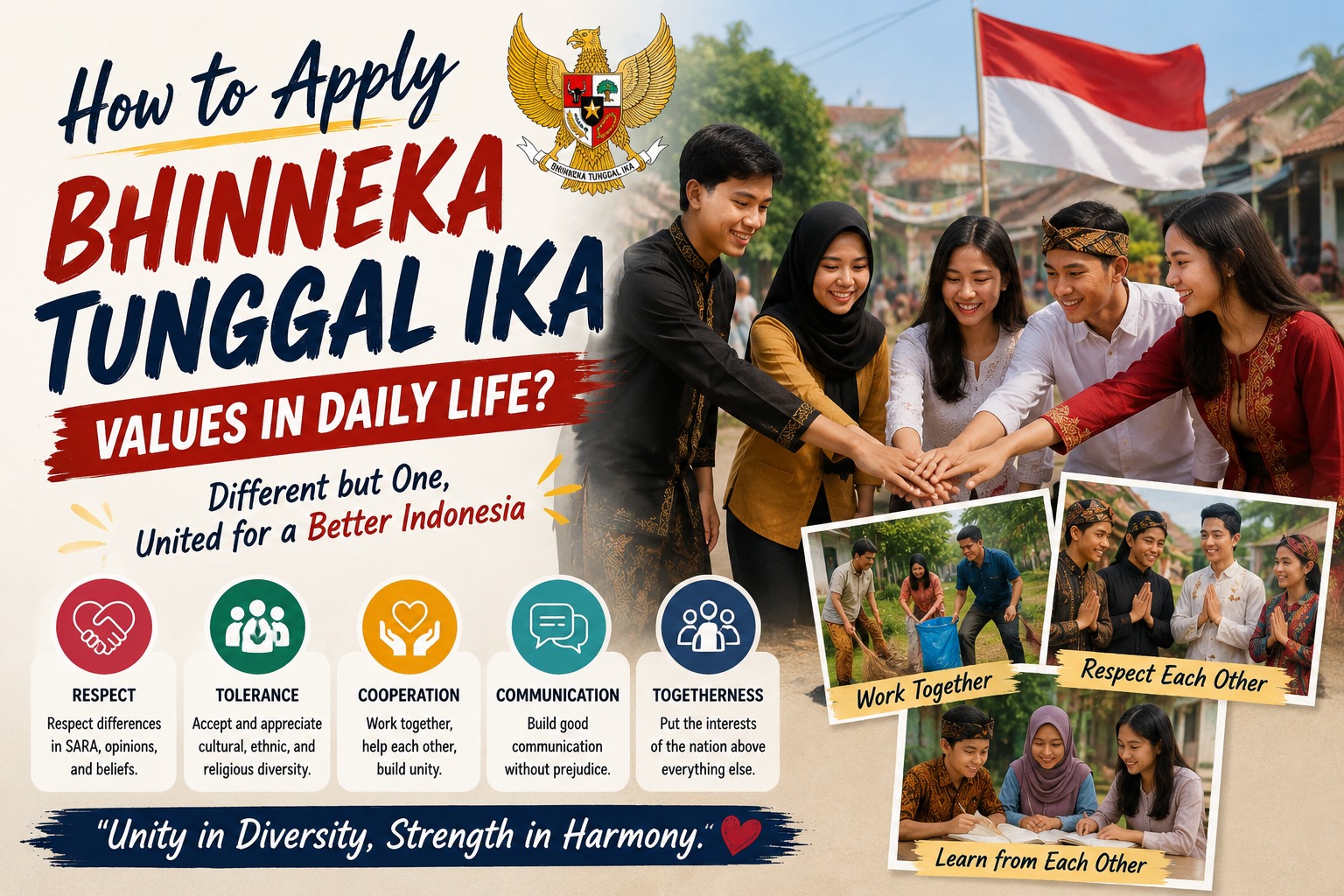
Indonesia is a country known for its rich diversity of ethnic groups, religions, languages, cultures, and traditions. This diversity is one of the nation’s greatest strengths, but it also requires people to respect one another and maintain social harmony. Bhinneka Tunggal Ika, which means “Unity in Diversity,” provides an important principle for living peacefully despite differences.
Applying Bhinneka Tunggal Ika in daily life does not require complicated actions. It can begin with simple habits such as respecting other people, avoiding discrimination, cooperating with others, and appreciating different cultures. When these values are practiced consistently, diversity can become a source of unity rather than division.
UNDERSTANDING BHINNEKA TUNGGAL IKA IN DAILY LIFE
Bhinneka Tunggal Ika is Indonesia’s national motto and expresses the idea that people can remain united despite having different backgrounds. The principle is closely connected to Indonesia’s diverse society, where people have different ethnic, religious, linguistic, and cultural identities. Understanding this meaning is the first step toward applying its values in everyday situations.
The principle does not ask people to remove their differences. Instead, it encourages everyone to respect those differences while maintaining a shared identity as Indonesians. This perspective can help people build healthier relationships at home, at school, at work, and in their communities.
RESPECTING DIFFERENCES IN EVERYDAY INTERACTIONS
One of the simplest ways to apply Bhinneka Tunggal Ika is by respecting people who have different backgrounds. People may have different religions, cultures, traditions, opinions, or lifestyles. These differences should not become reasons to insult, exclude, or discriminate against others.
Respect can be shown through simple actions, such as listening when someone expresses an opinion and avoiding offensive comments about their identity. People should also avoid judging others based only on stereotypes. Small acts of respect can create a more comfortable and inclusive environment for everyone.
PRACTICING RELIGIOUS TOLERANCE
Religious tolerance is an important part of maintaining harmony in a diverse society. People can practice it by respecting the rights of others to worship and follow their religious beliefs. Tolerance also means avoiding actions that disturb or disrespect other people’s religious practices.
In daily life, religious tolerance can be shown by respecting religious celebrations, maintaining appropriate behavior around places of worship, and avoiding negative comments about other faiths. People do not need to share the same beliefs to treat one another with dignity. Mutual respect can help create stronger relationships across religious communities.
APPRECIATING INDONESIAN CULTURAL DIVERSITY
Indonesia has a wide variety of traditional arts, languages, clothing, foods, music, dances, and customs. Appreciating this diversity is another practical way to apply Bhinneka Tunggal Ika. Learning about traditions from other regions can help people understand that different cultures have their own histories and meanings.
People can support cultural diversity by attending cultural events, learning traditional arts, trying local foods, and sharing accurate information about Indonesian heritage. Young people can also use digital platforms to introduce regional cultures to wider audiences. These activities can strengthen pride in Indonesia’s cultural richness while encouraging respect for different communities.
WORKING TOGETHER WITHOUT DISCRIMINATION
Cooperation is an important part of unity. In daily life, people can work together with others regardless of their ethnicity, religion, gender, regional background, or social status. Shared goals can bring people together even when their personal identities are different.
Teamwork can be practiced through school projects, workplace activities, neighborhood programs, volunteer work, or community events. Everyone should receive a fair opportunity to contribute according to their abilities. By cooperating without discrimination, people can build trust and strengthen relationships within their communities.
RESOLVING DIFFERENCES THROUGH DIALOGUE
Differences of opinion are normal in families, schools, workplaces, and communities. Applying Bhinneka Tunggal Ika means handling these differences through respectful communication instead of hostility. Listening carefully can help people understand why others have different perspectives.
When disagreements occur, people should focus on the issue rather than attacking someone’s identity. Finding common ground and discussing possible solutions can prevent small disagreements from becoming larger conflicts. This approach supports a culture of peace and mutual understanding.
USING SOCIAL MEDIA RESPONSIBLY
Social media is now an important part of everyday communication. It can connect people from different backgrounds, but it can also spread misinformation, hate speech, and discriminatory content. Therefore, applying Bhinneka Tunggal Ika is also important in digital spaces.
Before sharing information, users should check whether the content comes from a reliable source. They should also avoid creating or spreading content that insults ethnic, religious, or cultural groups. Using social media to share positive stories about diversity can help create a healthier digital environment.
TEACHING UNITY AND TOLERANCE TO YOUNG PEOPLE
Families and educational institutions have an important role in teaching Bhinneka Tunggal Ika to younger generations. Children and teenagers can learn about diversity through classroom discussions, cultural activities, group projects, and community programs. These experiences can help them understand that differences are a normal part of Indonesian society.
Adults should also provide good examples through their own behavior. Young people are more likely to develop tolerance when they see parents, teachers, and community members treating others fairly. Consistent examples can turn the values of respect and unity into everyday habits.
BUILDING A MORE INCLUSIVE COMMUNITY
Applying Bhinneka Tunggal Ika ultimately means helping create a community where people feel respected and included. This can begin by avoiding discrimination, supporting cooperation, and giving others opportunities to participate. Every individual can contribute to a positive social environment through simple and consistent actions.
A diverse community becomes stronger when its members recognize both their differences and their shared interests. People can maintain their unique identities while still cooperating for common goals. In this way, Bhinneka Tunggal Ika becomes more than a national motto and becomes a practical guide for everyday life.
CONCLUSION
Applying Bhinneka Tunggal Ika values in daily life can begin with simple actions such as respecting differences, practicing religious tolerance, appreciating cultural diversity, cooperating without discrimination, and communicating respectfully. These habits can strengthen relationships and help prevent differences from becoming sources of conflict.
The responsibility for maintaining unity belongs to everyone. When individuals consistently practice tolerance at home, at school, at work, in their communities, and on social media, Indonesia’s diversity can remain a source of strength. Bhinneka Tunggal Ika therefore remains an important guide for creating a peaceful, respectful, and united society.
About the Author
Gusti Ayu Tita P
Author — STEKOM University
An active author focused on academic issues, educational technology, and human resource development in the campus environment.















