How Unity and Diversity Shaped Indonesian History?
Gusti Ayu Tita P
8 Agustus 2026
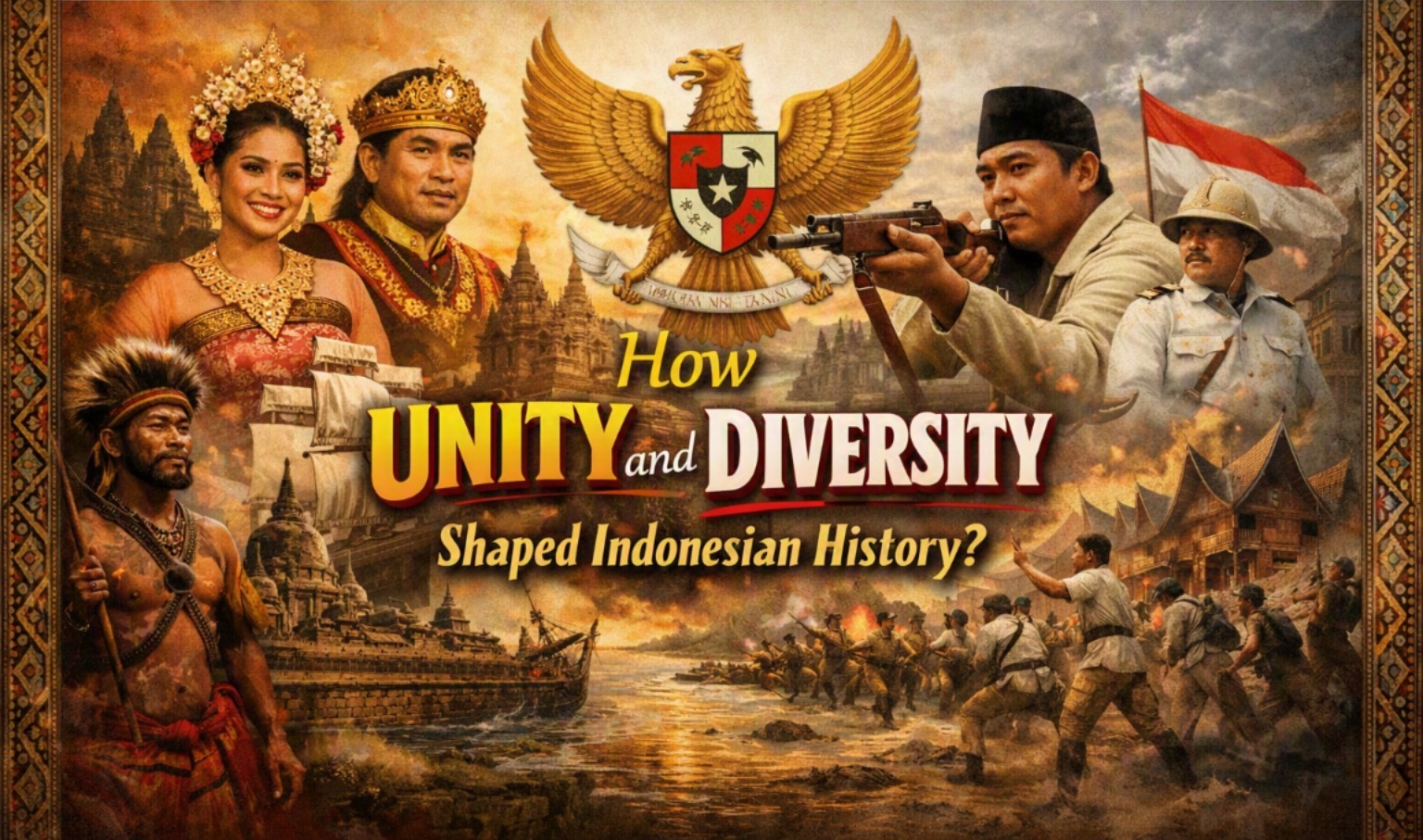
Indonesia is one of the world's most diverse countries, with hundreds of ethnic groups, languages, traditions, and local cultures. This diversity has played an important role in shaping the country's long history. At the same time, the ability to build unity among different communities has helped Indonesia overcome many political and social challenges.
The relationship between unity and diversity can be seen throughout Indonesian history, from ancient kingdoms and maritime trade to colonial resistance and the formation of the modern state. Understanding this relationship helps explain why Bhinneka Tunggal Ika, meaning Unity in Diversity, became an important national principle. Indonesian history shows that differences do not always create division because they can also become a source of strength when communities work toward common goals.
DIVERSITY IN EARLY INDONESIAN SOCIETY
Long before Indonesia became a modern nation, the Indonesian archipelago was home to many different communities. Each region developed its own languages, customs, beliefs, and traditions based on its environment and historical experiences. Maritime trade also brought people from India, China, Arabia, and other parts of Asia into contact with local communities. These interactions influenced religion, culture, technology, art, and trade across the archipelago.
The rise of major kingdoms demonstrated how different communities could interact within wider political and economic networks. Srivijaya became an important maritime power in Southeast Asia, while Majapahit later controlled or influenced large parts of the archipelago through political and commercial connections. Although these societies were not Indonesia in the modern national sense, their histories contributed to the development of long-term connections between different regions.
TRADE AND CULTURAL EXCHANGE CONNECTED THE ARCHIPELAGO
Trade was one of the most important forces connecting communities across the Indonesian islands. Strategic locations along major maritime routes allowed ports to become meeting places for people with different backgrounds. Traders exchanged not only spices and other goods, but also ideas, languages, technologies, and religious beliefs. As a result, Indonesian culture developed through continuous interaction between local traditions and outside influences.
The spread of Hinduism, Buddhism, and Islam also demonstrates the importance of cultural exchange. Islam gradually became influential in many coastal areas through trade, religious teachers, local rulers, and social networks. Instead of completely replacing existing traditions, new beliefs often interacted with established local customs. This process created diverse cultural practices that remain visible in Indonesian society today.
COLONIALISM STRENGTHENED THE IDEA OF NATIONAL UNITY
European colonialism created major changes in Indonesian society and politics. The Dutch gradually expanded their control over large parts of the archipelago, while different local communities resisted colonial rule in various regions. Leaders such as Diponegoro, Pattimura, and Cut Nyak Dien became important symbols of resistance in different historical contexts. These struggles showed the determination of local communities to defend their land, political interests, and independence.
However, resistance was often separated by geography and local interests, making it difficult to create a united national movement. During the early twentieth century, Indonesian nationalists increasingly promoted the idea that people from different ethnic and regional backgrounds shared a common future. Organizations, newspapers, schools, and youth movements helped spread national consciousness. This development transformed the idea of resistance from mainly local struggles into a broader movement for Indonesian independence.
THE YOUTH PLEDGE TURNED DIVERSITY INTO A NATIONAL STRENGTH
One of the most important moments in the development of Indonesian national identity was the Youth Pledge of 1928, known as Sumpah Pemuda. Young people from different regional and cultural backgrounds declared their commitment to one homeland, one nation, and one national language, Indonesian. The pledge did not erase regional identities or local languages. Instead, it created a shared identity that could exist alongside Indonesia's rich cultural diversity.
The decision to promote Indonesian as a common language was especially significant. A shared language made communication easier among communities that spoke many different local languages. It also helped strengthen education, journalism, political organization, and the national independence movement. The Youth Pledge demonstrated that diversity could become a foundation for unity when people recognized goals and values that they shared.
PANCASILA AND BHINNEKA TUNGGAL IKA
After Indonesia declared independence on August 17, 1945, the country faced the difficult task of building a new state from a highly diverse population. Different groups had different religious, cultural, regional, and political backgrounds. Pancasila became the foundation of the Indonesian state and provided principles intended to guide national life. Its values include belief in God, humanity, national unity, democracy, and social justice.
Another important national principle is Bhinneka Tunggal Ika, commonly translated as Unity in Diversity. The phrase comes from the 14th-century Javanese literary work Sutasoma, associated with the poet Mpu Tantular during the Majapahit period. It expresses the idea that differences can exist within a broader sense of unity. Today, this principle remains closely connected to Indonesia's national identity and its effort to maintain harmony among diverse communities.
UNITY AND DIVERSITY IN MODERN INDONESIA
Indonesia's history did not end with independence, and maintaining unity has continued to be a major national challenge. Regional differences, economic inequality, political disagreements, and social tensions can create divisions within society. At the same time, cultural diversity continues to enrich Indonesian life through traditional arts, food, languages, music, clothing, and festivals. This combination makes Indonesia a country where national identity and local identity can exist together.
Modern Indonesia demonstrates that unity does not mean making everyone identical. Instead, unity means respecting differences while working toward shared national goals. Education, equal opportunities, cultural preservation, and constructive communication can help strengthen relationships between different communities. The historical experience of Indonesia shows that diversity becomes a powerful national asset when it is supported by mutual respect, cooperation, and a strong sense of belonging.
CONCLUSION
The history of Indonesia shows that unity and diversity have developed together. From early maritime networks and cultural exchanges to the national movement and independence, interactions among different communities helped shape the country. Diversity provided Indonesia with a rich cultural foundation, while unity helped transform separate communities into a modern nation.
The story of Indonesia also provides an important lesson for future generations. Differences should not automatically be viewed as obstacles, because they can encourage cooperation, creativity, and cultural strength. By protecting diversity while maintaining national unity, Indonesia can continue building a society that respects its history and looks toward a shared future.
About the Author
Gusti Ayu Tita P
Author — STEKOM University
An active author focused on academic issues, educational technology, and human resource development in the campus environment.