
Important Materials to Study Before the Madrasah Examination
Gusti Ayu Tita P
29 Agustus 2026
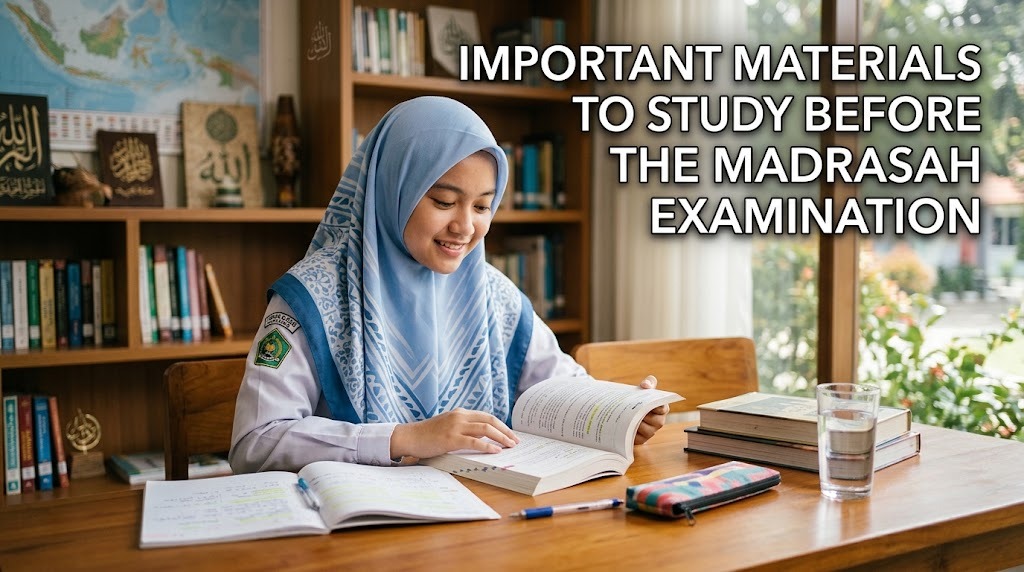
Preparing for the Madrasah Examination requires more than studying everything at the last minute. Students need to identify important materials, understand the main concepts, and practice applying what they have learned. A clear study plan can make preparation more organized and reduce unnecessary stress before the examination.
The exact subjects and topics may differ depending on the student’s grade level, curriculum, and madrasah. Therefore, students should use their school materials and follow guidance from their teachers when determining the final examination scope. Reviewing important topics early gives students enough time to improve areas that are still difficult.
UNDERSTAND THE EXAMINATION SCOPE
The first material to study is the examination scope provided by the madrasah or teacher. Students should review textbooks, class notes, assignments, learning modules, and other materials used during the academic year. If teachers provide an outline or list of competencies, use it as a guide for organizing study priorities. This helps students focus on relevant topics instead of studying randomly.
Create a checklist of subjects and topics that need to be reviewed. Separate familiar topics from those that still require more attention. Difficult topics should receive additional study time, while familiar topics can be reviewed periodically. This simple system can make preparation more efficient.
REVIEW ISLAMIC RELIGIOUS STUDIES
Islamic religious studies are important areas for students in madrasah. Depending on the educational level and curriculum, these subjects may include Quran and Hadith, Islamic jurisprudence, Islamic creed and ethics, and Islamic cultural history. Students should understand the concepts, meanings, rules, and examples discussed during lessons. Memorization can be useful for certain topics, but understanding the context is also essential.
For Quran and Hadith, review the meaning and main messages of the texts studied in class. In Islamic jurisprudence, focus on rules and procedures related to the topics covered in the curriculum. For Islamic creed and ethics, understand important beliefs and examples of good character. Islamic cultural history can be studied by organizing important figures, events, causes, developments, and lessons from history.
STUDY INDONESIAN LANGUAGE
Indonesian language preparation requires strong reading and comprehension skills. Students should review different types of texts, main ideas, supporting information, conclusions, text structures, and language features included in their learning materials. Reading practice can help students understand longer passages more efficiently. Pay attention to information that is directly stated as well as information that must be inferred.
Students should also review relevant grammar and vocabulary. Practice identifying the purpose, structure, and important information of a text. When answering questions, read the passage and question carefully before choosing an answer. This habit can reduce mistakes caused by misunderstanding the information.
REVIEW MATHEMATICS
Mathematics requires both conceptual understanding and regular practice. Students should review important formulas, mathematical concepts, and problem solving procedures according to their grade level. Memorizing formulas without understanding how they work can make unfamiliar questions more difficult. Therefore, practice applying each formula to different types of problems.
Start with basic questions before moving to more complex exercises. Keep a record of questions that are frequently answered incorrectly. Review the steps that caused the mistake rather than looking only at the final answer. Regular practice can improve accuracy, speed, and confidence when solving mathematical problems.
STUDY SCIENCE CONCEPTS
Science materials are easier to understand when students focus on relationships between concepts. Depending on the grade level, topics may include living organisms, matter, energy, environmental systems, physical processes, or other scientific concepts. Students should understand definitions as well as how these concepts work in real situations. Diagrams, tables, and simple examples can make difficult topics easier to remember.
After reviewing a topic, try explaining it without looking at the textbook. This technique can show whether the concept has actually been understood. Practice questions can then be used to test the ability to apply the concept. If an answer is incorrect, return to the relevant material and identify the reason for the mistake.
REVIEW SOCIAL STUDIES
Social studies may cover history, geography, economics, social interaction, and other topics depending on the curriculum. Students should understand important concepts and how different events or conditions are connected. For history, focus on chronology, important figures, causes, consequences, and significant developments. Understanding relationships between events is often more useful than memorizing isolated dates.
For geography and economics, connect concepts with real examples whenever possible. Maps, tables, timelines, and mind maps can help organize large amounts of information. After studying, try summarizing each topic using your own words. This method can strengthen understanding and make revision easier.
STRENGTHEN ENGLISH SKILLS
English may also require preparation if it is included in the examination. Students can focus on vocabulary, grammar, reading comprehension, sentence structure, and other skills included in their learning materials. Learning vocabulary through sentences is often more useful than memorizing individual words. Regular reading can also improve the ability to understand English texts.
Practice questions can help students become familiar with common question patterns. Pay attention to keywords that provide clues about the meaning of a sentence or passage. Review mistakes and identify whether they come from vocabulary, grammar, or comprehension problems. Short but consistent practice can produce better results than studying English only before the examination.
PRACTICE WITH SAMPLE QUESTIONS
After reviewing the main materials, students should test their knowledge with sample questions. Practice can reveal which topics are already understood and which ones still need improvement. Choose questions that match the subjects and level being studied. Whenever possible, use reliable materials recommended by teachers or educational institutions.
Do not simply count how many questions are answered correctly. Review incorrect answers and understand the concepts behind them. Keep a list of recurring mistakes and use it as a revision guide. This approach turns practice sessions into opportunities for improvement.
REVIEW USING SUMMARIES AND MIND MAPS
Summaries can make revision faster when the examination is approaching. Write only the essential information, such as key concepts, formulas, definitions, important events, and main messages. Avoid copying entire textbook pages because lengthy notes can be difficult to review. Short summaries allow students to revisit important information efficiently.
Mind maps can also help connect related ideas. Place the main topic in the center and add important concepts around it. Use simple words and logical connections so the information is easy to recall. Choose the method that makes the material easiest for you to understand and remember.
IDENTIFY WEAK AREAS
Students should know which topics require the most attention. After completing practice questions, identify subjects or concepts where mistakes occur frequently. Do not ignore difficult topics simply because they are uncomfortable to study. Instead, divide them into smaller sections and learn them step by step.
Ask a teacher or classmate for help when a concept remains unclear. Additional explanations can sometimes make a difficult topic easier to understand. Return to the topic after a short period and test your understanding again. Gradual improvement is more useful than trying to master everything in one study session.
PREPARE YOUR STUDY PRIORITIES
Not every topic requires exactly the same amount of study time. Give greater attention to important or difficult materials while continuing to review topics that are already familiar. Create daily or weekly study targets that are realistic and achievable. Avoid studying too many subjects in one session because this can reduce concentration.
Include enough time for sleep, meals, worship, exercise, and relaxation. A balanced routine can help students maintain energy throughout the preparation period. Review the study plan regularly and adjust it when necessary. Consistency is more important than studying for extremely long hours.
CONCLUSION
Important materials to study before the Madrasah Examination should be selected according to the examination scope, curriculum, grade level, and guidance provided by the madrasah. Students can prioritize Islamic religious studies, Indonesian language, mathematics, science, social studies, English, and other subjects included in their examination. Understanding concepts, practicing questions, reviewing mistakes, and creating useful summaries can make preparation more effective.
Students should avoid relying entirely on last minute study. Start early, identify weak areas, and review difficult topics gradually. At the same time, maintain adequate sleep, healthy habits, worship, and rest. With organized preparation and consistent practice, students can approach the Madrasah Examination with greater confidence and readiness.
About the Author
Gusti Ayu Tita P
Author — STEKOM University
An active author focused on academic issues, educational technology, and human resource development in the campus environment.















