
Indonesian History from Ancient Times to the Modern Era
Gusti Ayu Tita P
5 Agustus 2026
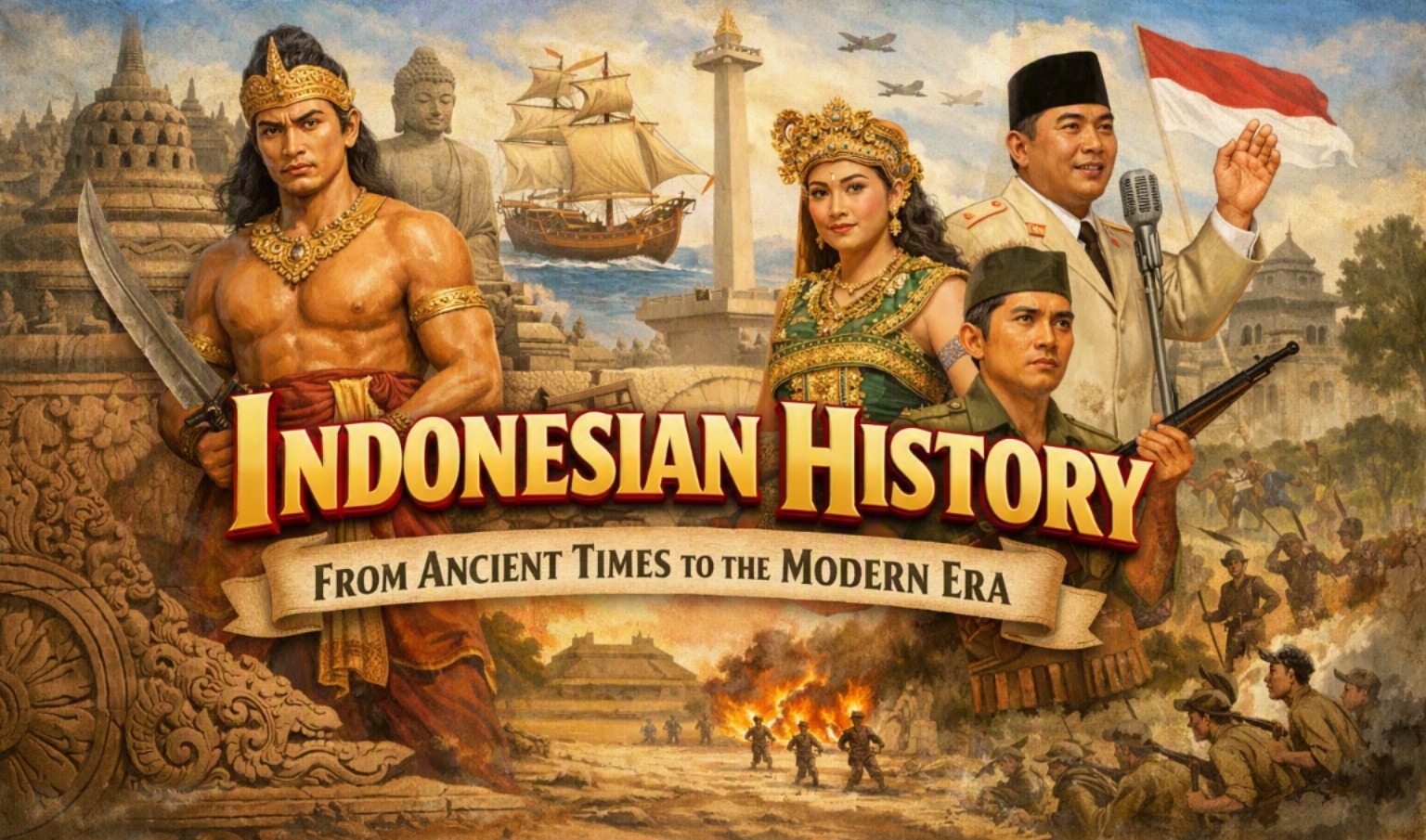
Indonesia has a long and fascinating history that stretches from prehistoric communities to a modern democratic nation. Its strategic location between the Indian Ocean and the Pacific Ocean made the archipelago an important center of trade, culture, and civilization for thousands of years. Throughout history, Indonesia experienced the rise of powerful kingdoms, the arrival of major religions, the era of European colonialism, the struggle for independence, and rapid national development. Every historical period has contributed to shaping the country's identity, diversity, and resilience. Understanding Indonesian history helps people appreciate the nation's rich cultural heritage and the values that continue to influence modern society.
EARLY CIVILIZATIONS IN THE INDONESIAN ARCHIPELAGO
The story of Indonesia began long before written records existed. Archaeological discoveries show that early humans lived in the archipelago hundreds of thousands of years ago. One of the most famous discoveries is Homo erectus, often known as the Java Man, whose fossils were found on the island of Java. These findings demonstrate that Indonesia has been an important location in the study of human evolution.
As communities developed, people learned farming, fishing, and metalworking. They established settlements and built strong social structures based on cooperation. Trade between islands also became increasingly active, allowing knowledge, technology, and cultural traditions to spread. These early developments laid the foundation for the growth of future civilizations across the Indonesian archipelago.
THE RISE OF GREAT HINDU BUDDHIST KINGDOMS
Between the fourth and fifteenth centuries, several Hindu and Buddhist kingdoms flourished throughout Indonesia. Among the most influential were Kutai, Tarumanagara, Srivijaya, and Majapahit. These kingdoms controlled important trade routes and maintained diplomatic relations with neighboring regions, including India and China. Their prosperity encouraged advancements in education, literature, architecture, and governance.
One of the greatest legacies from this period is the construction of magnificent temples such as Borobudur and Prambanan. These monuments continue to attract visitors from around the world and reflect the remarkable artistic and engineering achievements of ancient Indonesia. The success of these kingdoms also helped establish Indonesia as a major cultural and economic center in Southeast Asia.
THE ARRIVAL OF ISLAM AND GROWING TRADE NETWORKS
Beginning in the thirteenth century, Islam spread across the Indonesian archipelago through peaceful trade, cultural exchange, and the influence of religious scholars. Muslim merchants from Arabia, Persia, and India introduced Islamic teachings while maintaining commercial relationships with local communities. Coastal trading cities gradually developed into important Islamic centers.
Several powerful Islamic sultanates, including Demak, Aceh, and Mataram, emerged during this period. They strengthened regional trade and promoted the development of education, literature, and Islamic culture. The blending of Islamic traditions with local customs created a unique cultural identity that remains visible throughout Indonesia today.
THE ERA OF EUROPEAN COLONIALISM
European nations arrived in Indonesia during the sixteenth century seeking valuable spices and new trading opportunities. The Portuguese were among the first Europeans to establish a presence, followed by the Dutch, who gradually expanded their influence through the Dutch East India Company. Eventually, Dutch colonial rule extended across much of the archipelago.
Colonial policies often prioritized economic profit while placing heavy burdens on local communities. Forced labor systems, monopolies, and limited political freedom created widespread dissatisfaction. Despite these challenges, many Indonesian leaders, intellectuals, and organizations began promoting national awareness, education, and unity, laying the groundwork for future independence movements.
THE STRUGGLE FOR INDEPENDENCE
The early twentieth century witnessed the rapid growth of the Indonesian nationalist movement. Organizations, students, religious groups, and community leaders encouraged the people to unite despite differences in ethnicity, language, and religion. National consciousness continued to strengthen through education and political activism.
Following the end of the Second World War, Indonesia declared its independence on August 17, 1945. The declaration marked the beginning of a determined struggle to defend national sovereignty. Through diplomacy and sacrifice, Indonesia eventually gained international recognition as an independent nation, marking one of the most significant milestones in its history.
INDONESIA IN THE MODERN ERA
Since independence, Indonesia has continued to develop its government, economy, education, and infrastructure. As the world's largest archipelagic country, Indonesia faces various challenges while also benefiting from abundant natural resources and cultural diversity. Democratic reforms have strengthened public participation and improved many national institutions.
Today, Indonesia plays an important role in regional and international affairs through organizations such as ASEAN and the G20. The country continues to invest in technology, sustainable development, education, and innovation. While preserving its rich historical heritage, Indonesia also embraces modernization to build a stronger future for coming generations.
CONCLUSION
Learning Indonesian history provides valuable lessons about unity, perseverance, and national identity. Historical events demonstrate how cooperation among diverse communities contributed to the formation of the modern Indonesian nation. They also encourage appreciation for cultural diversity and democratic values.
Understanding the past helps people make informed decisions for the future. By studying ancient civilizations, colonial experiences, and independence movements, younger generations can better understand the importance of preserving cultural heritage while supporting national progress. Indonesian history remains an essential source of inspiration for building a peaceful, prosperous, and united society.
About the Author
Gusti Ayu Tita P
Author — STEKOM University
An active author focused on academic issues, educational technology, and human resource development in the campus environment.















