
Land Ownership Certificate and How to Verify Its Authenticity?
Gusti Ayu Tita P
28 Agustus 2026
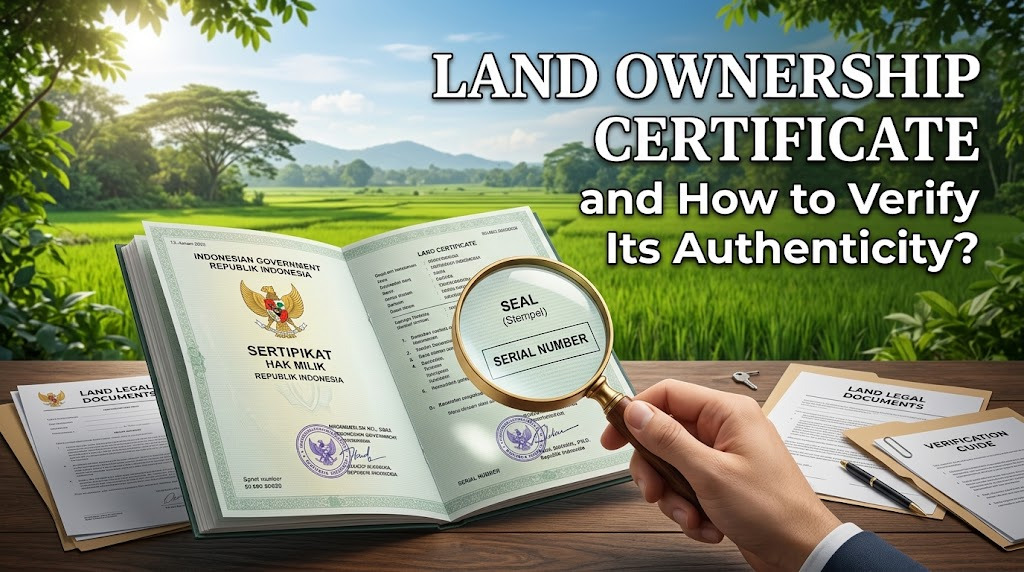
A Land Ownership Certificate is an important legal document related to land rights and ownership in Indonesia. For property owners and potential buyers, understanding the certificate is essential because land transactions involve significant financial and legal considerations. A certificate provides important information about the registered rights over a specific plot of land, but its physical appearance alone should not be the only basis for determining whether the document is genuine.
Verifying the authenticity of a land ownership certificate is particularly important before purchasing land or a house. Buyers should carefully compare the information on the document with official land records and the actual condition of the property. Proper verification can reduce the risk of purchasing land connected to ownership disputes, incorrect information, or fraudulent documents.
UNDERSTANDING LAND OWNERSHIP CERTIFICATES
A Land Ownership Certificate serves as evidence of registered rights over a particular plot of land. In Indonesia, one of the strongest forms of land rights is Hak Milik, commonly represented by a Sertifikat Hak Milik or SHM. The certificate contains important information related to the registered land rights and the person or party recorded as the rights holder.
However, having a certificate does not mean that every detail can be ignored. Land use remains subject to applicable regulations, including spatial planning and other legal requirements. Property owners should therefore understand both the rights recorded in the certificate and their responsibilities regarding the use of the land.
IMPORTANT INFORMATION CONTAINED IN THE CERTIFICATE
When checking a land ownership certificate, several pieces of information should be reviewed carefully. These can include the name of the rights holder, certificate number, land area, location, and survey-related information. The information should correspond with the identity of the seller and the actual property being offered.
Buyers should also compare the certificate with supporting documents. Differences in names, land area, boundaries, or location should not be ignored. Any discrepancy should be clarified through the appropriate land administration authority before the transaction proceeds.
WHY CERTIFICATE AUTHENTICITY MUST BE VERIFIED
Checking the authenticity of a land certificate helps protect buyers from potential legal and financial problems. A document can appear convincing without necessarily proving that all information is valid or that the person presenting it has the right to sell the property. Official verification provides stronger protection than relying solely on a physical document.
Verification is especially important when purchasing expensive property. A mistake made before completing a transaction can become difficult and costly to resolve afterward. Buyers should therefore make document verification one of the earliest steps in the purchasing process.
HOW TO VERIFY A LAND CERTIFICATE
The safest approach is to use official land administration services provided by the Indonesian Ministry of Agrarian Affairs and Spatial Planning/National Land Agency (ATR/BPN). Depending on the type of service and available data, verification may be conducted through official digital services or directly through the relevant Land Office.
Buyers should not rely exclusively on unofficial websites or individuals offering instant verification. Official records and procedures should be the primary reference. If a transaction involves substantial value or complicated ownership circumstances, professional assistance from a qualified Land Deed Official or PPAT can also be considered.
CHECKING THE IDENTITY OF THE RIGHTS HOLDER
Another important step is confirming that the seller's identity matches the registered rights holder. The name appearing on the certificate should be compared with valid identification documents. If another person is acting on behalf of the registered owner, the buyer should request documentation proving that person's legal authority.
Special attention is necessary when the property comes from inheritance, joint ownership, or another form of transfer. Additional documents may be necessary to demonstrate who is legally entitled to transfer the property. Buyers should not proceed simply because the seller claims to have authority.
CHECKING THE LAND'S LEGAL STATUS
Certificate verification should go beyond confirming that a document exists. Buyers should also determine whether the land has relevant legal records or encumbrances, where such information is available through the official land administration process. This can be important when the land is being used as collateral or is subject to another legal interest.
The physical condition of the property should also correspond with the registered information. Check the location, boundaries, and approximate area against the certificate and supporting documents. If the actual property differs substantially from the documentation, the discrepancy should be investigated before any payment is finalized.
WARNING SIGNS TO WATCH FOR
Several situations should make a potential buyer more cautious. These include a seller refusing official verification, inconsistent ownership information, unexplained differences in land area, or pressure to make immediate payment. These circumstances do not automatically prove fraud, but they justify additional verification.
Buyers should also be cautious when they are shown only photographs or copies of documents. A copy of a certificate is not a substitute for proper verification of the original document and official records. If important questions remain unanswered, delaying the transaction is generally safer than proceeding without sufficient information.
KESIMPULAN
A Land Ownership Certificate is an important document for establishing registered land rights, but its physical appearance alone cannot guarantee authenticity. Buyers and property owners should carefully verify the registered owner, certificate number, land area, location, boundaries, and relevant legal status through official procedures.
The safest approach is to use official ATR/BPN services and, when appropriate, obtain assistance from a PPAT or other qualified professional. Careful verification before purchasing property can significantly reduce the risk of fraudulent documents, ownership disputes, and financial losses.
About the Author
Gusti Ayu Tita P
Author — STEKOM University
An active author focused on academic issues, educational technology, and human resource development in the campus environment.















