Landowner Rights in Duplicate Land Certificate Cases
Gusti Ayu Tita P
28 Agustus 2026
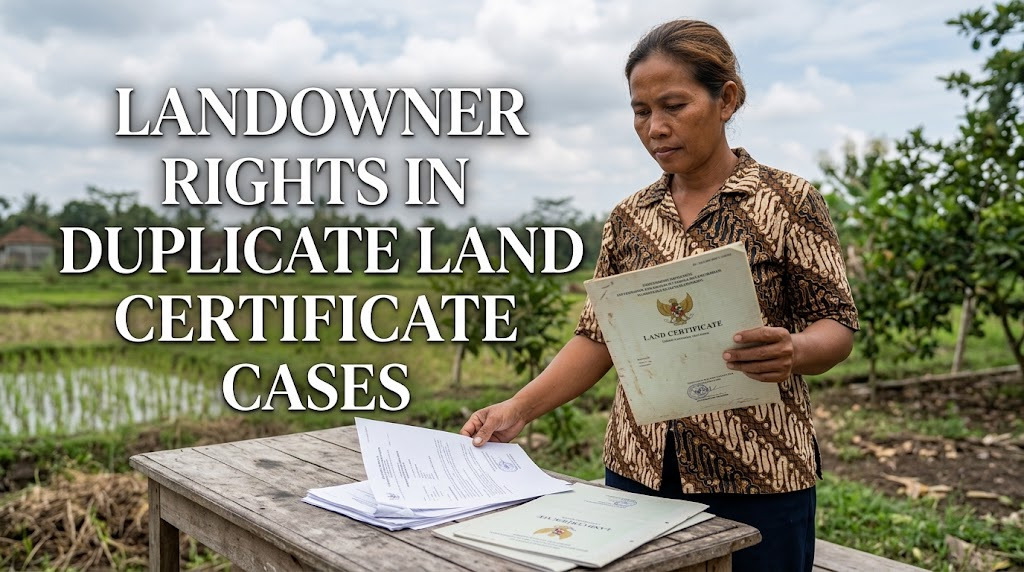
Duplicate land certificate cases can create uncertainty about land ownership and legal rights. This situation may occur when more than one certificate is associated with the same land parcel or when registered boundaries overlap. Landowners who face such a problem need to understand their rights and the proper procedures for protecting their interests.
The existence of a duplicate certificate does not automatically determine which party has the strongest legal position. The status of the land needs to be examined based on official records, physical data, legal data, ownership history, and supporting documents. Understanding these rights can help landowners respond to the dispute in an orderly manner.
RIGHT TO VERIFY LAND INFORMATION
Landowners have the right to seek information about their registered land rights and relevant land records through the applicable procedures. This information can help determine whether the certificate corresponds with the official records. Verification may also reveal differences in land area, location, boundaries, or registered ownership information. Such information is important when a duplicate certificate is suspected.
Landowners should use official channels when requesting information and follow the requirements established by the relevant authority. Documents obtained during the verification process should be stored safely. If inconsistencies are discovered, the landowner can ask for clarification about the available administrative procedures. This provides a more reliable basis for deciding what to do next.
RIGHT TO DEFEND LAND RIGHTS
A landowner has the right to defend their claimed land rights using relevant evidence. Documents such as land certificates, survey records, sale and purchase deeds, inheritance documents, and other transfer records may help establish the history of the property. The evidence should be organized clearly and presented through the appropriate process. A complete record can help explain the basis of the landowner's claim.
The landowner also has the right to provide clarification or objections through available procedures when registered information is considered inaccurate. However, every claim should be supported by reliable evidence. Landowners should not alter, destroy, or conceal documents related to the property. Preserving original documents is important throughout the dispute-resolution process.
RIGHT TO SEEK DISPUTE RESOLUTION
When a duplicate certificate results in a dispute, the affected landowner has the right to seek an appropriate dispute-resolution mechanism. Mediation may be considered when the parties are willing to discuss their claims and seek a settlement. Each party can present its documents and explain the basis of its position. The process can help clarify the issues before more formal action is considered.
If mediation does not result in an agreement, the landowner may consider appropriate administrative or legal measures. The correct route depends on the specific facts and nature of the dispute. A landowner should understand the available options before proceeding. Professional legal advice may be useful when the case involves complicated ownership or registration issues.
RIGHT TO LEGAL PROTECTION
Landowners involved in a duplicate certificate dispute may seek legal protection through the procedures provided by law. This can include using available administrative mechanisms or pursuing legal remedies when appropriate. The strength of a claim depends on the evidence and legal circumstances of the individual case. Therefore, documentation is an important part of protecting land rights.
Landowners should also avoid unilateral actions that could worsen the dispute. Selling, transferring, or otherwise dealing with disputed land may create additional complications. All relevant correspondence and official documents should be preserved. When necessary, professional assistance can help ensure that the landowner understands the implications of each legal step.
RIGHT TO PROFESSIONAL ASSISTANCE
Landowners have the option to seek assistance from a qualified legal professional when dealing with a complicated duplicate certificate case. A professional can help review documents, explain possible procedures, and identify issues that may require further examination. This can be especially helpful when different parties present conflicting ownership evidence. The assistance should be based on the facts and documents available.
The landowner should still prioritize official verification of the land records. Professional advice cannot replace the authority of the relevant land administration system to examine registered data. By combining official information with properly organized evidence, landowners can make more informed decisions. This approach can help protect their interests throughout the dispute-resolution process.
CONCLUSION
Landowners involved in duplicate land certificate cases have important rights, including the right to verify land information, defend their claimed rights, seek dispute resolution, obtain legal protection, and receive professional assistance. These rights should be exercised through proper procedures and supported by reliable evidence.
The first step should be to verify the official land records and ownership documents. If a dispute exists, mediation may be considered before further administrative or legal measures are pursued. By preserving evidence and following the applicable procedures, landowners can work toward greater legal certainty over their property rights.
About the Author
Gusti Ayu Tita P
Author — STEKOM University
An active author focused on academic issues, educational technology, and human resource development in the campus environment.