Latest AI Animation Trends You Should Know in 2026
Gusti Ayu Tita P
31 Agustus 2026
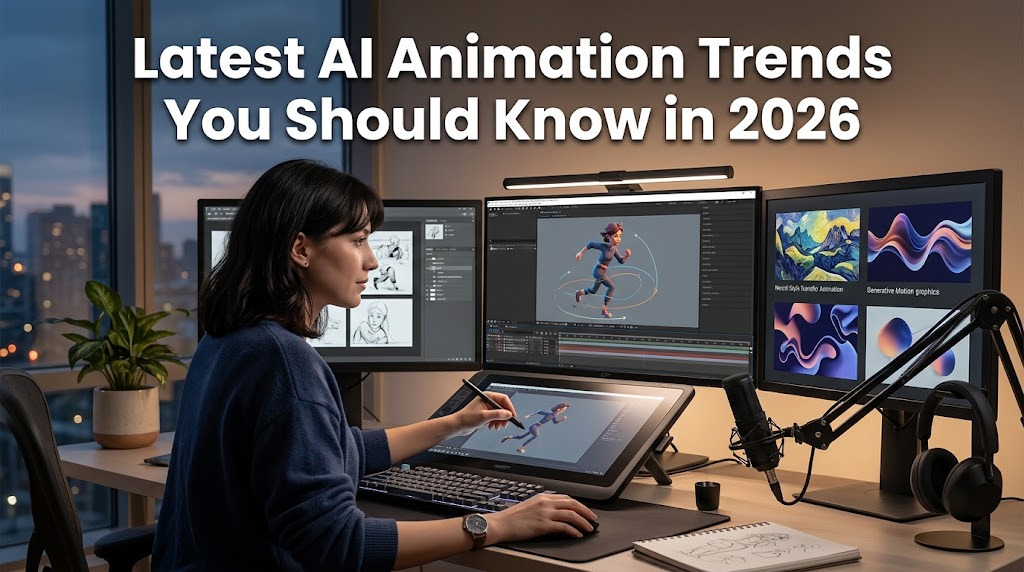
AI animation continues to develop rapidly in 2026, changing how creators, businesses, educators, and independent artists produce visual content. Artificial intelligence is increasingly being used to assist with tasks such as generating scenes, animating characters, creating visual effects, and transforming static images into moving sequences. Instead of replacing the entire creative process, these technologies are becoming part of a broader AI animation workflow that combines automation with human direction.
The biggest change is the growing accessibility of advanced animation capabilities. Tasks that previously required specialized software and considerable production time can now be assisted by AI through simpler interfaces. However, quality still depends heavily on the user's creative direction, prompting skills, editing decisions, and understanding of visual storytelling. AI can accelerate production, but strong creative ideas remain essential for producing memorable content.
TEXT TO VIDEO ANIMATION IS BECOMING MORE ADVANCED
One of the most important AI animation trends in 2026 is the continued development of text-to-video technology. Users can describe a scene using natural language and generate short visual sequences based on that description. Improvements in motion, camera movement, lighting, and scene composition are making generated videos increasingly useful for creative experiments and professional workflows.
Text-to-video systems are particularly attractive for content creators and marketers because they can quickly visualize ideas before investing in a full production. A creator might describe a futuristic city, an animated character walking through a classroom, or a cinematic product scene and use the result as a starting point. Even when the generated output requires editing, it can significantly shorten the early stages of visual development.
IMAGE TO VIDEO IS CHANGING STATIC CONTENT
Another major trend is the increasing use of image-to-video AI. This technology allows users to take a static image and add movement, camera effects, environmental animation, or character motion. It provides a practical way to transform photographs, illustrations, product images, and concept art into short videos.
For social media creators, this development creates new possibilities for producing short-form animated content. A single photograph can become the starting point for a video with subtle movement, zoom effects, environmental details, or cinematic camera motion. Businesses can also use image-to-video technology to create more dynamic presentations of products and promotional materials without producing an entirely new visual asset from scratch.
AI CHARACTERS ARE BECOMING MORE EXPRESSIVE
AI animated characters are also becoming more sophisticated. Newer systems can assist with character movement, facial expressions, lip synchronization, gestures, and different forms of interaction. This creates opportunities for virtual presenters, educational characters, digital mascots, entertainment projects, and social media personalities.
Character consistency remains an important challenge, but improvements in AI workflows are making it easier to maintain recognizable characters across multiple scenes. Creators can establish specific details such as appearance, clothing, personality, environment, and visual style and then reuse those characteristics throughout a project. Consistency is especially valuable when developing an animated series or recurring digital character.
REALISTIC 3D AI ANIMATION IS GAINING ATTENTION
The combination of AI and 3D animation is another trend worth watching. Traditional 3D animation can involve modeling, rigging, texturing, lighting, and complex rendering processes. AI-assisted tools can help automate or accelerate portions of these workflows, allowing creators to focus more on design and storytelling.
The technology is also making 3D experimentation more accessible to people who may not have professional animation backgrounds. Creators can use AI-assisted workflows to explore environments, characters, objects, and motion before refining the results with conventional 3D software. However, professional-quality 3D animation still requires careful artistic control and technical knowledge, particularly for complex productions.
AI ANIMATION IS BECOMING MORE IMPORTANT FOR SOCIAL MEDIA
The demand for fast and visually engaging content is encouraging more creators to explore AI animation for social media. Platforms such as TikTok, YouTube Shorts, Instagram Reels, and other short-form video channels reward content that can capture attention quickly. AI animation allows creators to experiment with unusual visual concepts without requiring a large production team.
Short animated explainers, character-based videos, visual stories, educational clips, and promotional animations can all benefit from this trend. The key is not simply adding AI-generated movement but creating content that provides value, entertainment, information, or emotional appeal. A technically impressive animation can still perform poorly if the story and message are unclear.
AI ANIMATION WORKFLOWS ARE BECOMING MORE HUMAN AND HYBRID
A significant trend in 2026 is the movement toward hybrid animation workflows. Rather than allowing AI to handle everything, creators increasingly combine AI generation with traditional editing, illustration, 2D or 3D software, voice production, and human review. This approach can provide greater control over the final result.
Human involvement remains important for deciding what should be created and how it should communicate with an audience. AI can generate possibilities, but creators still need to select the strongest ideas, correct inconsistencies, refine movement, and maintain a consistent visual identity. This combination of AI efficiency and human creativity is likely to remain an important part of modern animation production.
ETHICAL AND CREATIVE CONSIDERATIONS ARE MORE IMPORTANT
As AI animation becomes more capable, questions surrounding copyright, consent, originality, and responsible AI use are becoming increasingly important. Creators need to understand the terms governing the tools they use, especially when content is intended for commercial purposes. They should also avoid using recognizable people, characters, artwork, or copyrighted materials in ways that could create legal or ethical problems.
Another concern is maintaining originality. Because AI systems can make content production easier, many creators may use similar visual styles or concepts. Developing a distinctive brand identity and creative voice therefore becomes even more valuable. The strongest creators are likely to be those who use AI as a production assistant while maintaining their own ideas, storytelling approach, and artistic judgment.
CONCLUSION
The latest AI animation trends in 2026 show that artificial intelligence is becoming a significant part of modern visual content production. Developments in text-to-video, image-to-video, AI characters, 3D animation, and social media content creation are giving creators new ways to develop visual ideas more quickly. At the same time, AI animation still has technical, creative, legal, and ethical limitations that users need to understand.
The future of animation is unlikely to depend entirely on AI or traditional methods alone. Instead, human creativity combined with AI technology can provide a powerful workflow for creators, businesses, and professional animation teams. Anyone who wants to take advantage of these developments should focus not only on learning new tools but also on improving storytelling, visual direction, editing, and responsible technology use.
About the Author
Gusti Ayu Tita P
Author — STEKOM University
An active author focused on academic issues, educational technology, and human resource development in the campus environment.