
Legal Steps to Deal With Duplicate Land Certificates
Gusti Ayu Tita P
28 Agustus 2026
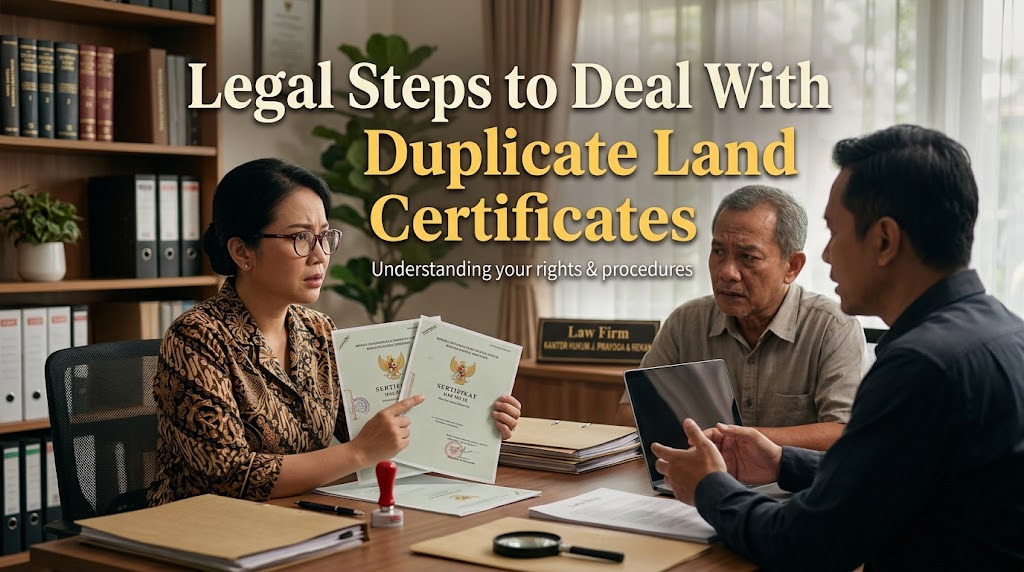
Duplicate land certificates can create serious uncertainty about land ownership and legal rights. The problem occurs when more than one certificate is associated with the same land parcel or when registered boundaries overlap. When this situation develops into a dispute, the affected party needs to take careful legal and administrative steps.
The process should be based on official land records, ownership documents, and evidence of the land's history. Taking action without verifying the facts can make the dispute more complicated. A structured approach can help landowners understand what should be done before pursuing further legal measures.
VERIFY THE LAND STATUS
The first legal step is to verify whether there is actually a duplicate or overlapping land certificate. Examine the certificate number, registered owner, land area, location, survey information, and boundaries. These details should be compared with the physical condition of the land and other supporting documents. A certificate's appearance alone cannot determine its legal status.
The landowner should request official verification from the relevant Land Office. This allows the information in the certificate to be compared with registered physical and legal data. If inconsistencies are discovered, the landowner should request clarification regarding the appropriate administrative procedure. The results of the verification should be kept as part of the case documentation.
PREPARE OWNERSHIP EVIDENCE
The next step is to collect all documents supporting the land rights. These may include certificates, survey documents, sale and purchase deeds, inheritance documents, gift deeds, and other relevant transfer records. The documents should be arranged according to the chronology of ownership. A well-organized collection of evidence can make the dispute easier to understand.
It is also important to prepare a clear ownership history. Explain how the land was acquired, who previously held the rights, and whether any transfers occurred. Supporting documents should be preserved in their original form whenever possible. If the dispute is complex, professional legal assistance can help assess which evidence is most relevant.
REPORT THE LAND DISPUTE
When there is a suspected duplicate certificate, the landowner can submit a complaint or report to the relevant Land Office. The report should clearly explain the problem and include the available supporting documents. The authority can then determine the appropriate examination or dispute-resolution mechanism. The requirements and procedures should be confirmed with the relevant office.
The landowner should keep proof of the submitted complaint and related correspondence. This documentation may be useful when following up on the case. Avoid making accusations against another party without sufficient evidence. A factual and document-based report is more appropriate for an official examination.
USE MEDIATION WHEN POSSIBLE
If the dispute involves another landowner, mediation may be considered as part of the resolution process. Each party can present its documents and explain the basis of its claim. Mediation provides an opportunity to find a solution without immediately proceeding to formal litigation. It may be effective when both parties are willing to negotiate.
If an agreement is reached, the result should be recorded properly and implemented according to applicable procedures. However, mediation may not resolve every dispute. If the parties cannot reach an agreement, further administrative or legal action may be necessary. The decision to proceed should be based on the facts and evidence available.
CONSIDER FORMAL LEGAL ACTION
If administrative measures and mediation do not resolve the dispute, the affected party may consider formal legal action. The appropriate route depends on the nature of the dispute, which may involve administrative decisions, ownership claims, or the validity of documents. Because land disputes can be legally complex, professional advice should be considered before filing a case.
Before proceeding, prepare certificates, survey records, transfer documents, ownership history, and other relevant evidence. A detailed chronology can help explain the development of the dispute. The landowner should also avoid selling or transferring the disputed land while its status remains uncertain. Careful legal preparation can help protect the party's interests throughout the process.
CONCLUSION
The legal steps to deal with duplicate land certificates begin with verifying the land status and official records, followed by gathering complete ownership evidence. A formal report to the relevant Land Office may be appropriate when there is a suspected overlap or duplicate registration. Mediation can also provide an opportunity to resolve the dispute without immediate litigation.
If these efforts do not produce a solution, formal legal action may be considered based on the specific circumstances. Professional legal advice can be useful when the dispute involves complicated ownership histories or administrative issues. Most importantly, landowners should rely on official records and reliable evidence when defending their rights.
About the Author
Gusti Ayu Tita P
Author — STEKOM University
An active author focused on academic issues, educational technology, and human resource development in the campus environment.















