
Measuring Functional Position Performance
Gusti Ayu Tita P
12 Agustus 2026
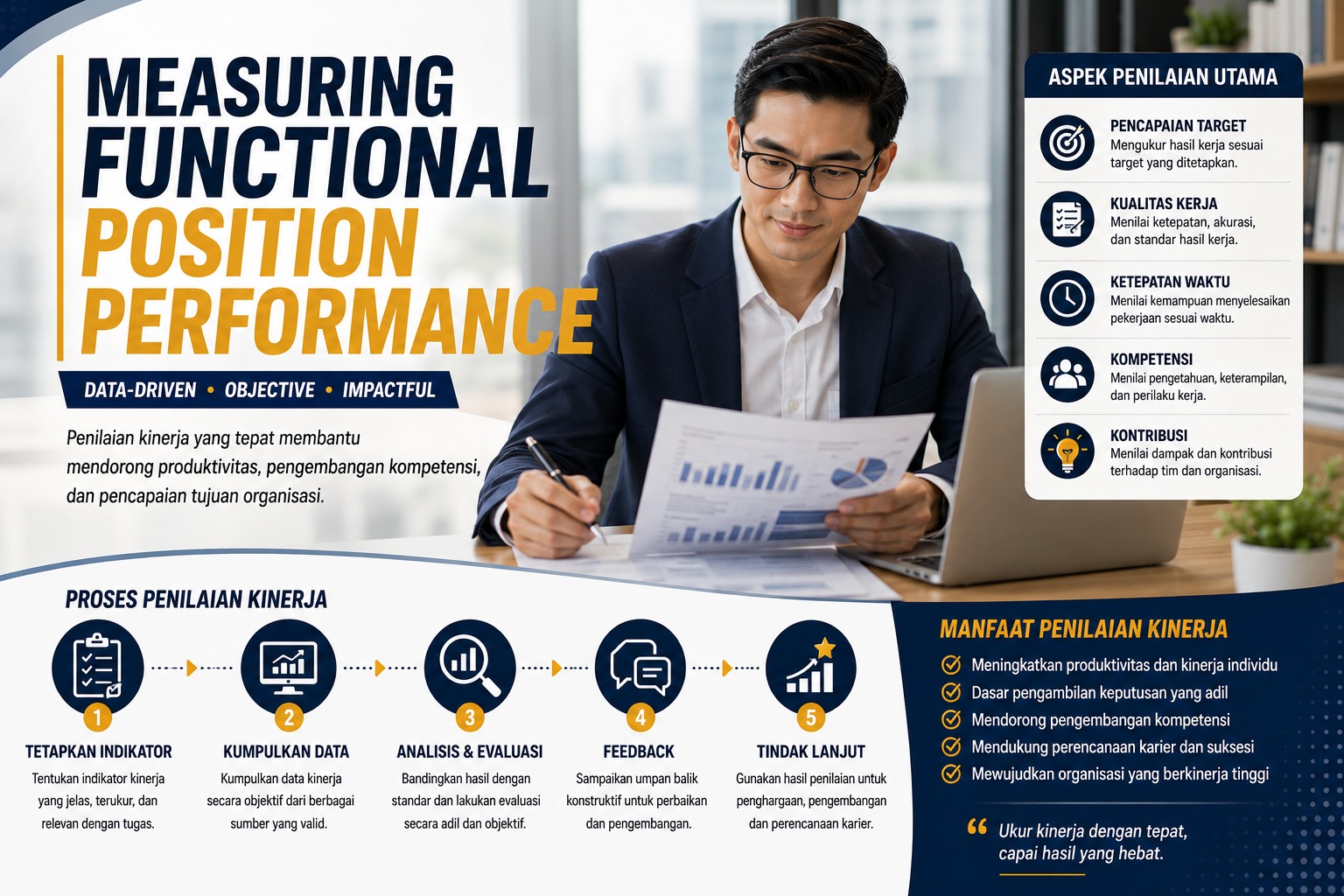
Measuring performance in a functional position is important to determine whether professional responsibilities are being carried out effectively. Performance measurement does not simply focus on how many tasks are completed, but also considers the quality, accuracy, efficiency, and impact of the work. Clear measurement can help organizations identify strengths and areas that need improvement. For professionals, it can also provide a useful basis for career development and competency improvement.
Each functional position may have different responsibilities and performance expectations. Therefore, performance should be assessed according to the duties, targets, and standards relevant to the position. A structured approach makes evaluation more objective and helps professionals understand how their work contributes to organizational goals.
UNDERSTANDING FUNCTIONAL POSITION PERFORMANCE
Functional position performance refers to the extent to which a professional successfully carries out responsibilities according to established expectations. The assessment can include work quality, productivity, accuracy, timeliness, and professional responsibility. These aspects provide a broader picture than simply counting completed tasks. Performance measurement should reflect both the process and the results of professional work.
Clear performance expectations are essential before an evaluation is conducted. Professionals need to understand what results are expected, how those results will be assessed, and which standards apply to their work. When expectations are clearly communicated, performance evaluation becomes more transparent and measurable.
SETTING CLEAR PERFORMANCE INDICATORS
Performance indicators provide a practical basis for evaluating functional positions. Indicators should be connected to the actual responsibilities of the position and should be specific enough to assess progress. Depending on the field, indicators may include quality of output, completion of assignments, service effectiveness, accuracy, or achievement of established targets.
Good indicators should also be realistic and measurable. Indicators that are too general can make evaluation subjective, while unrealistic targets may not accurately represent professional performance. By establishing relevant indicators, organizations can create a more consistent performance measurement system.
MEASURING WORK QUALITY
Quality is an important component of functional position performance. A professional may complete many tasks, but the results still need to meet appropriate standards. Accuracy, consistency, relevance, and reliability can be used to evaluate whether the work provides the expected value. Quality measurement is especially important for positions involving technical expertise or professional services.
Quality can be evaluated through work reviews, documented results, feedback, or comparison with established standards. Regular evaluation can identify recurring errors and opportunities for improvement. This process helps professionals understand how they can produce better and more reliable results.
EVALUATING PRODUCTIVITY AND EFFICIENCY
Productivity measures how effectively professionals use their available time and resources to produce results. It should not be interpreted simply as completing as many tasks as possible. Efficient performance means achieving appropriate results while using resources responsibly and maintaining quality.
Technology can support productivity by reducing repetitive processes and improving information management. However, professionals still need to determine whether the tools they use actually improve their workflow. Evaluating productivity alongside quality provides a more balanced picture of overall work performance.
USING FEEDBACK AND PERFORMANCE REVIEWS
Feedback is an important part of measuring professional performance. Supervisors, colleagues, clients, or other relevant stakeholders may provide information about the quality and effectiveness of a professional's work. Constructive feedback can reveal strengths and identify areas that require further development.
Performance reviews should not only focus on weaknesses. Recognizing achievements can encourage professionals to maintain good practices and develop their strengths further. When feedback is specific and supported by evidence, it can become a useful tool for continuous performance improvement.
CONNECTING PERFORMANCE WITH COMPETENCY DEVELOPMENT
Performance measurement can reveal whether a professional has the competencies required for a particular functional position. If an evaluation identifies weaknesses in technical knowledge or supporting skills, appropriate development activities can be planned. Training, mentoring, practical experience, and independent learning can help address these competency gaps.
The results of performance evaluations can also support long-term career planning. Professionals can use the information to identify skills that should be strengthened before taking on more complex responsibilities. In this way, performance measurement becomes more than an evaluation process because it can support professional growth and career development.
USING EVALUATION FOR CONTINUOUS IMPROVEMENT
Performance measurement should be viewed as an ongoing process rather than a one-time activity. Regular evaluation allows professionals and organizations to identify changes in workload, standards, and workplace requirements. The results can then be used to improve procedures and establish more effective work strategies.
Continuous improvement requires a willingness to review existing practices and make necessary adjustments. Professionals should be open to learning from mistakes, feedback, and changing circumstances. When performance evaluation is combined with continuous learning, it can strengthen both individual performance and organizational effectiveness.
CONCLUSION
Measuring functional position performance requires clear indicators, relevant standards, and consistent evaluation. Important aspects include work quality, productivity, efficiency, professional responsibility, and competency development. Performance measurement should not only identify weaknesses but also recognize achievements and guide future improvement. With a structured and objective approach, performance evaluation can support professional development, organizational effectiveness, and long-term career growth.
About the Author
Gusti Ayu Tita P
Author — STEKOM University
An active author focused on academic issues, educational technology, and human resource development in the campus environment.















