
MRT Jakarta Compared with Other Public Transportation in Jakarta
Gusti Ayu Tita P
11 Agustus 2026
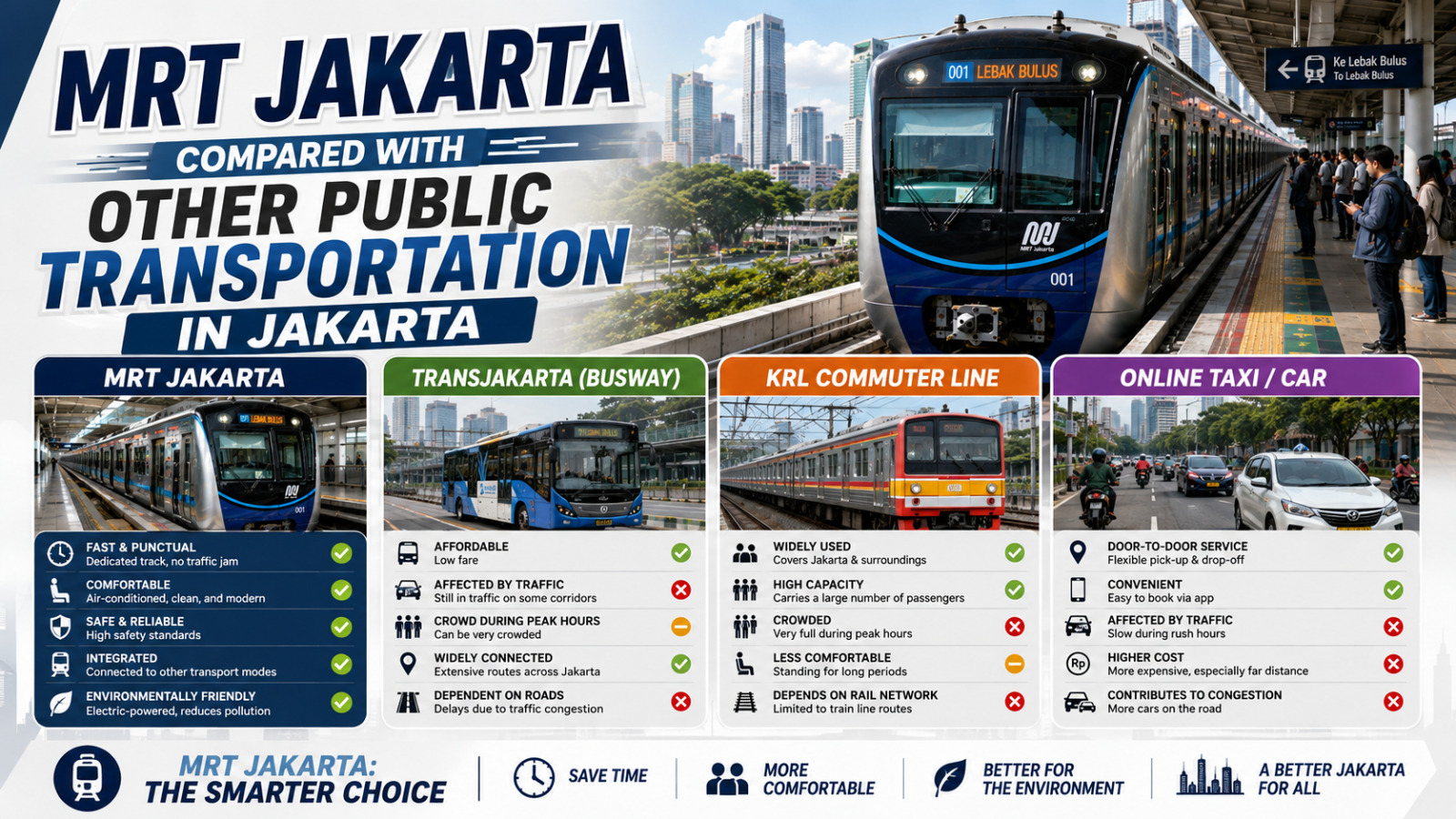
Jakarta has a variety of public transportation options that serve different travel needs. MRT Jakarta is one of the newer rail-based systems and operates on dedicated tracks through elevated and underground sections. Other options, such as TransJakarta buses, commuter trains, and conventional city transportation, operate differently and serve different areas. Understanding these differences can help passengers choose the most suitable transportation for their journey.
Each transportation mode has its own strengths and limitations. Route coverage, travel conditions, capacity, accessibility, fares, and connections can influence which option is most practical. MRT Jakarta is particularly useful along its operating corridor, while other modes may provide better access to locations outside the MRT network. Therefore, there is no single transportation mode that is always the best for every trip.
MRT JAKARTA AND TRANSJAKARTA
MRT Jakarta and TransJakarta are both important parts of Jakarta’s public transportation network, but they use different operating systems. MRT uses electric trains on dedicated railway tracks, while TransJakarta primarily uses buses operating on dedicated bus corridors and other road routes. MRT is less directly affected by road traffic because its trains operate separately from ordinary road vehicles. TransJakarta can provide broader road-based access to areas that are not directly served by MRT.
Another difference is the way passengers move through the network. MRT passengers travel between railway stations, while TransJakarta passengers use bus stops and terminals across its network. TransJakarta generally offers wider road-based coverage, while MRT provides high-capacity rail transportation along its corridors. The two systems can complement each other when passengers transfer between them.
MRT JAKARTA AND COMMUTER LINE
MRT Jakarta and the Commuter Line are both rail-based transportation systems, but they serve different transportation needs. MRT Jakarta primarily serves urban travel within Jakarta and currently focuses on its North-South corridor. The Commuter Line connects Jakarta with surrounding areas and is particularly important for passengers traveling between the capital and nearby cities. Their route networks therefore have different geographical coverage.
Both systems can carry large numbers of passengers and provide alternatives to road transportation. However, their station locations, routes, service patterns, and passenger markets are different. Commuter Line is especially useful for longer regional trips, while MRT is designed to support rapid urban travel along its network. Passengers can sometimes combine the two systems to complete a longer journey.
MRT JAKARTA AND CONVENTIONAL CITY TRANSPORTATION
Conventional city transportation includes various smaller road-based services that operate on specific routes. These vehicles can sometimes provide access to areas that are not directly served by major rail or bus systems. MRT, in contrast, operates through fixed railway stations and dedicated tracks. This creates a more structured travel experience but also means passengers need to reach an MRT station.
Another difference is passenger capacity and operating environment. MRT trains can carry many passengers in one journey, while smaller city transportation vehicles generally have lower capacity. Road-based services may provide more flexible local access, especially for short distances. For some trips, passengers can use smaller transportation modes to reach an MRT station and then continue by train.
COMPARING COMFORT AND TRAVEL RELIABILITY
MRT Jakarta offers a controlled rail environment that is separated from ordinary road traffic. This can make travel times more predictable along the MRT corridor, particularly when roads are heavily congested. Stations and trains also provide modern facilities designed to support passenger comfort. These characteristics can make MRT attractive for commuters who value structured journeys.
Other public transportation modes can still be more convenient depending on the destination. A bus may stop closer to a passenger’s final location, while a commuter train may be more suitable for traveling from outside Jakarta. Convenience depends on the complete journey, not only on the transportation mode itself. Passengers should consider access, transfers, travel time, and destination before choosing a service.
CHOOSING THE RIGHT TRANSPORTATION
The best transportation option depends on the passenger’s route, destination, time, and personal needs. MRT is a strong choice when the departure and destination points are conveniently connected to its stations. TransJakarta can be useful when a bus corridor provides a more direct route. Commuter Line is generally more appropriate for trips connecting Jakarta with surrounding areas.
In many cases, the most efficient journey involves combining several transportation modes. Passengers can use walking, feeder services, buses, MRT, or commuter trains as different parts of one trip. Integrated transportation gives passengers more flexibility and can reduce the need to rely on private vehicles. Comparing the available options before traveling can help passengers save time and make their journey more convenient.
CONCLUSION
MRT Jakarta has several advantages compared with other public transportation options, particularly its dedicated railway system, modern facilities, and predictable travel along its operating corridor. However, TransJakarta, Commuter Line, and other road-based transportation services also have important roles. Each mode serves different routes and passenger needs.
Rather than viewing one mode as better than all others, passengers should consider which service best matches their journey. MRT, TransJakarta, Commuter Line, and other transportation modes can complement one another through effective integration. A connected public transportation network gives Jakarta residents more choices and supports more efficient urban mobility.
About the Author
Gusti Ayu Tita P
Author — STEKOM University
An active author focused on academic issues, educational technology, and human resource development in the campus environment.















