
PhD Salaries Across Different Professions
Gusti Ayu Tita P
22 Agustus 2026
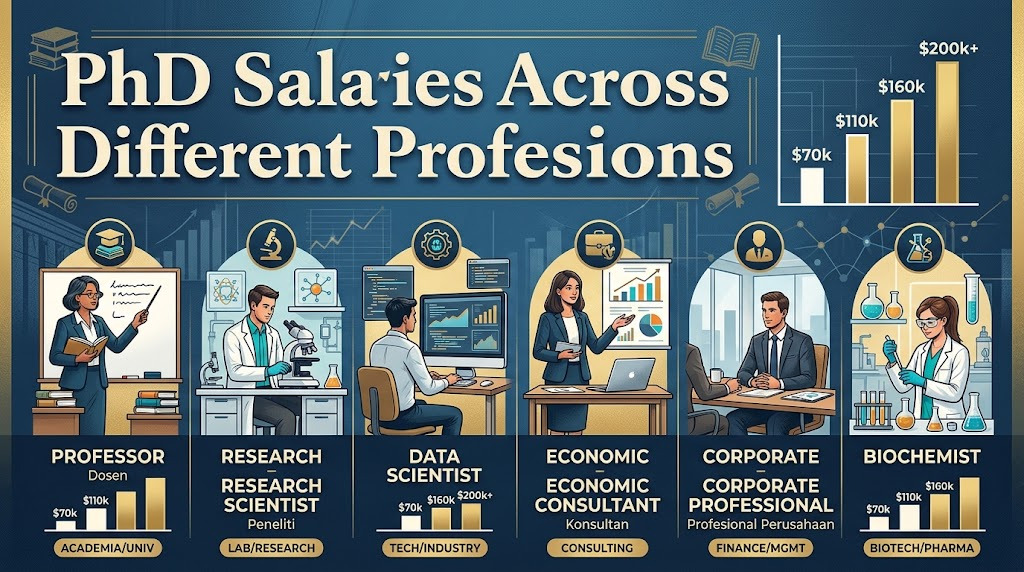
A PhD degree can lead to many professional opportunities beyond traditional academic careers. Doctoral graduates may work as lecturers, researchers, scientists, consultants, data specialists, engineers, managers, or industry experts. Because these professions have different responsibilities and market demands, their salaries can vary considerably.
For prospective doctoral students, understanding PhD salaries across different professions is useful when planning a long-term career. A PhD can provide advanced knowledge and specialized expertise, but income depends on how those qualifications are applied. Experience, industry demand, professional skills, and the type of employer can be just as important as the doctoral degree itself.
PHD SALARIES IN ACADEMIC CAREERS
University lecturer is one of the most common career choices for PhD graduates. Universities generally value doctoral qualifications for teaching, research, postgraduate supervision, and academic development. However, lecturer compensation differs depending on the institution, employment status, academic rank, workload, and applicable allowances.
Academic income can increase as lecturers gain experience and take on greater responsibilities. Research publications, academic rank, leadership positions, research projects, and postgraduate supervision can support career progression. Therefore, the earning potential of a PhD lecturer should be evaluated as a long-term career path rather than based only on the initial salary.
PHD SALARIES IN RESEARCH PROFESSIONS
Research is another major career option for doctoral graduates. Researchers can work in universities, government institutions, laboratories, private companies, research centers, and other organizations that require advanced analytical capabilities. Their work may involve designing studies, analyzing data, developing new knowledge, testing technologies, or producing research reports.
The PhD researcher salary depends on the research field, employer, experience, and responsibilities. Professionals working in specialized areas such as biotechnology, engineering, medicine, artificial intelligence, and advanced sciences may have different earning opportunities from researchers in other disciplines. Strong research achievements and project management abilities can also support progression into senior positions.
PHD SALARIES IN TECHNOLOGY AND DATA CAREERS
The growth of digital industries has created opportunities for PhD graduates with expertise in data science, artificial intelligence, computer science, machine learning, and related technologies. These professionals may work as research scientists, data specialists, technical experts, or advanced technology consultants. Their doctoral training can be valuable when their research expertise addresses complex business or technical problems.
Technology employers may place strong emphasis on practical skills and measurable results. Therefore, a PhD graduate with advanced technical knowledge and industry experience may have stronger career prospects than someone who has academic qualifications without practical application. Continuous learning is also important because technology changes rapidly.
PHD SALARIES IN CONSULTING AND BUSINESS
Some PhD graduates move into consulting and business-related careers where analytical and problem-solving skills are highly valued. Consultants with specialized expertise may help organizations evaluate strategies, conduct research, analyze markets, or solve complex operational challenges. Their income can depend on experience, specialization, employer, client responsibilities, and professional performance.
A doctoral background can be particularly useful when consulting requires deep expertise in a specific subject. However, business careers often require additional abilities such as communication, negotiation, presentation, and project management. Combining academic knowledge with practical business skills can make a PhD graduate more competitive.
PHD SALARIES IN SCIENCE AND ENGINEERING
Science and engineering offer several career opportunities for doctoral graduates. Professionals may work in laboratories, manufacturing companies, technology firms, energy organizations, research institutions, or specialized industrial sectors. Their responsibilities can include product development, experimentation, technical research, innovation, and quality improvement.
The PhD salary by profession can differ significantly within science and engineering because industries have different levels of demand. Graduates with highly specialized technical knowledge may qualify for positions involving advanced research or technical leadership. Experience with real-world projects can further strengthen their professional value.
FACTORS THAT CREATE SALARY DIFFERENCES
Several factors explain why two PhD graduates can earn very different incomes. Field of study is one major factor because some specializations have stronger demand in the labor market. Professional experience, geographic location, employer type, academic rank, technical skills, and leadership responsibilities also influence compensation.
Another important consideration is whether the graduate works in academia, government, or the private sector. Private organizations may use different compensation structures from universities or public institutions. In addition, performance, professional achievements, networking, and specialized certifications may influence career advancement and income growth.
HOW PHD GRADUATES CAN IMPROVE THEIR INCOME
A doctoral degree provides advanced knowledge, but graduates can increase their earning potential by developing complementary professional skills. Leadership, communication, data analysis, project management, digital skills, and industry knowledge can make a graduate suitable for a wider range of positions. These abilities are especially useful for professionals who want to move beyond traditional academic careers.
PhD holders can also strengthen their professional profile through publications, research projects, patents, consulting experience, industry collaborations, and successful technical projects. Building a strong portfolio can demonstrate practical value to potential employers. Over time, combining a doctoral qualification with relevant professional achievements can create better opportunities for career advancement.
CONCLUSION
PhD salaries across different professions can vary widely because doctoral graduates work in many different sectors. Academic careers, research, technology, consulting, science, and engineering all offer different responsibilities and compensation structures. The highest earning potential is not determined by the PhD title alone but by the combination of expertise, experience, industry demand, and professional performance.
For people considering doctoral education, it is important to look beyond the degree itself. Researching PhD salary Indonesia, career opportunities, industry demand, and long-term salary progression can help prospective students make a more informed decision. A PhD can be a valuable career investment when its knowledge and skills are matched with the right professional opportunities.
About the Author
Gusti Ayu Tita P
Author — STEKOM University
An active author focused on academic issues, educational technology, and human resource development in the campus environment.















