
PhD Salary Ranges in Indonesia
Gusti Ayu Tita P
22 Agustus 2026
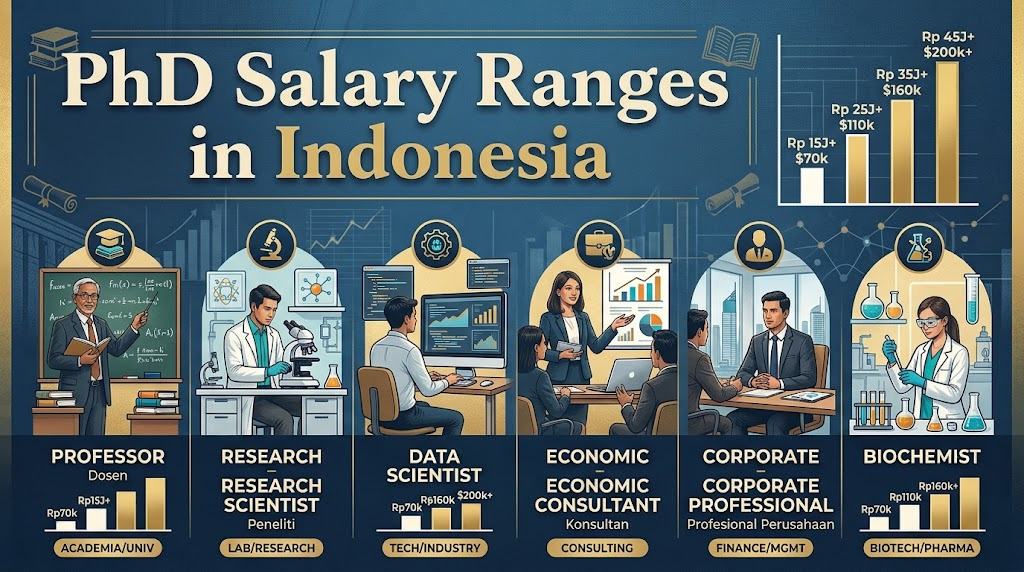
Understanding PhD salary ranges in Indonesia is important for students and professionals who are considering doctoral education. A PhD is a significant academic investment that can lead to careers in universities, research institutions, government agencies, private companies, and specialized industries. However, there is no single salary figure that applies to every doctoral graduate.
Income can vary depending on profession, field of study, experience, employer, location, academic position, and professional responsibilities. A newly graduated PhD may earn differently from an experienced lecturer, senior researcher, or industry specialist. Therefore, salary ranges should be viewed as a broad career consideration rather than a guaranteed income level.
FACTORS THAT DETERMINE PHD SALARY RANGES
Several factors influence the income of PhD graduates in Indonesia. The field of specialization is important because industries have different levels of demand for advanced expertise. Professional experience also matters because employers often consider practical achievements alongside academic qualifications.
The type of employer can create additional differences. Universities, government institutions, research organizations, and private companies generally use different compensation systems. Location, job responsibilities, academic rank, technical skills, and leadership experience can also affect the total income received by a doctoral graduate.
PHD LECTURER SALARY RANGE
Many PhD graduates pursue careers as university lecturers. Doctoral qualifications are particularly relevant for academic positions involving teaching, research, postgraduate supervision, and academic development. However, lecturer compensation can differ between public and private institutions as well as according to employment status and academic rank.
An experienced lecturer may have additional responsibilities that influence overall compensation. Academic rank, research achievements, publications, postgraduate supervision, and institutional leadership can contribute to career progression. For this reason, the salary of a PhD lecturer should be evaluated as part of a longer academic career rather than based only on the starting income.
PHD RESEARCHER SALARY RANGE
Research careers are another important option for doctoral graduates. Researchers can work in universities, government research organizations, laboratories, private companies, and specialized research centers. Their work may involve developing research projects, analyzing data, conducting experiments, publishing findings, and supporting innovation.
The PhD researcher salary can vary according to research discipline and employer. Fields involving advanced technology, engineering, biotechnology, medicine, data science, and scientific innovation may have different compensation structures. Researchers who develop strong technical expertise and gain experience managing projects may have opportunities to progress into senior positions.
PHD SALARY RANGE IN THE PRIVATE SECTOR
The private sector provides another potential career path for PhD graduates. Companies may hire doctoral professionals for positions involving research and development, data analysis, product innovation, technical consulting, scientific research, and specialized management. Compensation in these roles can depend heavily on the commercial value of the graduate's expertise.
Private-sector employers may place significant emphasis on practical skills and measurable results. A PhD holder with industry experience may therefore have stronger opportunities than someone whose experience is limited to academic research. Combining doctoral knowledge with business awareness, technical skills, and professional experience can improve career prospects.
PHD SALARY DIFFERENCES BY FIELD OF STUDY
The salary potential of a doctoral graduate can differ significantly by specialization. Graduates in engineering, computer science, artificial intelligence, data science, biotechnology, medicine, and other technical disciplines may encounter different opportunities from graduates in fields with different labor-market conditions.
This does not mean that graduates from other disciplines cannot achieve strong incomes. Professional experience, specialization, employer, leadership responsibilities, and the ability to apply academic knowledge can have a major influence. A graduate with a less commercially focused specialization may still build a successful career through consulting, education, research, management, or specialized professional services.
EXPERIENCE AND CAREER PROGRESSION
A PhD salary often changes as graduates gain professional experience. Newly qualified doctoral holders may begin in positions with moderate compensation while they build a professional record. Over time, promotions, specialized responsibilities, research achievements, and leadership opportunities can contribute to higher income.
Career progression is therefore an important part of evaluating the financial value of a PhD. A professional may move from junior research or teaching roles into senior researcher, academic leader, technical specialist, or management positions. The income associated with these roles can differ substantially from the initial compensation received after graduation.
HOW TO INCREASE PHD EARNING POTENTIAL
PhD graduates can improve their earning potential by developing skills that complement their academic specialization. Technical skills, communication, leadership, data analysis, project management, and industry knowledge can help graduates qualify for a wider range of positions. These abilities are especially useful for professionals who want to move between academic and private-sector careers.
Building a strong professional portfolio is also important. Publications, patents, successful research projects, professional certifications, industry collaborations, and leadership experience can demonstrate practical value. Graduates should also monitor changes in the labor market and continue developing relevant skills to remain competitive.
CONCLUSION
There is no universal PhD salary range in Indonesia because doctoral graduates work across many professions and industries. Lecturer, researcher, technology, engineering, consulting, and private-sector careers can all have different compensation structures. Income generally depends on the combination of education, experience, specialization, employer, location, and professional performance.
For prospective PhD students, salary should be considered together with career opportunities, education costs, professional goals, and long-term income growth. A doctoral degree can provide valuable opportunities, particularly when it is supported by practical skills and expertise that are in demand. Careful career planning can help graduates maximize the professional and financial value of their PhD.
About the Author
Gusti Ayu Tita P
Author — STEKOM University
An active author focused on academic issues, educational technology, and human resource development in the campus environment.















