
Reincarnation in Religion and Culture Around the World
Gusti Ayu Tita P
9 September 2026
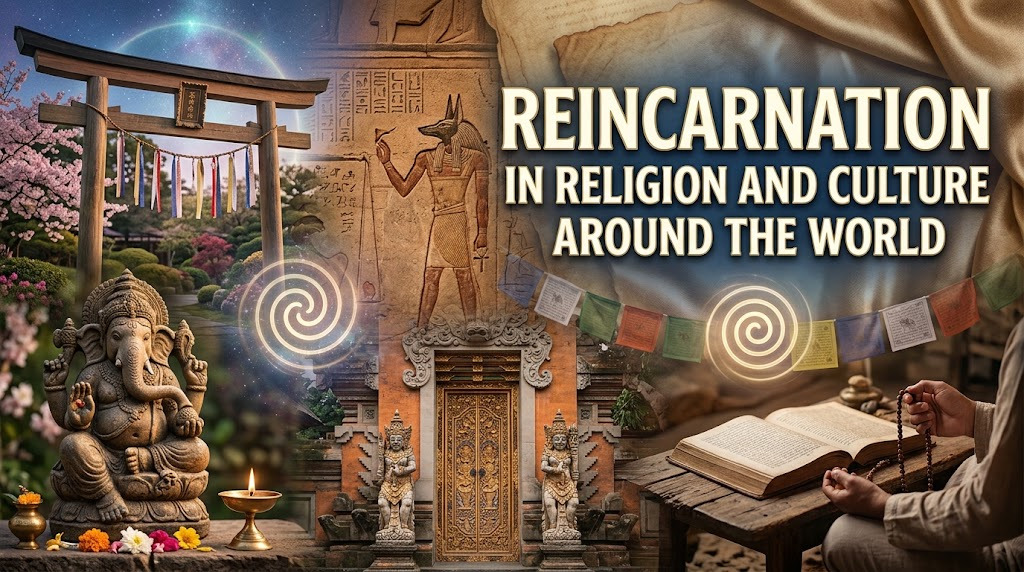
Reincarnation is a concept that has appeared in various religions, cultures, and spiritual traditions throughout history. It generally refers to the idea that existence continues through rebirth after death. However, the meaning of reincarnation differs significantly between belief systems. Some traditions connect rebirth with karma and spiritual development, while others focus on ancestors, spirits, or the continuation of life. Exploring these perspectives shows how different societies have tried to understand death and what may come afterward.
REINCARNATION IN HINDUISM
In Hinduism, reincarnation is closely associated with samsara, the cycle of birth, death, and rebirth. The concept of karma is also important because actions are believed to have consequences that influence a person's spiritual journey. Life is therefore understood as part of a larger process rather than an isolated existence. The cycle continues until spiritual liberation is achieved.
The ultimate goal is commonly described as moksha, or freedom from samsara. Different Hindu traditions have developed various philosophical explanations of the self, karma, and liberation. Reincarnation is consequently connected not only with another birth but also with moral responsibility and spiritual progress. These ideas have played an important role in Hindu religious thought for centuries.
REBIRTH IN BUDDHISM
Buddhism also includes the concept of rebirth, although its explanation differs from the idea of a permanent soul moving between bodies. Buddhist teachings emphasize causes and conditions that influence continued existence. Karma is one of the important concepts used to explain this process. The cycle of existence is known as samsara.
The purpose of Buddhist practice is to overcome the conditions that keep beings within samsara and ultimately reach Nirvana. Different Buddhist traditions may place different emphasis on aspects of rebirth and spiritual practice. Nevertheless, rebirth is closely connected with teachings about suffering, attachment, actions, and liberation. This makes the Buddhist understanding distinct from many popular interpretations of reincarnation.
REINCARNATION IN ASIAN CULTURES
Beyond Hinduism and Buddhism, various Asian cultures have developed traditions concerning life after death, spirits, and ancestors. Some communities have stories about individuals returning to the world in another form. Others focus more strongly on maintaining relationships with ancestors or honoring the spirits of those who have died. These traditions cannot all be categorized as reincarnation in exactly the same sense.
In many cases, cultural beliefs are passed down through family traditions, ceremonies, folklore, and oral storytelling. Ideas about past lives may therefore have both spiritual and cultural significance. Local history also influences how communities understand death and the possibility of another existence. This diversity demonstrates that Asian beliefs about death and rebirth are far from uniform.
TRADITIONAL BELIEFS ABOUT LIFE AFTER DEATH
Traditional beliefs around the world often contain ideas about what happens after a person dies. Some cultures believe that spirits remain connected to their families or communities. Others describe journeys into another spiritual realm or the possibility of returning to the world. These ideas may be expressed through ceremonies, myths, stories, and customary practices.
It is important to distinguish traditional beliefs from formal religious teachings. A community may have several ideas about death that have developed over generations rather than following one standardized doctrine. In some traditions, rebirth may be connected to family lineage, nature, or spiritual transformation. As a result, the concept of life after death can have different meanings depending on the cultural setting.
DIFFERENCES BETWEEN RELIGIOUS AND CULTURAL PERSPECTIVES
Although many religions and cultures discuss death and continued existence, their explanations are not identical. Hinduism emphasizes karma, samsara, and liberation, while Buddhism explains rebirth through its teachings about causes, conditions, and the absence of a permanent self. Traditional cultures may place greater emphasis on ancestors, spirits, or community traditions. These differences show why the concept of reincarnation should not be treated as having only one universal definition.
Understanding these perspectives also requires separating religious beliefs from scientific claims. Religious traditions are based on teachings, practices, and spiritual beliefs, while scientific investigation requires evidence that can be systematically examined. Stories about previous lives may be culturally meaningful without serving as scientific proof. Looking at each perspective within its own context allows for a more balanced understanding of reincarnation.
CONCLUSION
Reincarnation has different meanings across religions and cultures around the world. Hinduism connects it with karma, samsara, and moksha, while Buddhism presents a distinct concept of rebirth linked to causes, conditions, and liberation. Various Asian and traditional cultures also have their own ideas about spirits, ancestors, and life after death. These differences reflect the diversity of human beliefs about existence and mortality. Understanding each tradition in its proper context can provide a more accurate and respectful view of reincarnation.
About the Author
Gusti Ayu Tita P
Author — STEKOM University
An active author focused on academic issues, educational technology, and human resource development in the campus environment.















