
Requirements and Process for Appointing Ministers in Indonesia
Gusti Ayu Tita P
12 Agustus 2026
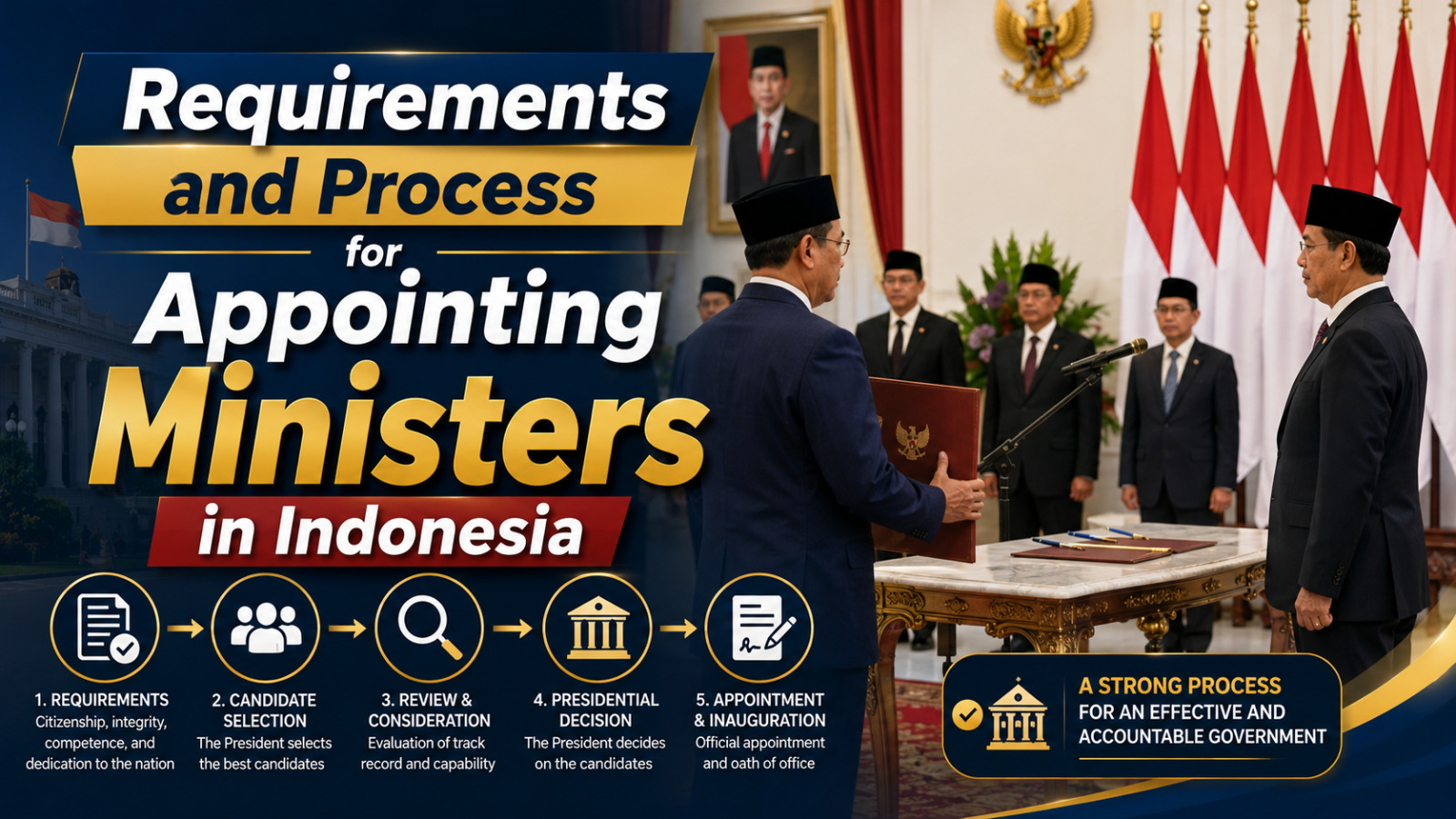
Ministers are important government officials who assist the President in managing specific areas of government. In Indonesia, the appointment of ministers is regulated by the Constitution and laws governing ministries. The President has the authority to appoint and dismiss ministers, while candidates must meet requirements established by applicable regulations. Understanding the appointment process helps explain how Indonesia's cabinet is formed and organized.
LEGAL BASIS FOR APPOINTMENT
The appointment of ministers has a constitutional basis in the 1945 Constitution of the Republic of Indonesia. Article 17 states that the President is assisted by ministers of state and that each minister is responsible for a particular area of government. Ministers are appointed and dismissed by the President.
Further provisions concerning ministries and ministers are regulated through legislation. These rules establish the organization, duties, functions, and other requirements related to ministries. Therefore, the appointment of a minister must follow the applicable legal framework.
REQUIREMENTS FOR MINISTERIAL CANDIDATES
Candidates for ministerial positions must meet requirements established by law. These include being an Indonesian citizen, believing in God, being loyal to Pancasila and the Constitution, and having good integrity and character. Candidates must also have the ability to carry out their duties as ministers.
There are also legal requirements concerning matters such as criminal convictions, citizenship status, and certain positions that may create conflicts with ministerial responsibilities. These requirements are intended to ensure that candidates are legally and professionally qualified. The President can consider a candidate's competence, experience, integrity, and suitability for a particular ministry.
SELECTING MINISTERIAL CANDIDATES
The selection of ministers is within the President's authority. In forming the cabinet, the President may consider various factors, including professional qualifications, experience, integrity, and the needs of the government. The suitability between a candidate's abilities and the responsibilities of a ministry is an important consideration.
The President may communicate with political parties and other relevant parties during the process of forming a cabinet. However, the constitutional authority to appoint ministers remains with the President. After candidates are selected, the appointment process proceeds according to applicable procedures.
APPOINTMENT AND INAUGURATION
After selecting candidates, the President officially appoints them as ministers. The appointment is followed by an inauguration according to the applicable procedures. Once inaugurated, ministers begin carrying out their responsibilities within their respective ministries.
Ministers then lead their ministries and assist the President in administering government affairs. They formulate and implement policies, coordinate programs, and supervise the work of their ministries. The President may also make changes to the cabinet when necessary, including appointing or dismissing ministers according to the law.
CONCLUSION
The appointment of ministers in Indonesia is based on constitutional provisions and applicable laws. The President has the authority to appoint and dismiss ministers, while candidates must meet the required legal qualifications. The process generally involves candidate selection, consideration of qualifications, official appointment, and inauguration. After taking office, ministers lead their respective ministries and assist the President in carrying out government affairs. This system provides a legal framework for forming and managing the Indonesian cabinet.
About the Author
Gusti Ayu Tita P
Author — STEKOM University
An active author focused on academic issues, educational technology, and human resource development in the campus environment.















