
Salary Prospects After Completing a PhD
Gusti Ayu Tita P
22 Agustus 2026
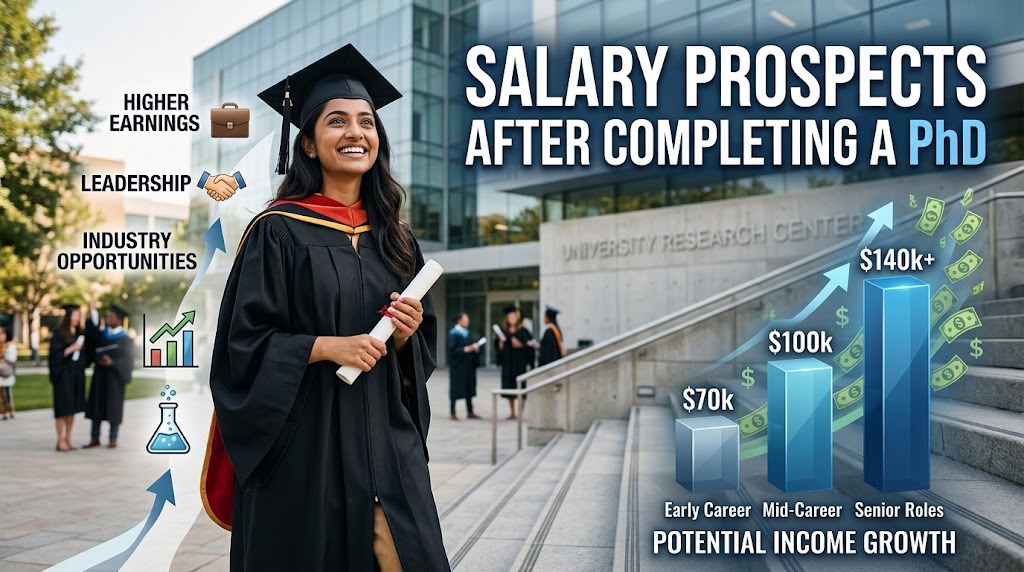
Completing a PhD degree is a major academic achievement that can create opportunities in education, research, government, business, and specialized industries. However, many graduates want to know whether completing a doctorate will significantly improve their income. The answer depends on the career path chosen, the field of study, professional experience, and the demand for specific expertise.
A doctoral qualification can provide access to positions that require advanced knowledge, research ability, analytical thinking, and specialized expertise. However, salary growth usually develops gradually rather than immediately after graduation. Understanding the factors that influence income can help PhD graduates make better career decisions.
INITIAL SALARY PROSPECTS AFTER A PHD
The income of a newly graduated PhD holder can vary considerably depending on the position and employer. Someone entering academia may begin with compensation based on institutional policies, employment status, academic responsibilities, and qualifications. Meanwhile, graduates entering private companies may receive compensation based on their technical expertise, industry demand, and professional experience.
A new PhD graduate salary should therefore not be viewed as a fixed national figure. Some graduates may start with moderate earnings and experience significant growth after gaining professional experience. Others may enter specialized positions where their doctoral expertise is immediately valuable.
CAREER PROGRESSION AND INCOME GROWTH
One of the main advantages of completing a PhD is the possibility of accessing a career path with greater professional responsibility. Graduates can progress from entry-level research or academic roles to senior positions involving project management, leadership, advanced research, and strategic decision-making. Greater responsibility can contribute to higher compensation over time.
Career progression is particularly important when evaluating the financial value of a doctorate. A graduate may not see a dramatic salary increase immediately after completing the degree, but income can improve as professional achievements accumulate. Experience, performance, publications, leadership, and specialized expertise can all support long-term career development.
SALARY PROSPECTS FOR PHD LECTURERS
Many doctoral graduates pursue careers as university lecturers. A PhD can strengthen eligibility for academic positions and may support progression toward higher academic ranks. Lecturer income can include basic compensation and applicable allowances, depending on the university, employment status, academic position, workload, and institutional policies.
Over time, lecturers may increase their professional value through research publications, academic leadership, postgraduate teaching, research projects, and institutional responsibilities. These achievements can contribute to career advancement. Therefore, the long-term earning potential of a lecturer should be evaluated together with academic progression rather than only the starting salary.
SALARY PROSPECTS IN RESEARCH AND INDUSTRY
PhD graduates can also build careers as researchers and specialists outside traditional academia. Research organizations, technology companies, pharmaceutical businesses, engineering firms, financial institutions, and other industries may require professionals with advanced analytical and technical capabilities. In these environments, income can depend heavily on the practical value of the graduate's expertise.
Fields such as data science, artificial intelligence, biotechnology, engineering, medicine, and advanced technology may provide attractive opportunities for highly specialized professionals. Graduates who understand both research methodology and industry requirements can potentially compete for senior technical or research positions. Practical experience can make a doctoral qualification more valuable in these settings.
FACTORS THAT INFLUENCE POST-PHD SALARIES
Several factors affect salary prospects after completing a PhD. The field of study is important because demand for expertise differs between industries. Location, employer type, professional experience, academic rank, technical skills, and leadership responsibilities can also influence compensation.
Another important factor is the ability to translate academic knowledge into practical results. Employers may value graduates who can solve business problems, develop useful technologies, manage research projects, or provide evidence-based recommendations. Communication skills, networking, project management, and continuous professional development can also strengthen long-term earning potential.
HOW TO IMPROVE EARNING POTENTIAL AFTER A PHD
PhD graduates can improve their career prospects by developing skills that complement their academic specialization. Technical expertise should ideally be combined with communication, leadership, digital skills, project management, and industry knowledge. These abilities can help graduates compete for a wider range of professional positions.
Building a strong professional portfolio is equally important. Graduates can demonstrate their value through research publications, successful projects, patents, professional presentations, industry collaborations, or measurable achievements. Expanding professional networks and remaining aware of labor-market trends can also help graduates identify better career opportunities.
LONG-TERM VALUE OF A PHD DEGREE
The financial value of a PhD should be considered over the long term rather than based only on the first salary after graduation. A doctorate may provide access to specialized careers and senior professional roles that are unavailable or more difficult to reach with lower academic qualifications. However, the financial return depends on the relationship between education costs, career opportunities, salary growth, and individual career choices.
For some graduates, the main benefit of a PhD may be career advancement, research independence, or access to specialized professional communities rather than an immediate increase in income. For others, the qualification can support a transition into high-value industries. The best outcome usually occurs when the doctoral degree is combined with relevant experience and skills that are in demand.
CONCLUSION
The salary prospects after completing a PhD can be promising, but they differ widely between professions and individuals. A doctoral degree can create opportunities in academia, research, technology, consulting, government, and other specialized fields. Nevertheless, income growth depends on more than the degree itself.
Graduates who combine a PhD with practical experience, specialized skills, strong professional achievements, and continuous learning may have better long-term earning potential. Prospective students should therefore consider career demand, education costs, professional goals, and expected salary progression before pursuing doctoral education.
About the Author
Gusti Ayu Tita P
Author — STEKOM University
An active author focused on academic issues, educational technology, and human resource development in the campus environment.















