
Skills Bachelor’s Degree Graduates Need To Earn A Competitive Salary
Gusti Ayu Tita P
22 Agustus 2026
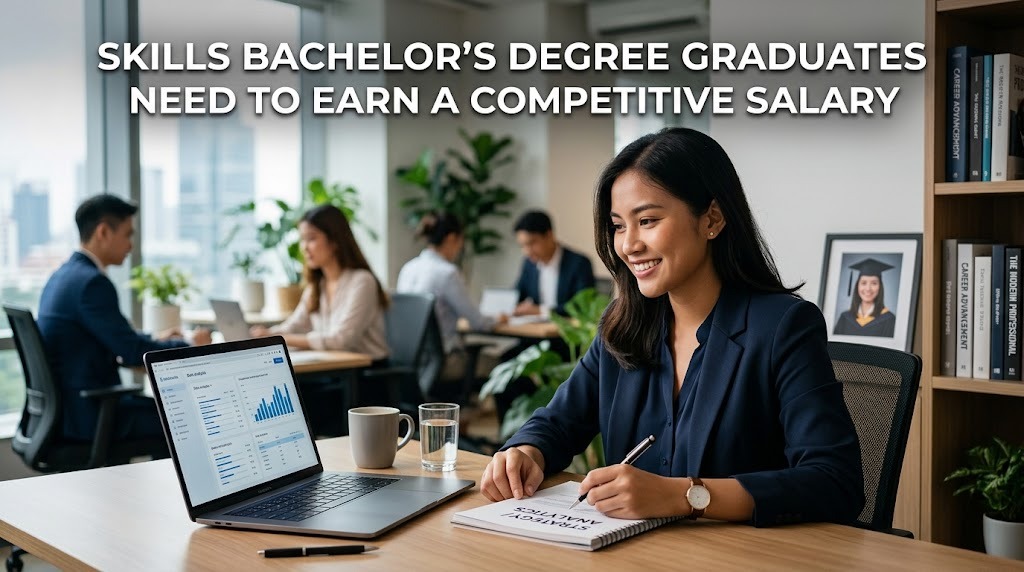
A bachelor’s degree provides an important academic foundation, but employers often expect graduates to demonstrate practical abilities as well. Career Skills can influence how effectively an employee performs tasks and contributes to organizational goals. Graduates with relevant and up-to-date abilities may have stronger opportunities to obtain competitive positions.
Skills can also become more valuable as a professional gains experience. Employees who can solve complex problems, improve processes, and take on greater responsibilities may become stronger candidates for promotion. Therefore, continuous skill development can support long-term Salary Growth.
TECHNICAL SKILLS
Technical skills are abilities that are directly related to a specific profession. Depending on the career, these may include programming, accounting software, data analysis, graphic design, engineering tools, financial modeling, cybersecurity, or digital marketing.
Graduates should prioritize technical skills that are relevant to their target industry. Practical knowledge is particularly valuable when candidates can demonstrate it through projects, portfolios, internships, or previous work. Strong technical abilities can help graduates compete for specialized positions.
DIGITAL SKILLS
Digital technology is now part of many professional environments. Graduates should understand the digital tools commonly used in their industry, including productivity software, collaboration platforms, data tools, and other relevant technologies.
The exact skills required vary by occupation. A marketing graduate may need digital analytics and advertising tools, while a finance graduate may benefit from advanced spreadsheet and financial software skills. Developing appropriate Technical Skills can improve professional efficiency and employability.
COMMUNICATION SKILLS
Good communication is essential in almost every workplace. Graduates need to communicate ideas clearly through conversations, emails, presentations, reports, and professional discussions. Strong communication can help employees work effectively with colleagues, clients, and managers.
Communication also involves listening and understanding other people's needs. Employees who can explain complex information in a simple way may be valuable to organizations. These Soft Skills can support teamwork and improve professional relationships.
PROBLEM-SOLVING AND CRITICAL THINKING
Employers value professionals who can identify problems and develop practical solutions. Graduates should learn how to analyze information, evaluate different options, and make decisions based on evidence.
Critical thinking is particularly important when dealing with unexpected situations. Instead of immediately reacting to a problem, employees should understand its cause and consider possible consequences. Strong Problem-Solving Skills can increase an employee's professional value.
TEAMWORK AND COLLABORATION
Modern workplaces often require employees to work as part of a team. Graduates should be able to share responsibilities, respect different opinions, communicate effectively, and contribute toward common goals.
Being a good team member does not mean always agreeing with others. It means being able to discuss ideas constructively and focus on achieving results. Strong Soft Skills can help graduates adapt to different teams and professional environments.
LEADERSHIP SKILLS
Leadership is not only important for managers. Even entry-level employees can demonstrate leadership by taking initiative, organizing tasks, supporting colleagues, and accepting responsibility for projects.
As professionals gain experience, leadership abilities can help them qualify for supervisory and management roles. Leadership Skills combined with technical expertise can create opportunities for greater responsibility and potentially higher compensation.
ADAPTABILITY AND CONTINUOUS LEARNING
The workplace changes as technology, customer expectations, and business strategies evolve. Graduates need to be willing to learn new tools and adjust to different working conditions.
Adaptability can make employees more resilient when their responsibilities change. Professionals who regularly update their knowledge can remain relevant and competitive. A commitment to Continuous Learning is therefore an important part of long-term career development.
TIME MANAGEMENT AND ORGANIZATION
Managing time effectively helps employees complete tasks according to deadlines. Graduates should learn how to prioritize work, organize schedules, avoid unnecessary delays, and maintain consistent quality.
Good organization can improve productivity and reduce workplace stress. Employees who can manage multiple responsibilities efficiently may gain the trust of supervisors and receive more important assignments. These abilities can contribute to stronger Professional Skills.
EMOTIONAL INTELLIGENCE
Emotional intelligence involves understanding and managing emotions while recognizing the feelings of others. This ability can help professionals handle disagreements, respond to criticism, and maintain positive workplace relationships.
High emotional intelligence can be especially useful for people who work with customers, teams, or managers. It supports self-awareness, empathy, communication, and conflict management, which can improve overall workplace effectiveness.
CONCLUSION
Bachelor’s degree graduates need more than academic qualifications to compete for a Competitive Salary. Important abilities include Technical Skills, digital skills, communication, problem-solving, teamwork, leadership, adaptability, time management, and emotional intelligence.
The most valuable skills depend on the chosen career and industry. Graduates should focus on abilities that employers genuinely need and demonstrate them through practical experience. By continuously developing Professional Skills and producing measurable results, graduates can improve their career opportunities and potential for Salary Growth.
About the Author
Gusti Ayu Tita P
Author — STEKOM University
An active author focused on academic issues, educational technology, and human resource development in the campus environment.















