What Soft Skills Do Companies Look For Most and How Students Rate Them in Themselves?
Gusti Ayu Tita P
27 November 2025
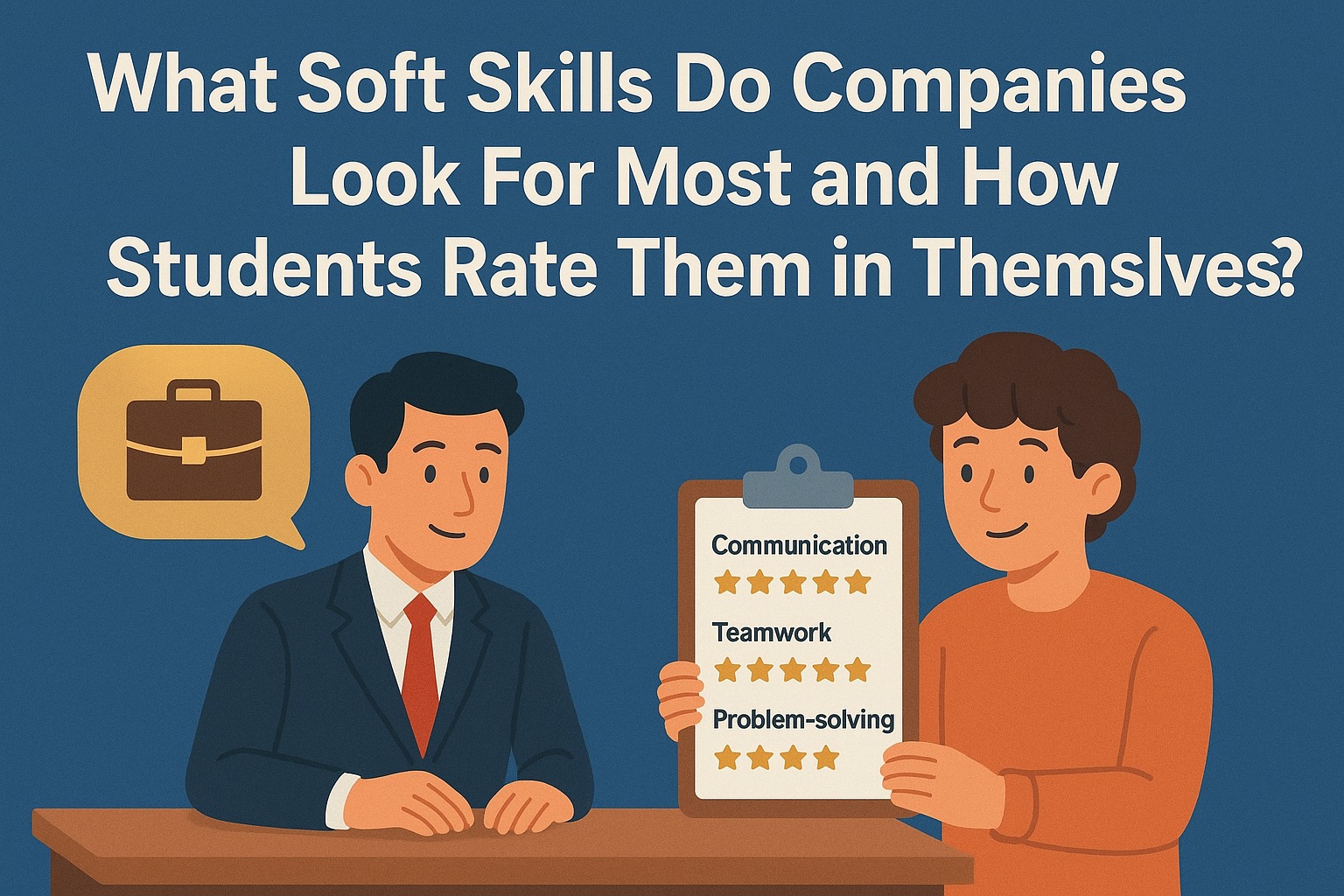
The question *“Which soft skills are popular right now?”* sounds logical, but it is actually inaccurate. Popularity does not guarantee relevance. Companies are not looking for a random list of soft skills—they want abilities that align with the job context. What matters is not trends, but whether the skill helps a candidate consistently handle real work.
Soft Skills Most Sought After by Companies
- Communication & Clarity — the ability to explain ideas clearly, concisely, and in a structured way. Without this, teamwork often becomes chaotic even when technical skills are strong.
- Problem Solving — not merely being “smart,” but being able to break down problems, identify root causes, and propose pragmatic solutions.
- Adaptability & Resilience — the ability to quickly adjust to change and stay steady when things are uncertain.
- Teamwork & Coordination — the ability to work across functions, manage minor conflicts, and maintain project rhythm with the team.
- Ownership & Reliability — consistently completing tasks, being trustworthy, not waiting to be told, and taking responsibility from start to finish.
How to Assess Your Own Soft Skills
Accurate self-assessment should not be based on assumptions. Many students think *“I’m fairly communicative”* or *“I have good teamwork”* even though there is no behavioral evidence. Proper evaluation must always be situational.
Use real examples: When was the last time you faced a conflict? Presented an important idea? Made a decision under pressure?
Observe your patterns: What responses appear most often? Avoiding? Delaying? Taking over? Communicating first?
Self-Assessment Framework
- Strength–Gap Analysis: Identify which skills you have already mastered (based on evidence) and which ones still represent significant gaps.
- Situational Audit: Evaluate how you respond in various situations—pressure, intensive teamwork, priority conflicts, changing requests.
Avoiding Self-Assessment Biases
- Dunning–Kruger Effect: The less experience you have, the easier it is to believe you’re “already good enough.”
- Overconfidence: Judging yourself based on intentions rather than actual behavior.
- Confirmation Bias: Remembering only the moments when you performed well and ignoring the times you failed.
Connecting Soft Skills to Specific Careers
- For creative roles: idea communication, collaboration, ability to receive feedback.
- For technical roles: problem solving, debugging mindset, clear technical communication.
- For managerial roles: coordination, leadership, decision-making, conflict handling.
About the Author
Gusti Ayu Tita P
Author — STEKOM University
An active author focused on academic issues, educational technology, and human resource development in the campus environment.