
The History of Temples in Indonesia You Should Learn
Gusti Ayu Tita P
4 September 2026
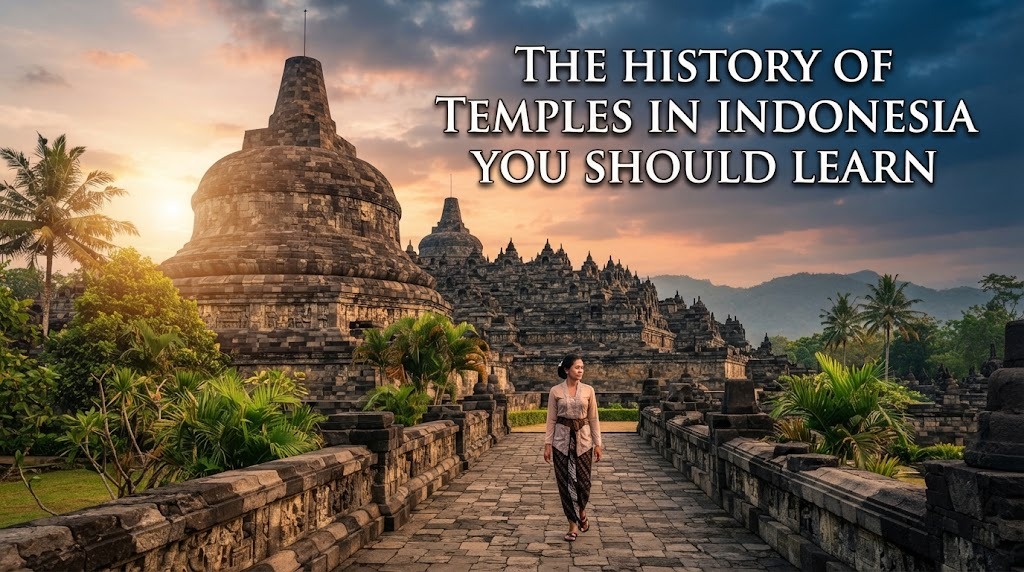
Indonesia is known for its rich cultural heritage, including many ancient temples that tell stories about the country's past. These temples were built centuries ago and are closely connected to the development of Hinduism and Buddhism in the Indonesian archipelago. Their architecture, carvings, and religious symbols provide valuable information about ancient societies.
Learning about the history of temples in Indonesia is not only about knowing when they were built. Temples also reveal information about ancient kingdoms, religious traditions, art, architecture, and daily life. By studying these historical sites, people can better understand how Indonesian culture developed over time.
THE ORIGINS OF TEMPLES IN INDONESIA
The development of temples in Indonesia was closely related to the spread of Hinduism and Buddhism. These religions reached the Indonesian archipelago through long periods of cultural interaction and trade with other parts of Asia. Local communities then adapted these influences to their own traditions and cultural practices.
Temple construction became an important part of religious and cultural development. Ancient builders used stone and other materials to create large structures with detailed carvings and carefully planned layouts. These buildings demonstrate that ancient Indonesian societies had advanced knowledge of architecture, craftsmanship, and religious symbolism.
BOROBUDUR TEMPLE AND BUDDHIST HERITAGE
Borobudur Temple is one of the most famous historical temples in Indonesia. Located in Central Java, it was built during the period of the Sailendra dynasty and is associated with Mahayana Buddhist traditions. Its massive structure consists of several levels decorated with stupas, Buddha statues, and thousands of relief panels.
The reliefs contain stories and teachings while also providing images of life in ancient Java. The temple's design represents a spiritual journey in Buddhist tradition. Its impressive architecture makes Borobudur an important cultural and historical site as well as a major tourism destination.
PRAMBANAN TEMPLE AND HINDU HISTORY
Prambanan Temple is one of the most important Hindu temple complexes in Indonesia. Located in Central Java near Yogyakarta, the complex is known for its tall main temples dedicated to major Hindu deities. Its architecture and carvings demonstrate the development of Hindu culture in ancient Java.
One of the most well known features of Prambanan is its relief depicting scenes from the Ramayana. These carvings show how religious stories were incorporated into temple architecture. Prambanan therefore provides valuable insight into ancient Hindu traditions, artistic skills, and the history of Java.
TEMPLES IN DIENG AND EARLY HINDU CULTURE
The Dieng Temple Complex is another important historical site in Central Java. Located on the Dieng Plateau, the temples are believed to have been built during the early development of Hindu culture in Java. Their relatively small structures have a simple but distinctive architectural style.
The temples are important because they provide evidence of early religious architecture in the region. Their location in a highland area also makes them different from many other temples found in lower areas. Studying the Dieng temples can help explain how Hindu traditions developed in ancient Java.
MENDUT AND PAWON TEMPLES
Mendut and Pawon are Buddhist temples located near Borobudur. Although they are smaller than Borobudur, both sites have important historical and cultural value. Their locations and architectural characteristics have led researchers to study them in relation to the wider Buddhist landscape around Borobudur.
Mendut is particularly known for its large Buddha statues, while Pawon has a distinctive architectural design and decorative elements. Together with Borobudur, these temples demonstrate the importance of the region as a center of Buddhist culture. They also show that ancient religious sites could be connected through a wider cultural and spiritual landscape.
TEMPLES FROM THE SINGASARI KINGDOM
The Singasari Kingdom played an important role in the history of East Java. Several temples were built during or associated with this period, including Singosari Temple, Kidal Temple, and Jago Temple. These sites provide evidence of the religious and artistic development of East Java during the medieval period.
Singosari Temple is associated with the history of King Kertanegara, while Kidal Temple is connected with King Anusapati. Jago Temple is also notable for its detailed reliefs and distinctive architecture. These temples demonstrate how religious traditions and royal history were closely connected in ancient Java.
TEMPLES FROM THE MAJAPAHIT PERIOD
The Majapahit period produced many important historical sites in East Java. Several of them can be found around Trowulan, an area strongly associated with the former Majapahit capital. Examples include Bajang Ratu, Tikus Temple, and Brahu Temple.
These structures have different forms and possible functions. Some are associated with religious activities, while others are believed to have served as gateways or water-related structures. Their diversity provides an important picture of the architecture, technology, and cultural practices of the Majapahit period.
TEMPLE RELIEFS AS HISTORICAL SOURCES
Temple reliefs are valuable sources for understanding ancient Indonesian society. They often depict religious stories, animals, plants, clothing, transportation, buildings, and various human activities. These details can help researchers understand aspects of daily life that may not be clearly described in written historical sources.
Reliefs also demonstrate the artistic abilities of ancient craftsmen. Creating detailed images on stone required careful planning and considerable skill. Because of this, temple carvings are important not only for religious reasons but also for studying ancient Indonesian art and culture.
TEMPLES AND ANCIENT ARCHITECTURE
The architecture of Indonesian temples reflects the knowledge and creativity of ancient builders. Temple structures were carefully planned according to religious concepts, spatial arrangements, and symbolic meanings. Different regions and historical periods also produced different architectural characteristics.
The materials and construction techniques used in these buildings provide evidence of technological development. The ability to move, shape, and arrange large quantities of stone demonstrates considerable organizational skills. These achievements make Indonesian temples important examples of ancient architectural heritage.
THE ROLE OF TEMPLES IN INDONESIAN CULTURE
Temples have played an important role in preserving Indonesia's cultural identity. They provide physical evidence of the diverse religious and cultural traditions that developed across the archipelago. Their existence also demonstrates that Indonesian history was shaped by interactions between local traditions and influences from other regions.
Today, temples serve several purposes. They can function as historical sites, cultural attractions, educational destinations, and places connected with religious activities. Their continued importance shows that historical heritage can remain meaningful even as society changes.
WHY LEARNING TEMPLE HISTORY IS IMPORTANT
Learning about temple history helps people understand Indonesia beyond modern times. Ancient temples provide direct evidence of the achievements and beliefs of earlier generations. They also help students and visitors connect historical events with physical places.
Studying these sites can also encourage greater appreciation for cultural heritage. When people understand the historical value of a temple, they are more likely to respect and protect it. Historical knowledge can therefore support efforts to preserve important cultural sites for future generations.
PROTECTING INDONESIAN TEMPLE HERITAGE
Many ancient temples have survived for hundreds or even thousands of years, but they still face various challenges. Weather, natural processes, environmental changes, and human activities can affect their condition. Proper conservation is therefore necessary to protect these historical structures.
Visitors also have an important role in preservation. Following site regulations, avoiding damage to structures and carvings, keeping the area clean, and respecting cultural rules are simple but meaningful actions. Responsible tourism allows people to enjoy historical sites without putting their long term preservation at risk.
CONCLUSION
The history of temples in Indonesia is closely connected to the development of religion, kingdoms, art, architecture, and culture. Borobudur and Prambanan are among the most famous examples, while temples in Dieng, East Java, and the Trowulan area reveal other important chapters of Indonesian history.
These temples are more than ancient buildings. Their structures, reliefs, statues, and surrounding landscapes contain valuable information about the people who created them. Learning about and protecting Indonesian temples is therefore an important way to appreciate the country's cultural heritage and pass its historical knowledge to future generations.
About the Author
Gusti Ayu Tita P
Author — STEKOM University
An active author focused on academic issues, educational technology, and human resource development in the campus environment.















