
The Importance Of Developing Love For The Homeland From An Early Age
Gusti Ayu Tita P
5 Agustus 2026
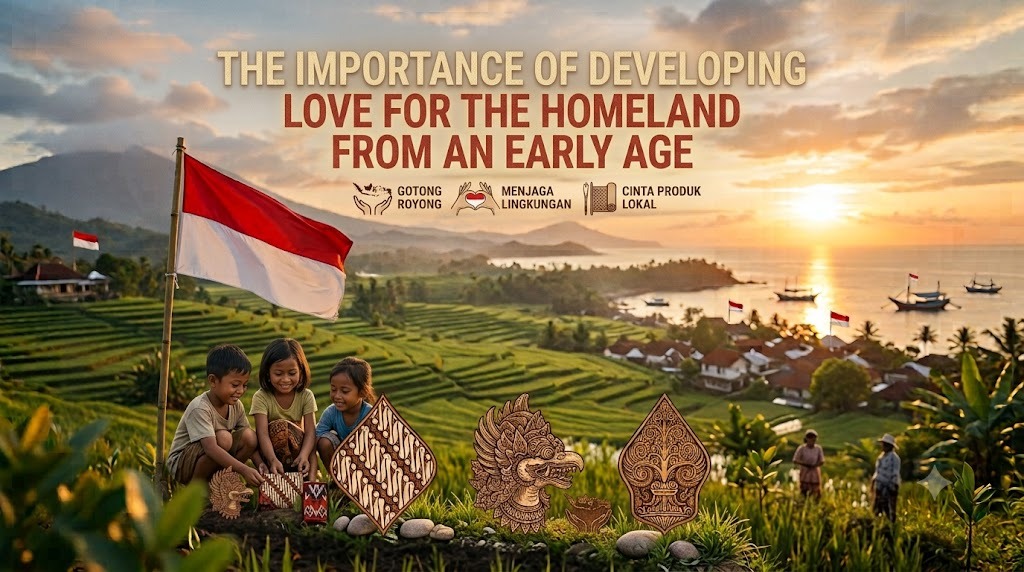
Love for the homeland is an important value that should be introduced to children from an early age. It teaches children to appreciate their country, culture, community, and fellow citizens. This attitude is not only about feeling proud of where they come from, but also about taking responsibility for the environment and society. When love for the homeland is introduced through simple daily activities, children can gradually develop a strong sense of belonging.
Early childhood is an important period for developing character, habits, and attitudes. Values learned during this period can influence how children behave as they grow older. Parents, teachers, and communities therefore have an important role in creating positive experiences related to national identity. Through education and daily examples, children can learn that caring for their homeland can begin with simple actions.
UNDERSTANDING LOVE FOR THE HOMELAND
Love for the homeland means having a sense of pride, belonging, respect, and concern for one's country. For Indonesian children, this can include learning about national history, respecting cultural diversity, and appreciating Indonesian traditions. It also means understanding that every citizen has responsibilities toward society and the environment. This value should be introduced in a way that children can easily understand.
Children do not need to perform complicated activities to show love for their country. Being respectful, following rules, helping others, keeping the environment clean, and learning about local culture are simple examples. These habits can be practiced at home, at school, and in the community. When children practice them regularly, national values can become a natural part of their character.
WHY LOVE FOR THE HOMELAND SHOULD BE TAUGHT EARLY
Teaching love for the homeland from an early age helps children develop a strong sense of identity and responsibility. Children who understand their cultural background may become more confident in appreciating their national identity. They can also learn to respect people who have different traditions and backgrounds. These attitudes are valuable for building peaceful and inclusive communities.
Early education also makes it easier for children to develop positive habits. Respect, discipline, cooperation, tolerance, and responsibility can be introduced through everyday activities. When children experience these values directly, they are more likely to understand their practical meaning. Early character development can therefore become an important foundation for responsible citizenship.
THE ROLE OF FAMILY IN BUILDING NATIONAL PRIDE
Family is the first environment where children learn values and behavior. Parents can introduce love for the homeland through simple conversations, stories, traditions, and daily activities. They can teach children to respect national symbols and appreciate local cultures. More importantly, parents can demonstrate positive behavior through their own actions.
Children often learn by observing the people around them. Parents who respect others, follow rules, care for the environment, and appreciate Indonesian culture can become positive examples. Family activities can also include visiting historical places, preparing traditional food, or learning local traditions. These experiences can make national values more meaningful and memorable.
THE ROLE OF SCHOOLS IN DEVELOPING NATIONAL VALUES
Schools have an important role in developing character and national awareness among students. Teachers can introduce Indonesian history, culture, Pancasila values, and national identity through classroom activities. Lessons can be designed to encourage students to think about their responsibilities as members of society. This approach can make national education more meaningful than simple memorization.
Schools can also provide practical activities such as cultural performances, community service, group projects, environmental programs, and national celebrations. These activities allow students to practice cooperation and responsibility. Students can learn to respect differences while working toward common goals. Through consistent education and positive experiences, schools can help strengthen students' love for Indonesia.
INTRODUCING INDONESIAN CULTURAL DIVERSITY
Indonesia has a rich cultural heritage that includes traditional languages, dances, music, clothing, food, crafts, and customs. Introducing this diversity to children can help them understand the uniqueness of their country. Children can learn that different traditions are valuable parts of Indonesia's national identity. Cultural education can also encourage respect for communities with different backgrounds.
Parents and teachers can introduce culture through stories, music, traditional games, art activities, and cultural events. Children can also be encouraged to learn about traditions from different regions. Such activities can make cultural learning enjoyable and interactive. When children become familiar with Indonesian culture, they may develop greater appreciation for their homeland.
TEACHING TOLERANCE AND RESPECT FOR DIFFERENCES
Indonesia is a diverse country, so children need to learn tolerance and mutual respect from an early age. They should understand that people may have different religions, ethnic backgrounds, languages, traditions, and opinions. These differences should not become reasons for discrimination or conflict. Instead, children can learn that diversity is an important part of Indonesian society.
Tolerance can be taught through sharing, teamwork, listening to others, and treating everyone fairly. Teachers and parents can encourage children to cooperate with friends from different backgrounds. When disagreements happen, children can be guided to communicate calmly and respectfully. These experiences can help them develop social skills while strengthening their understanding of unity.
TEACHING CHILDREN TO CARE FOR THE ENVIRONMENT
Environmental care is also a form of love for the homeland. Indonesia has valuable natural resources that need to be protected for present and future generations. Children can learn this value through simple habits such as throwing waste in the proper place, saving water, and taking care of plants. These activities teach children that everyone has a responsibility to protect their surroundings.
Schools and families can organize clean-up activities, tree planting, recycling projects, and environmental campaigns. Such activities can make environmental education more practical and enjoyable. Children can also learn that a clean environment benefits everyone in the community. By developing these habits early, they can grow into adults who care about Indonesia's natural environment.
USING TECHNOLOGY TO INTRODUCE NATIONAL IDENTITY
Technology can provide creative ways to introduce Indonesian history, culture, and national identity to children. Educational videos, digital books, interactive applications, and online learning materials can make lessons more engaging. Children can explore information about different regions and cultural traditions through age-appropriate digital content. Technology can therefore become a useful educational tool.
However, children should also learn responsible digital behavior. Parents and teachers need to guide children when they use the internet and help them understand that not all online information is accurate. Children should learn to communicate politely and avoid harmful content. With proper guidance, technology can support national education without replacing real-world experiences.
DEVELOPING RESPONSIBILITY THROUGH DAILY HABITS
Love for the homeland becomes more meaningful when it is connected to daily responsibility. Children can learn responsibility by completing school tasks, following household rules, caring for personal belongings, and helping others. These simple habits teach children that their actions have consequences. Responsibility can later develop into a stronger sense of social and national responsibility.
Children can also participate in activities that promote cooperation and community awareness. Helping classmates, participating in group projects, and taking care of shared spaces are useful examples. Parents and teachers should appreciate positive behavior while explaining why these actions matter. Through repeated practice, responsible behavior can become part of a child's character.
THE ROLE OF YOUNG PEOPLE IN THE FUTURE OF INDONESIA
Children who learn to love their homeland from an early age can grow into young people who care about Indonesia's future. As they become older, they can contribute through education, innovation, entrepreneurship, arts, technology, sports, and social activities. Their skills can be used to solve problems and create opportunities for society. Strong national values can guide them when making decisions.
Young people also have the opportunity to introduce Indonesia to the wider world. Creative works, cultural projects, local businesses, and digital content can showcase the country's strengths. However, they need to remain responsible and respectful when representing Indonesian culture. A combination of skills, creativity, and national awareness can help young people become valuable contributors to the country.
BUILDING LOVE FOR THE HOMELAND THROUGH POSITIVE EXAMPLES
Children learn effectively when national values are presented through real examples rather than only explanations. Adults can demonstrate respect, honesty, discipline, cooperation, and environmental responsibility in everyday situations. These examples allow children to see how national values can be practiced in real life. Positive experiences can be more memorable than abstract lessons.
The community also has an important role in creating a supportive environment. Community service, cultural events, environmental activities, and social programs can give children opportunities to participate. When families, schools, and communities work together, children receive consistent messages about responsibility and national pride. This cooperation can strengthen character development over time.
CONCLUSION
Developing love for the homeland from an early age is important for building responsible and caring citizens. Children can learn national values through family education, school activities, cultural experiences, environmental care, tolerance, and positive daily habits. These lessons do not need to be complicated because simple activities can have meaningful effects. What matters is consistency and good examples from the adults around them.
Ultimately, love for the homeland grows through knowledge, experience, and positive behavior. Children who learn to appreciate Indonesia's culture, diversity, environment, and community can develop a stronger sense of belonging. Families, schools, and communities must work together to support this process. By starting early, Indonesia can prepare a future generation that is confident, responsible, tolerant, and proud of its homeland.
About the Author
Gusti Ayu Tita P
Author — STEKOM University
An active author focused on academic issues, educational technology, and human resource development in the campus environment.















