
The Relationship Between Bhinneka Tunggal Ika and Pancasila
Gusti Ayu Tita P
4 Agustus 2026
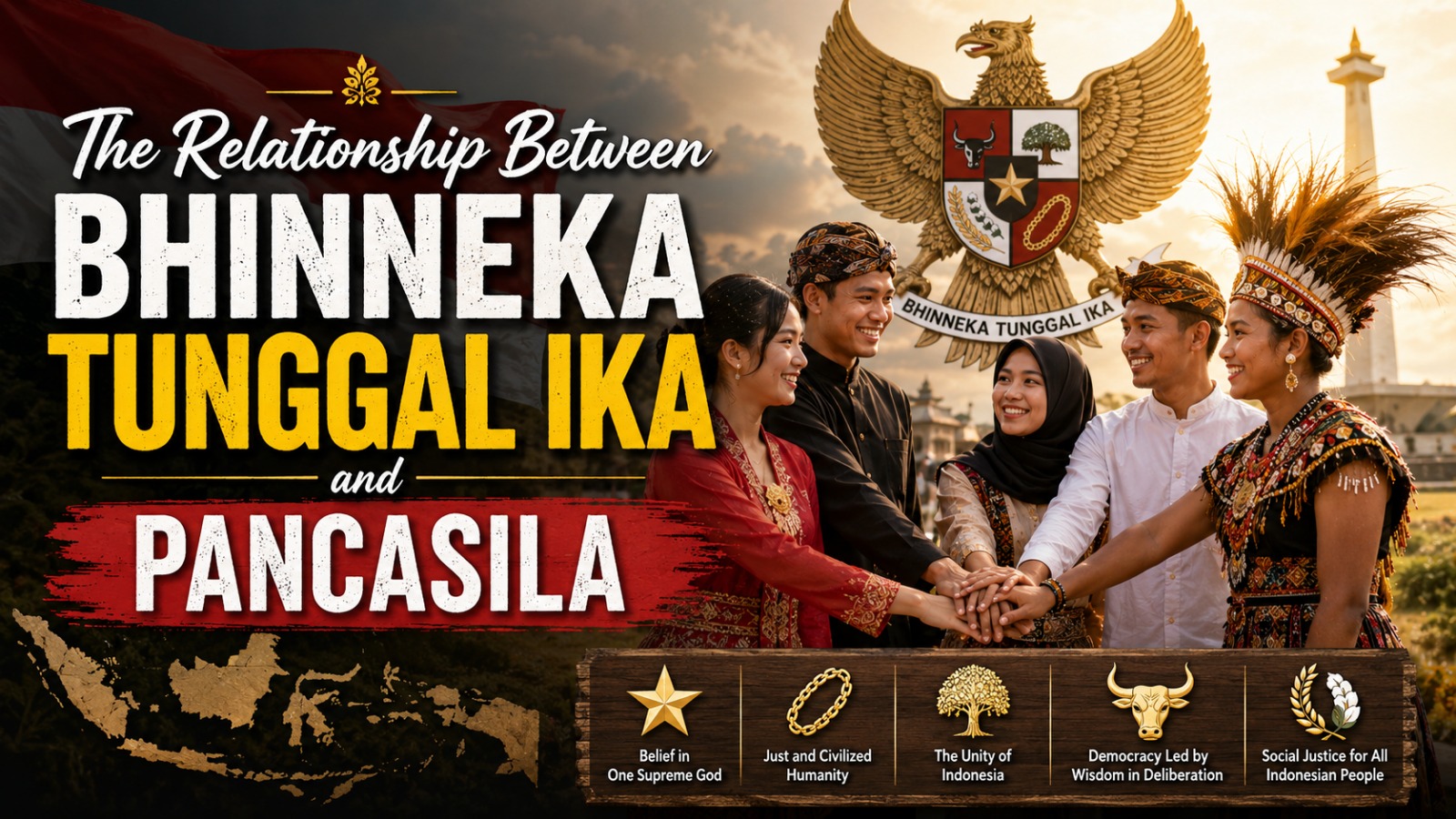
Indonesia is known for its remarkable diversity of ethnic groups, religions, languages, cultures, and traditions. Managing this diversity requires national values that can unite people without eliminating their differences. Bhinneka Tunggal Ika and Pancasila are two important foundations that support this goal. Although they have different roles, both encourage Indonesians to respect diversity, maintain unity, and build a fair society.
Bhinneka Tunggal Ika means “Unity in Diversity” and emphasizes the importance of staying united despite differences. Pancasila, meanwhile, serves as the philosophical foundation of the Indonesian state and consists of five principles that guide national and social life. Their relationship can be seen in the way Pancasila provides fundamental values while Bhinneka Tunggal Ika reflects the spirit of unity needed to live with diversity. Together, they support Indonesia’s national identity and social cohesion.
THE MEANING OF BHINNEKA TUNGGAL IKA
Bhinneka Tunggal Ika is an Old Javanese phrase commonly translated as “Unity in Diversity” or “Different but One.” It comes from the Kakawin Sutasoma, a literary work attributed to Mpu Tantular during the Majapahit period. The phrase was later adopted as Indonesia’s national motto and is displayed on the scroll held by the Garuda Pancasila. Its meaning reflects the reality of Indonesia as a nation with many different cultural and social identities.
The principle teaches that differences do not have to lead to division. Indonesians can maintain their ethnic, cultural, religious, and regional identities while recognizing their shared identity as one nation. This approach encourages tolerance, mutual respect, and cooperation. Therefore, Bhinneka Tunggal Ika provides an important perspective for managing diversity in Indonesian society.
UNDERSTANDING PANCASILA AS INDONESIA’S STATE FOUNDATION
Pancasila is the philosophical foundation of the Indonesian state and consists of five principles. These principles are belief in One and Only God, just and civilized humanity, the unity of Indonesia, democracy guided by wisdom through deliberation and representation, and social justice for all Indonesian people. Together, they provide fundamental values for national life. Pancasila also serves as a reference for developing a society based on dignity, justice, democracy, and unity.
The principles of Pancasila are closely connected to Indonesia’s diverse social conditions. They encourage citizens to respect religious beliefs, uphold humanity, prioritize national unity, participate responsibly in democratic life, and promote social justice. These values are important for creating relationships between citizens based on respect and fairness. In this context, Pancasila provides a broad ethical foundation for living together in a diverse country.
HOW BHINNEKA TUNGGAL IKA AND PANCASILA COMPLEMENT EACH OTHER
Bhinneka Tunggal Ika and Pancasila have complementary roles in maintaining Indonesian unity. Pancasila provides fundamental principles for national and social life, while Bhinneka Tunggal Ika emphasizes how unity can be maintained amid diversity. One focuses on the values that guide the nation, while the other highlights the importance of unity within differences. Their relationship becomes particularly important in a multicultural country such as Indonesia.
Both principles reject the idea that differences should automatically create division. Pancasila provides values such as humanity, unity, democracy, and social justice, while Bhinneka Tunggal Ika encourages people to respect differences within that framework. Together, they help Indonesians develop a sense of shared identity without requiring cultural uniformity. This combination strengthens social cohesion and supports peaceful coexistence.
THE CONNECTION BETWEEN BHINNEKA TUNGGAL IKA AND THE THIRD PRINCIPLE
The relationship between Bhinneka Tunggal Ika and Pancasila is especially clear in the third principle, “The Unity of Indonesia.” This principle emphasizes that national unity must be maintained despite differences among citizens. Bhinneka Tunggal Ika expresses a similar idea by recognizing diversity while emphasizing togetherness. Both encourage citizens to place national unity alongside respect for different identities.
Unity does not mean eliminating differences or forcing everyone to have the same culture and beliefs. Instead, unity can be built by recognizing shared responsibilities and national interests. Citizens can preserve local traditions while contributing to a common national identity. This understanding allows diversity to exist as part of Indonesia’s unity rather than becoming a source of separation.
TOLERANCE AS A SHARED VALUE
Tolerance is an important value that can be understood through both Pancasila and Bhinneka Tunggal Ika. Indonesia’s citizens have different religious beliefs, cultures, languages, and traditions, making tolerance essential for peaceful social interaction. The first principle of Pancasila emphasizes belief in One and Only God, while the broader values of humanity and unity encourage respect for others. Bhinneka Tunggal Ika reinforces the importance of living together despite differences.
Tolerance can be practiced through everyday actions. People can respect religious activities, avoid discrimination, listen to different opinions, and appreciate cultural traditions. These actions help create an environment where individuals can maintain their identities while participating in shared social life. When tolerance becomes a habit, diversity can strengthen relationships instead of creating conflict.
THE ROLE OF PANCASILA AND BHINNEKA TUNGGAL IKA IN SOCIAL HARMONY
Social harmony requires more than simply recognizing that differences exist. People also need values that guide how they interact with one another. Pancasila provides principles related to humanity, unity, democracy, and social justice, while Bhinneka Tunggal Ika emphasizes togetherness within diversity. Their combination can help society develop respectful and cooperative relationships.
These values can be applied in families, schools, universities, workplaces, and communities. People can cooperate with individuals from different backgrounds, resolve disagreements through discussion, and avoid discrimination. Social harmony becomes stronger when people recognize that everyone has rights and responsibilities within society. This creates an environment where diversity can coexist with unity.
THE IMPORTANCE FOR YOUNG INDONESIANS
Young Indonesians have an important role in maintaining the values of Pancasila and Bhinneka Tunggal Ika. They live in an increasingly connected environment where interaction between different cultures and communities is common. Young people can strengthen unity by building friendships, participating in diverse communities, and respecting different perspectives. They can also learn about Indonesian history and culture to develop a stronger understanding of national identity.
The digital environment provides both opportunities and challenges. Young people can use social media to promote cultural appreciation, educational content, and positive discussions. At the same time, they need to avoid misinformation, hate speech, and content that encourages hostility toward particular groups. Responsible digital behavior can help ensure that technology strengthens rather than weakens national unity.
APPLYING BOTH VALUES IN DAILY LIFE
The relationship between Pancasila and Bhinneka Tunggal Ika becomes meaningful when their values are practiced in everyday life. Students can cooperate with classmates from different backgrounds, respect different beliefs, and avoid discriminatory behavior. Communities can organize activities that encourage cooperation and mutual assistance. Individuals can also resolve disagreements through respectful discussion rather than hostility.
Small actions can have an important impact when practiced consistently. Listening to others, helping people in need, respecting cultural differences, and treating everyone fairly are examples of practical applications. These behaviors reflect the principles of humanity, unity, and social justice found in Pancasila while also expressing the spirit of Bhinneka Tunggal Ika. In this way, national values become part of everyday social behavior.
CONCLUSION
The relationship between Bhinneka Tunggal Ika and Pancasila is closely connected to Indonesia’s effort to maintain unity in diversity. Pancasila provides fundamental values for national and social life, while Bhinneka Tunggal Ika emphasizes that unity can be maintained without eliminating differences. Both encourage tolerance, mutual respect, cooperation, humanity, and national solidarity. Together, they provide an important foundation for building a peaceful and inclusive Indonesian society.
Their values should not remain limited to formal symbols or classroom lessons. They need to be practiced through daily interactions, education, community activities, and responsible behavior in the digital environment. By applying Pancasila and Bhinneka Tunggal Ika consistently, Indonesians can protect diversity while strengthening national unity. This relationship remains important for ensuring that Indonesia’s differences become a source of strength rather than division.
About the Author
Gusti Ayu Tita P
Author — STEKOM University
An active author focused on academic issues, educational technology, and human resource development in the campus environment.















