
The Relationship Between Pancasila and the 1945 Constitution
Gusti Ayu Tita P
4 Agustus 2026
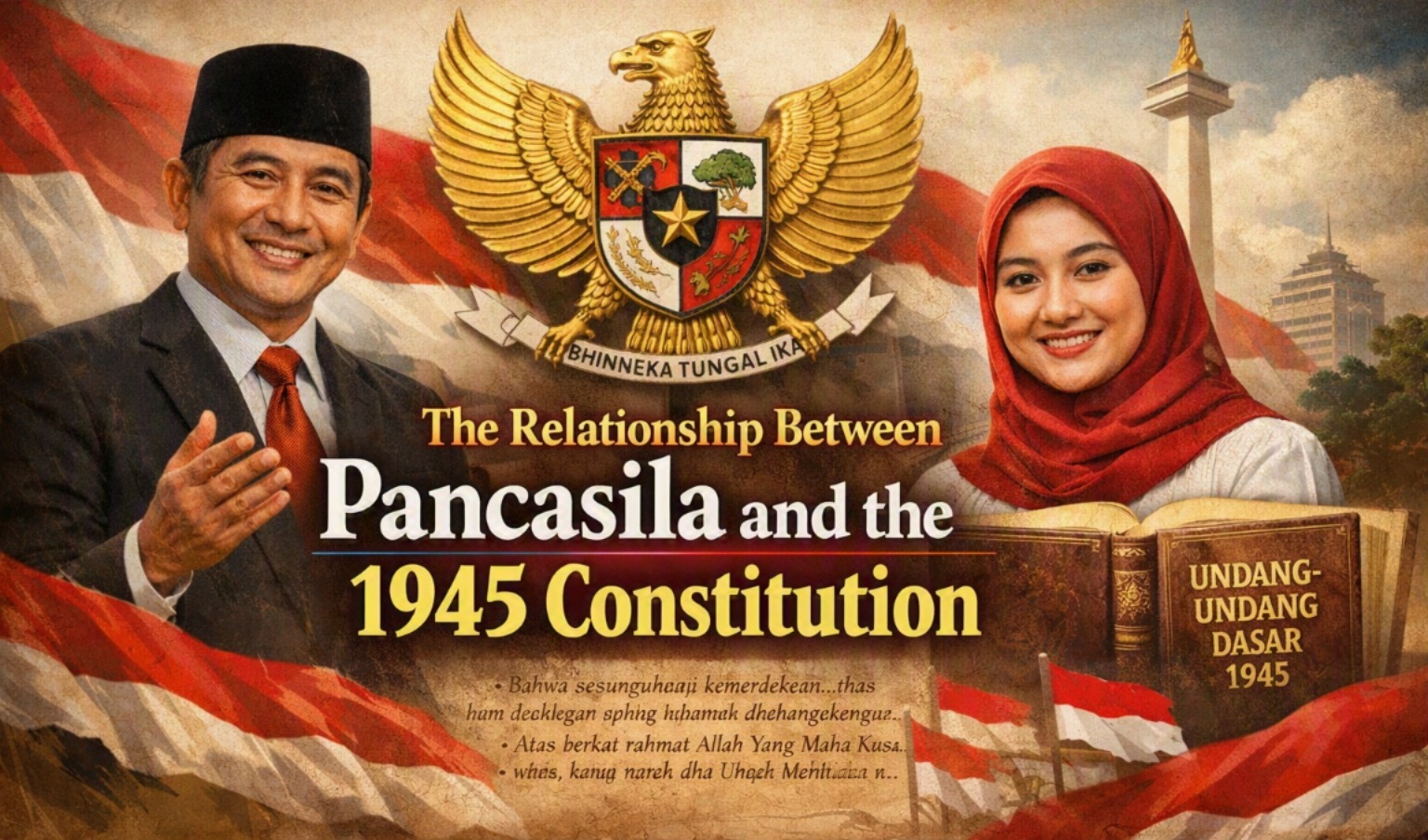
Pancasila and the 1945 Constitution are the two most important foundations of the Indonesian state. Both serve as the guiding principles for governing the country, protecting citizens' rights, and maintaining national unity. Although they have different roles, they are closely connected and complement one another. Pancasila provides the nation's philosophical values, while the 1945 Constitution transforms those values into binding legal rules.
Understanding the relationship between these two foundations is essential for every Indonesian citizen. Their connection ensures that the country's legal system, democracy, and public policies remain consistent with the nation's ideals. Together, they create a balanced framework that supports justice, equality, and sustainable national development.
PANCASILA AS THE PHILOSOPHICAL FOUNDATION
Pancasila is recognized as the philosophical foundation and state ideology of Indonesia. It consists of five principles that emphasize belief in God, humanity, national unity, democracy, and social justice. These principles reflect the nation's identity and provide ethical guidance for both the government and society. Every national policy should align with these core values to preserve Indonesia's vision as a democratic and inclusive country.
As the highest source of national values, Pancasila inspires the development of laws, regulations, and government institutions. It promotes respect for diversity while encouraging cooperation among all citizens. The values of justice, human dignity, and mutual respect remain relevant in addressing modern social, political, and economic challenges. Therefore, Pancasila continues to be the moral compass of Indonesia.
THE 1945 CONSTITUTION AS THE LEGAL FOUNDATION
The 1945 Constitution serves as the highest written law in Indonesia. It establishes the structure of government, defines the powers of state institutions, and guarantees the rights and obligations of citizens. The Constitution also outlines democratic principles and legal procedures that ensure accountability within the government. Every law and regulation must comply with the provisions of the Constitution.
Besides regulating the political system, the 1945 Constitution protects fundamental rights such as education, freedom of religion, equality before the law, and social welfare. Constitutional amendments have strengthened democratic institutions and improved the protection of human rights. As a result, the Constitution remains a dynamic legal framework capable of adapting to national development while maintaining its core principles.
HOW PANCASILA AND THE 1945 CONSTITUTION ARE CONNECTED?
The relationship between Pancasila and the 1945 Constitution is based on the principle that the Constitution derives its spirit and direction from Pancasila. Every constitutional provision should reflect the values contained in the five principles of Pancasila. This relationship ensures that Indonesia's legal system remains rooted in national identity instead of relying solely on legal formalities. It also prevents laws from contradicting the country's philosophical ideals.
At the same time, the 1945 Constitution gives practical legal form to the values of Pancasila. Without the Constitution, the principles of Pancasila would remain philosophical concepts without clear legal implementation. Conversely, without Pancasila, constitutional law could lose its moral and ethical direction. Together, they create a strong balance between legal certainty and national values.
THE IMPORTANCE OF THEIR RELATIONSHIP FOR INDONESIA
The close relationship between Pancasila and the 1945 Constitution contributes significantly to Indonesia's political stability and national unity. Government institutions rely on both foundations when creating laws, implementing public policies, and resolving constitutional disputes. This consistency strengthens public trust in the legal system and promotes responsible governance. It also supports the protection of democracy and human rights.
For citizens, understanding this relationship encourages greater respect for the law and appreciation of Indonesia's national identity. Schools, universities, and public institutions play an important role in promoting constitutional awareness and the values of Pancasila. As Indonesia continues to develop, these two foundations remain essential for maintaining harmony, justice, and sustainable progress.
CONCLUSION
The relationship between Pancasila and the 1945 Constitution is fundamental to Indonesia's constitutional system. Pancasila provides the nation's philosophical values, while the 1945 Constitution translates those values into enforceable legal principles. Their strong connection ensures that Indonesia's democracy, legal system, and governance remain consistent with the ideals of justice, unity, and humanity. By understanding and respecting both foundations, citizens can contribute to a stronger, fairer, and more prosperous Indonesia.
About the Author
Gusti Ayu Tita P
Author — STEKOM University
An active author focused on academic issues, educational technology, and human resource development in the campus environment.















