
The Role of Mining Energy in Supporting Communities
Gusti Ayu Tita P
20 Agustus 2026
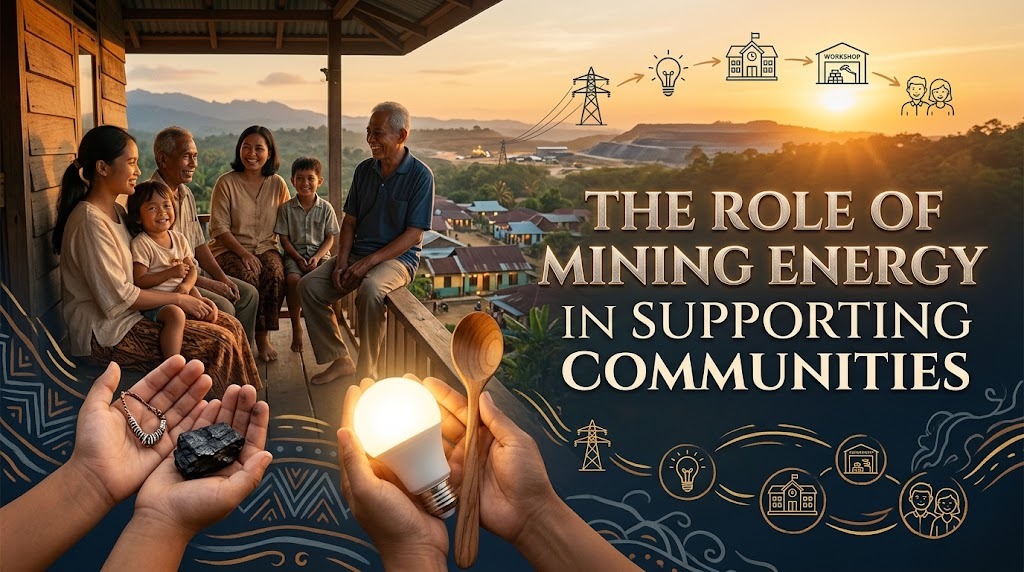
Energy is essential for modern communities because it supports households, businesses, transportation, public services, and industrial activities. In many countries, energy resources connected to the mining sector continue to contribute to electricity generation and industrial supply chains. Mining energy therefore has an important role in supporting economic and social activities, although its use must be managed responsibly.
Mineral resources are also increasingly important for modern energy technologies. Coal remains an important energy source in several power systems, while minerals such as nickel, copper, and other metals are needed for electrical infrastructure and energy technologies. The challenge is to ensure that mining activities provide economic and social benefits while maintaining environmental responsibility.
SUPPORTING ELECTRICITY SUPPLY
One of the major ways mining-related energy supports communities is through electricity generation. In countries where coal remains part of the electricity mix, coal mining can supply fuel for power plants. The electricity generated can then support homes, schools, hospitals, businesses, and public facilities.
Reliable electricity is essential for everyday activities and economic development. Households need electricity for lighting, communication, refrigeration, and other basic activities. Businesses and public institutions also depend on stable electricity to operate efficiently, making energy availability an important factor in community development.
SUPPORTING LOCAL BUSINESSES AND INDUSTRIES
Energy availability is closely connected to the development of local businesses. Small shops, food producers, workshops, offices, and other enterprises require electricity to operate equipment and provide services. Reliable energy can therefore support local economic activity and create opportunities for entrepreneurship.
Mining regions can also develop supporting industries around extraction and processing activities. Transportation, maintenance, accommodation, catering, and other services may grow as mining projects expand. These activities can create additional employment and income opportunities for communities when local businesses are able to participate in the supply chain.
CREATING EMPLOYMENT OPPORTUNITIES
The mining and energy sectors can create direct and indirect employment opportunities. Mining companies require workers in exploration, extraction, transportation, processing, engineering, maintenance, safety, and environmental management. Employment opportunities can provide income for households and contribute to local economic activity.
Indirect employment can develop through businesses that provide goods and services to mining operations and their workers. Local transportation providers, food businesses, construction services, and other suppliers may benefit from increased demand. However, communities also need access to skills development so they can compete for opportunities created by industrial projects.
MINERALS SUPPORTING MODERN ENERGY SYSTEMS
The relationship between mining and energy extends beyond traditional fuels. Minerals are essential for many modern energy technologies and electrical systems. Copper, for example, is widely used in electrical wiring and power infrastructure, while nickel and other minerals can be used in certain battery and industrial applications.
As electrification expands, demand for minerals used in power networks, renewable energy systems, batteries, and electric transportation may increase. This creates opportunities for mining countries to participate in emerging energy supply chains. Responsible mineral development will be important to ensure that the transition to new energy systems does not create unnecessary environmental and social impacts.
USING TECHNOLOGY TO IMPROVE ENERGY EFFICIENCY
Mining operations themselves can consume substantial amounts of energy. Heavy equipment, processing facilities, ventilation systems, and transportation require significant power or fuel. Energy efficiency is therefore important for both reducing operational costs and improving environmental performance.
Digital monitoring, automated equipment, optimized transportation, and predictive maintenance can help companies use energy more efficiently. Data systems can identify unnecessary fuel consumption or equipment operating time. By improving efficiency, mining companies can reduce waste while maintaining productivity.
MANAGING ENVIRONMENTAL RESPONSIBILITIES
Mining-related energy production and consumption can create environmental challenges, particularly when fossil fuels are involved. Companies need to manage emissions, water use, waste, land disturbance, and other potential impacts. Environmental management should be integrated into mining and energy planning from the beginning of a project.
Technology can support environmental monitoring by providing data about air quality, water conditions, energy consumption, and operational performance. Companies can use this information to identify areas requiring improvement. Strong regulations and consistent monitoring are also necessary to ensure that environmental commitments are implemented effectively.
SUPPORTING A MORE DIVERSE ENERGY FUTURE
The future energy system is likely to involve a broader combination of energy sources and technologies. Traditional mining energy may continue to play a role in some regions, while renewable energy and energy-efficient technologies expand. Energy transition therefore creates both challenges and opportunities for mining communities.
Mining regions can prepare for this transition by investing in education, workforce development, infrastructure, and economic diversification. Communities that develop skills and businesses beyond a single energy source may become more resilient to changes in commodity demand. This approach can help ensure that the economic benefits associated with natural resources continue beyond individual mining projects.
BUILDING LONG TERM COMMUNITY BENEFITS
Mining energy can contribute significantly to community development through electricity supply, employment, business opportunities, infrastructure, and industrial activity. However, these benefits are most valuable when they are supported by responsible resource management and long-term planning. Communities should have opportunities to participate in development and benefit from economic activities around mining areas.
The future of mining energy will depend on balancing resource utilization with environmental protection and social needs. Investment in technology, worker skills, efficient energy use, and community development can help strengthen this balance. With responsible management, the mining and energy sectors can continue supporting communities while adapting to the changing demands of a more sustainable future.
About the Author
Gusti Ayu Tita P
Author — STEKOM University
An active author focused on academic issues, educational technology, and human resource development in the campus environment.















