
The Role of MRT Jakarta in Supporting Sustainable Transportation
Gusti Ayu Tita P
11 Agustus 2026
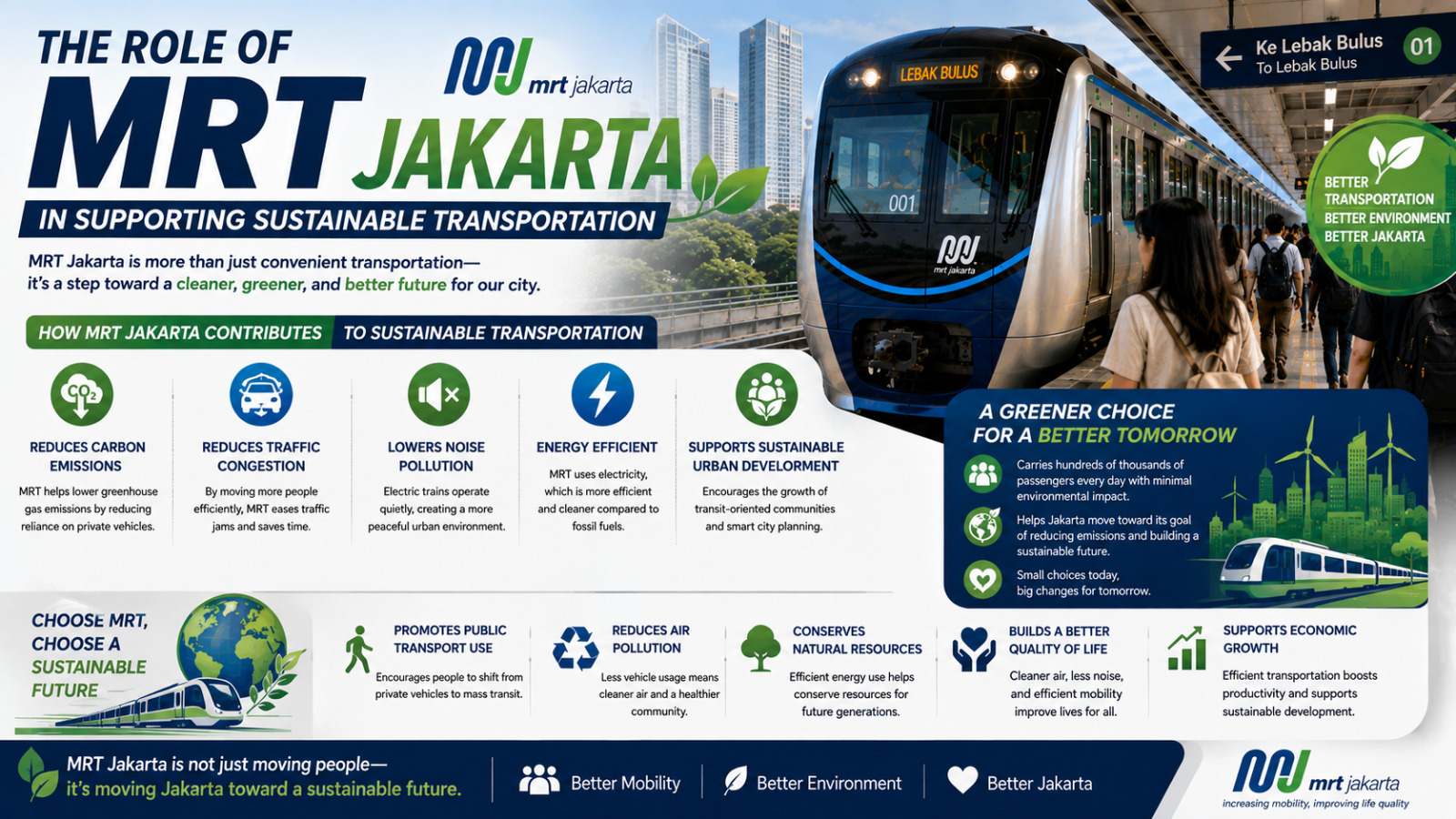
MRT Jakarta plays an important role in supporting sustainable transportation in Jakarta. As an electric rail-based public transportation system, MRT provides an alternative to private cars and motorcycles for daily travel. Its ability to carry many passengers on dedicated railway tracks makes it suitable for a city with high transportation demand. The development of MRT is therefore closely connected to Jakarta’s efforts to create a more efficient and sustainable mobility system.
Sustainable transportation is not only about using electric vehicles. It also involves efficient mobility, public transportation access, environmental considerations, and transportation integration. MRT Jakarta can contribute to these goals by encouraging people to use shared transportation for suitable journeys. Its benefits can become greater when the MRT network is connected effectively with buses, commuter trains, pedestrian facilities, and other modes.
MRT AS A MASS TRANSPORTATION SYSTEM
MRT Jakarta is designed to carry large numbers of passengers through a dedicated railway network. Unlike cars and motorcycles that generally carry relatively few people per vehicle, one MRT train can transport many passengers during a single journey. This makes mass transit an important part of urban transportation planning. It allows people to share one transportation system instead of depending entirely on individual vehicles.
The railway operates through elevated and underground sections depending on the route. Because MRT trains use dedicated tracks, their journeys are not directly dependent on road traffic conditions. More predictable travel can encourage people to consider MRT for regular commuting. A reliable mass transit system is essential for supporting sustainable urban mobility.
REDUCING DEPENDENCE ON PRIVATE VEHICLES
One of the important roles of MRT Jakarta is providing an alternative to private vehicle use. Jakarta has a large number of cars and motorcycles, and high vehicle use can contribute to congestion and other transportation challenges. When people choose MRT for appropriate journeys, they can avoid using individual vehicles for those trips. If this behavior occurs on a large scale, it can help reduce the pressure created by private vehicle traffic.
However, MRT cannot solve transportation problems independently. People need convenient ways to reach stations and continue their journeys after leaving the train. Integration with buses, feeder services, walking routes, and other transportation modes can make it easier to complete a journey without a private vehicle. This is why a sustainable transportation strategy needs several connected services rather than relying on one mode.
SUPPORTING ENVIRONMENTAL SUSTAINABILITY
MRT Jakarta operates using electric trains, which do not produce direct exhaust emissions along their railway routes. This provides an important difference compared with conventional fuel-powered vehicles. If MRT successfully encourages passengers to shift from private vehicles to public transportation, the environmental benefits may become more significant. However, the overall emissions impact also depends on how the electricity used by the system is generated.
MRT can also help use transportation infrastructure more efficiently by carrying many passengers through one railway system. Reducing the number of individual vehicle trips can potentially decrease fuel consumption and transportation emissions. Sustainable mobility requires changes in travel behavior as well as modern transportation technology. Therefore, encouraging people to use public transportation regularly is an important part of maximizing MRT’s environmental contribution.
INTEGRATING MRT WITH OTHER TRANSPORTATION
MRT Jakarta becomes more effective when it is connected to a broader integrated transportation network. Passengers may use buses or other services to reach an MRT station and then continue by train. After reaching their destination station, they may use another mode or walk to their final location. This allows different transportation services to work together as one journey.
Good integration requires convenient transfer points, pedestrian access, clear information, and compatible transportation services. When transfers are simple and practical, passengers are less likely to depend on private vehicles for parts of their journey. Seamless connections can therefore strengthen the role of MRT in sustainable transportation. The quality of the entire transportation network is important for encouraging long-term public transport use.
ENCOURAGING SUSTAINABLE URBAN MOBILITY
MRT Jakarta can also influence how people think about transportation in a modern city. Reliable public transportation gives residents an opportunity to choose shared mobility instead of using a private vehicle for every trip. This supports the idea that efficient urban mobility does not always require individual vehicle ownership. Over time, greater use of public transportation can contribute to changes in daily travel patterns.
The long-term success of sustainable transportation requires cooperation between government, operators, businesses, and passengers. Infrastructure must continue to improve, while services need to remain safe, accessible, and convenient. Passengers also have a role by following rules and choosing public transportation when appropriate. Consistent public participation can strengthen the benefits of MRT Jakarta and other sustainable transportation systems.
CONCLUSION
MRT Jakarta has an important role in supporting sustainable transportation through its electric railway system, large passenger capacity, and dedicated tracks. It provides an alternative to private vehicles and can support more efficient urban mobility. When people choose MRT for suitable journeys, the system can contribute to reducing dependence on individual transportation.
Its long-term benefits depend on strong transportation integration, accessibility, reliable services, and public participation. MRT should therefore be viewed as part of a wider sustainable transportation network rather than as an isolated system. With continued development and effective integration, MRT Jakarta can contribute to a more efficient, connected, and environmentally responsible future for urban transportation.
About the Author
Gusti Ayu Tita P
Author — STEKOM University
An active author focused on academic issues, educational technology, and human resource development in the campus environment.















