
The Supernatural World in Indonesian Beliefs and Cultural Traditions
Gusti Ayu Tita P
9 September 2026
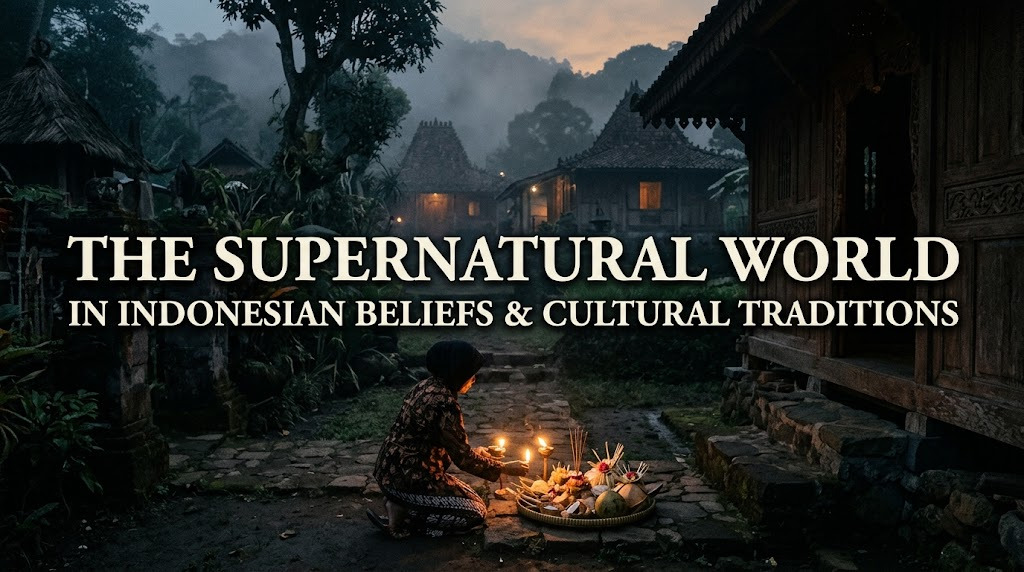
The supernatural world has an important place in many Indonesian stories, beliefs, and cultural traditions. Across generations, communities have developed different ideas about spirits, mystical beings, sacred places, and unexplained events. These beliefs are influenced by local history, religious traditions, social values, and oral storytelling. Although not every supernatural story can be verified scientifically, such narratives remain valuable for understanding Indonesian culture and folklore. Exploring them carefully can help distinguish cultural heritage from claims that have not been scientifically proven.
THE ROLE OF SUPERNATURAL BELIEFS IN INDONESIAN CULTURE
Indonesia consists of many ethnic groups with diverse traditions, so beliefs about the supernatural world are not identical everywhere. Some communities have stories about ancestral spirits, guardian beings, sacred locations, or supernatural creatures. These beliefs may appear in traditional ceremonies, legends, taboos, and oral narratives. In some areas, supernatural stories are connected with the relationship between humans, nature, ancestors, and the spiritual dimension. Their meanings can therefore extend beyond simple horror or entertainment.
The way people understand these beliefs has also changed over time. Modern education, science, religion, technology, and mass media have influenced how younger generations interpret traditional stories. Some people continue to regard certain traditions as meaningful cultural practices, while others see them primarily as folklore. This diversity of perspectives demonstrates that supernatural beliefs are closely connected with social and cultural change.
ANCESTRAL STORIES AND SPIRITUAL TRADITIONS
Stories about ancestors are found in various Indonesian cultural traditions. In some communities, ancestors are remembered through ceremonies, family traditions, or stories that explain the origins of particular customs. These narratives may emphasize respect for ancestors, family connections, and responsibility toward future generations. The interpretation of ancestral spirits can differ considerably depending on the community and its religious or cultural background. Therefore, it is important not to generalize one regional tradition as representing all Indonesian society.
Traditional narratives can also preserve memories about places, historical events, and community values. A story may explain why a location is considered special or why certain behaviors are discouraged. Over time, these narratives can become part of local folklore and continue to be retold within families and communities. Their cultural significance can remain strong even when different generations interpret the supernatural elements differently.
SUPERNATURAL CREATURES IN INDONESIAN FOLKLORE
Indonesian folklore contains many stories about supernatural creatures. Popular examples include the kuntilanak, pocong, genderuwo, wewe gombel, and leak, although descriptions and beliefs surrounding these figures vary across regions and storytelling traditions. Some characters are associated with particular moral lessons, locations, or ideas about danger. Others have become widely recognized through films, television programs, books, and online content. Their modern representations may differ significantly from older versions of the stories.
These creatures demonstrate how folklore can evolve with society. A character originally associated with a local tradition may later become a national horror icon. Writers and filmmakers may also change the appearance, personality, or background of a supernatural figure to suit contemporary audiences. Consequently, it is useful to distinguish between traditional folklore and modern fictional adaptations when discussing Indonesian supernatural creatures.
SACRED PLACES AND LOCAL MYSTERIES
Many Indonesian communities have stories connected with sacred or mysterious places. Mountains, forests, caves, rivers, old buildings, cemeteries, and other locations may be surrounded by legends or traditional restrictions. Such stories can encourage people to behave respectfully in places considered culturally or spiritually important. In some cases, the stories may also help communities preserve a sense of identity and connection to their environment.
However, a place having a supernatural reputation does not scientifically prove that supernatural activity occurs there. Darkness, isolation, unfamiliar sounds, weather, and expectations can influence how visitors perceive an environment. Stories can also become more dramatic as they are repeatedly retold. Understanding these factors allows people to appreciate mysterious places and local traditions without automatically treating every legend as established fact.
HOW RELIGION AND LOCAL TRADITIONS INTERACT
Indonesian supernatural traditions have developed alongside different religious and cultural influences. Local customs may interact with Islamic, Christian, Hindu, Buddhist, and indigenous traditions in different historical and regional contexts. This interaction has produced diverse interpretations of spirits, sacred practices, morality, and the unseen world. Some traditional practices have been maintained, while others have changed or been reinterpreted over time. The result is a complex cultural landscape that cannot be explained through a single belief system.
It is also important to recognize that cultural traditions are not necessarily the same as formal religious teachings. A supernatural story may be part of local folklore without being an official doctrine of a religion. Separating these categories helps create a more accurate understanding of Indonesian culture. It also prevents stereotypes about particular communities and their beliefs.
SUPERNATURAL TRADITIONS IN THE MODERN ERA
Technology has changed how Indonesians encounter stories about the supernatural world. Traditional legends that were once passed mainly through spoken storytelling can now spread through websites, videos, podcasts, films, and social media. This has made regional folklore accessible to audiences across the country and even internationally. At the same time, digital platforms can mix traditional stories with fictional content, personal claims, and sensational material. Readers should therefore evaluate supernatural content carefully and consider its original cultural context.
Modern interest in supernatural stories does not necessarily mean that traditional beliefs remain unchanged. Young people may reinterpret old legends as entertainment, while cultural organizations and communities may preserve them as part of cultural heritage. Some stories are adapted into contemporary horror films or novels, giving them new forms and audiences. This process shows how folklore can survive by adapting to changing communication technologies.
CONCLUSION
The supernatural world in Indonesian culture is closely connected with folklore, local traditions, ancestral stories, and community values. Different regions have developed distinctive narratives about supernatural creatures, sacred places, spirits, and mysterious events. These stories provide more than entertainment because they can reflect how communities understand nature, morality, history, and social relationships. Their continued presence demonstrates the richness and diversity of Indonesian cultural traditions.
At the same time, supernatural narratives should be approached with cultural respect and critical thinking. Folklore can be appreciated as an important part of heritage without presenting unverified supernatural claims as scientific facts. By examining these traditions through historical, cultural, psychological, and social perspectives, people can better understand why supernatural stories continue to survive in Indonesia.
About the Author
Gusti Ayu Tita P
Author — STEKOM University
An active author focused on academic issues, educational technology, and human resource development in the campus environment.















