
The Supernatural World in Indonesian Folklore Through the Ages
Gusti Ayu Tita P
9 September 2026
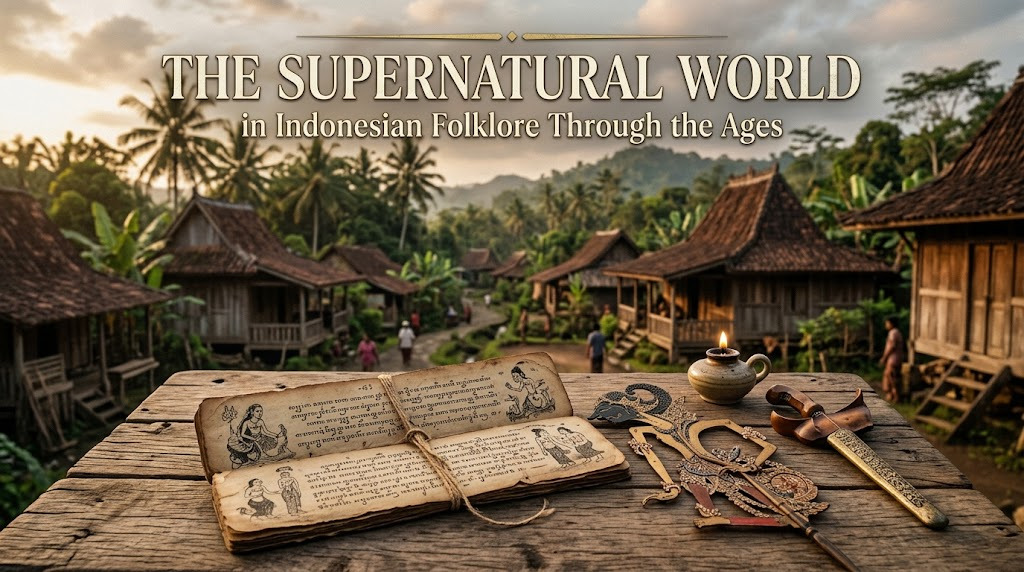
The supernatural world has been an important part of Indonesian folklore for generations. Stories about spirits, mystical creatures, sacred places, and unexplained events have been passed down through oral traditions and later developed through literature and modern media. Because Indonesia consists of many ethnic groups and regions, supernatural stories can have very different forms and meanings. Some stories are connected with moral lessons, ancestral traditions, nature, or community values. Exploring the supernatural world in Indonesian folklore provides an interesting way to understand how cultural beliefs have changed and survived through time.
THE ORIGINS OF SUPERNATURAL STORIES IN INDONESIAN FOLKLORE
Indonesian supernatural folklore developed through long traditions of oral storytelling. Before modern communication became widespread, communities relied heavily on spoken narratives to preserve stories, customs, and explanations about unusual events. Stories about spirits and mysterious beings were often shared by parents, elders, storytellers, and community leaders. These narratives could serve as entertainment while also communicating warnings or social values. As stories moved from one generation to another, their details could change according to local circumstances.
The development of these stories was also influenced by Indonesia's diverse environments. Mountains, forests, rivers, caves, beaches, and villages often became settings for legends involving supernatural beings. Communities could associate certain locations with sacred traditions, unusual events, or stories about invisible forces. This connection between landscape and folklore remains visible in many regional traditions. As a result, Indonesian supernatural folklore cannot be understood as a single uniform belief system.
SUPERNATURAL CREATURES AND REGIONAL LEGENDS
Indonesia has numerous stories about supernatural creatures, and each region can have its own distinctive characters. Some well-known figures in popular culture include kuntilanak, pocong, genderuwo, and wewe gombel. Other traditions contain different beings whose descriptions and roles may be less familiar outside their local communities. These characters can represent danger, fear, morality, death, or unexplained forces. Their stories have continued to evolve as they are retold in different periods.
Regional differences are particularly important when studying Indonesian folklore. A supernatural figure may have a specific meaning in one community but a different interpretation elsewhere. Local culture, language, history, and environment can influence how a legend develops. This diversity demonstrates that Indonesian supernatural beliefs are closely connected with broader cultural identity. It also shows why a single explanation cannot represent every supernatural tradition across the country.
SACRED PLACES AND SUPERNATURAL BELIEFS
Many Indonesian legends connect the supernatural world with particular locations. Old trees, mountains, caves, springs, forests, cemeteries, and other places may be described as sacred or mysterious. Some communities establish traditional rules about how people should behave when entering these locations. Such rules may reflect spiritual beliefs, respect for ancestors, environmental concerns, or community customs. Stories surrounding these places can therefore carry meanings beyond simple horror.
The reputation of a location can become stronger when its story is repeated over many years. Local legends and personal experiences may become closely connected with the identity of a particular place. However, claims about supernatural activity should not automatically be treated as scientifically verified. Natural environmental conditions, human perception, and historical circumstances may provide alternative explanations for some experiences. Understanding both perspectives allows people to appreciate the cultural meaning of mysterious locations without presenting folklore as proven fact.
HOW SUPERNATURAL FOLKLORE CHANGED THROUGH TIME
Indonesian folklore has never remained completely unchanged. As communities experienced social, religious, technological, and cultural changes, traditional stories were also adapted. Characters could receive new appearances, personalities, or origins depending on the storyteller and audience. Oral traditions could gradually develop into written stories, books, theater performances, films, and television programs. This process helped supernatural narratives remain relevant in different periods.
Modern adaptations sometimes make traditional characters very different from their older forms. A folklore figure may become primarily associated with horror entertainment rather than its original cultural meaning. Popular media can simplify or transform complex traditions to make them easier for large audiences to understand. Despite these changes, the basic themes of mystery, fear, morality, and the unknown often remain. This demonstrates the ability of folklore to adapt while preserving recognizable cultural elements.
SUPERNATURAL STORIES IN MODERN INDONESIAN CULTURE
Today, supernatural stories remain highly visible in Indonesian society. Horror movies, television programs, novels, podcasts, social media videos, and online discussions frequently use traditional supernatural themes. Younger audiences can discover legends from regions they may never have visited. Digital platforms have also allowed local storytellers to share regional folklore with wider audiences. This has created new opportunities for traditional stories to remain part of contemporary culture.
At the same time, modern audiences often approach supernatural stories differently from previous generations. Some people treat them as entertainment or cultural heritage, while others continue to connect them with personal beliefs. There are also people who are interested in the stories but prefer scientific or psychological explanations for unusual experiences. These different perspectives can exist within the same society. The variety of interpretations shows that folklore can remain meaningful even when people's beliefs about it change.
PRESERVING FOLKLORE WHILE USING CRITICAL THINKING
Preserving Indonesian folklore does not require every supernatural claim to be presented as factual. Traditional stories can be documented and studied as cultural heritage while their historical and social contexts are explained clearly. Researchers, educators, writers, and content creators can help preserve regional narratives by recording their different versions. This is especially important because oral traditions can disappear when younger generations no longer hear or retell them. Proper documentation can help maintain cultural diversity for the future.
At the same time, critical thinking is important when discussing supernatural experiences. People can respect traditional beliefs while distinguishing between folklore, personal testimony, fictional adaptations, and scientifically verified information. This balanced approach prevents misinformation without unnecessarily dismissing cultural traditions. It also encourages people to explore the origins and meanings of stories rather than simply accepting sensational claims. In this way, cultural preservation and rational inquiry can exist together.
CONCLUSION
The supernatural world in Indonesian folklore has developed through generations of storytelling, regional traditions, environmental experiences, and cultural change. Stories about supernatural creatures, mysterious locations, and unexplained events have become part of Indonesia's rich cultural heritage. Although the details vary between regions, many narratives share themes involving fear, morality, nature, spirituality, and the unknown. Modern media has transformed these stories while helping them reach new audiences. As a result, Indonesian supernatural folklore continues to evolve rather than disappear.
Understanding these traditions requires both cultural appreciation and critical awareness. A folklore story can have historical and social value even when its supernatural elements cannot be scientifically verified. By documenting traditional narratives and examining them from different perspectives, people can preserve cultural heritage without confusing belief with established evidence. The long history of Indonesian supernatural folklore shows how powerful storytelling can be in connecting the past with the present.
About the Author
Gusti Ayu Tita P
Author — STEKOM University
An active author focused on academic issues, educational technology, and human resource development in the campus environment.















