The Values of Bhinneka Tunggal Ika for Building a Harmonious Society
Gusti Ayu Tita P
4 Agustus 2026
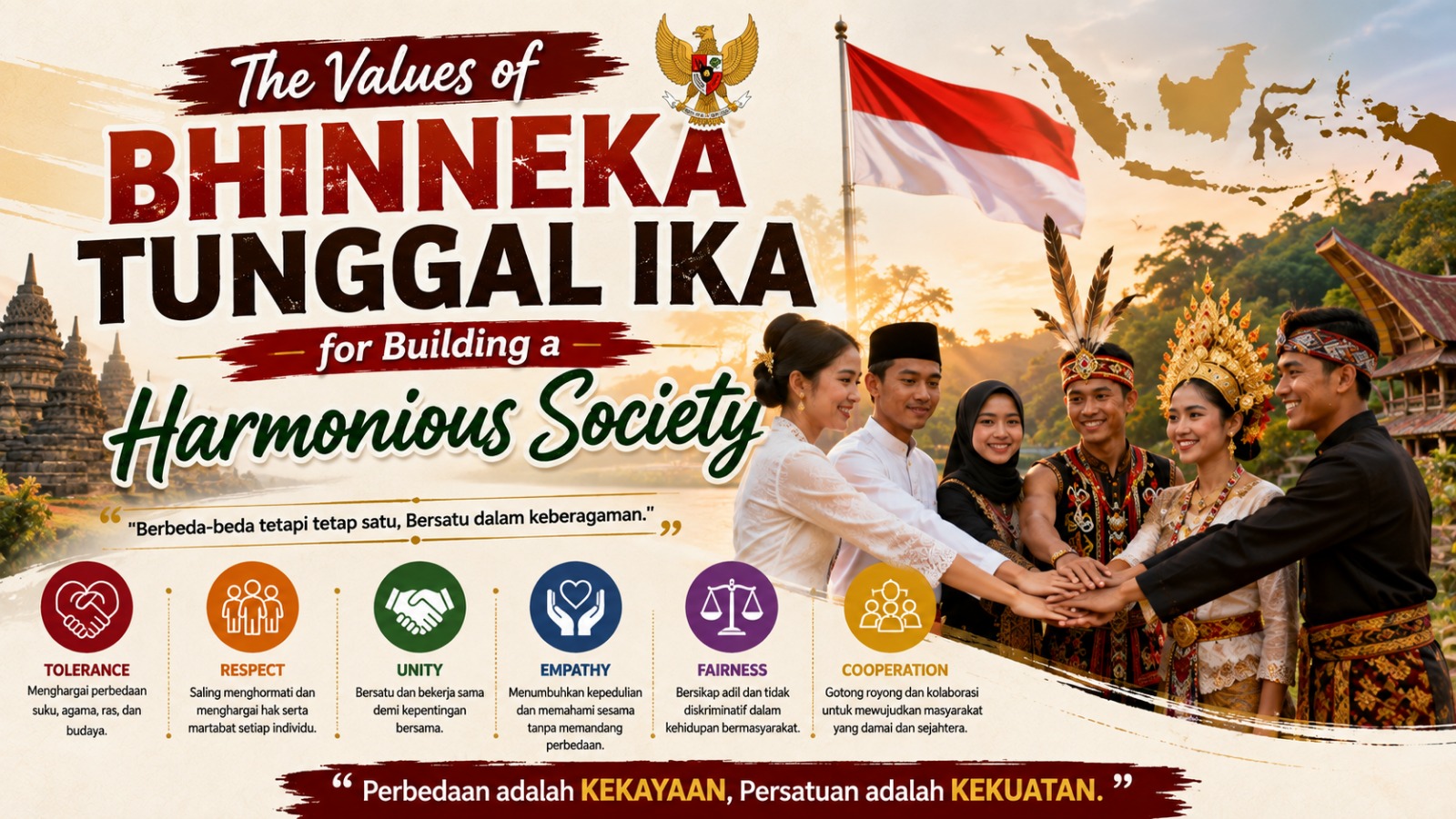
Indonesia is a diverse country with many ethnic groups, religions, languages, traditions, and cultural identities. This diversity is one of Indonesia’s greatest strengths, but it also requires mutual understanding and respect. Bhinneka Tunggal Ika, commonly understood as “Unity in Diversity,” provides an important principle for living peacefully within such differences. Its values encourage people to respect diversity while maintaining a shared sense of unity as one nation.
The values of Bhinneka Tunggal Ika are relevant not only at the national level but also in everyday social life. Tolerance, mutual respect, cooperation, fairness, and responsibility can help create stronger relationships between individuals and communities. When these values are practiced consistently, differences are less likely to become sources of conflict. Instead, diversity can become a foundation for building a peaceful, inclusive, and harmonious society.
THE MEANING OF BHINNEKA TUNGGAL IKA
Bhinneka Tunggal Ika is an Old Javanese phrase commonly translated as “Unity in Diversity” or “Different but One.” The phrase is associated with the Kakawin Sutasoma, a literary work from the Majapahit period attributed to Mpu Tantular. It was later adopted as Indonesia’s national motto and appears on the scroll held by the Garuda Pancasila. Its meaning reflects Indonesia’s reality as a nation made up of many different communities.
The principle does not mean that everyone must have the same culture, religion, language, or way of life. Instead, it emphasizes that differences can exist within a broader national unity. Every community can maintain its identity while respecting the rights and dignity of others. This understanding is essential for creating social relationships based on acceptance rather than exclusion.
TOLERANCE AS A FOUNDATION OF HARMONY
Tolerance is one of the most important values in building a harmonious society. Indonesia has communities with different religious beliefs, cultural traditions, ethnic backgrounds, and social experiences. Tolerance encourages people to respect these differences without forcing others to follow their own beliefs or customs. It can also reduce prejudice and prevent disagreements from developing into serious conflicts.
Tolerance can be practiced through simple actions in daily life. People can respect different religious practices, listen to opinions they do not share, and avoid making negative judgments based on someone’s background. These behaviors create a safer environment for everyone. When tolerance becomes a social habit, diversity can strengthen relationships rather than separate communities.
MUTUAL RESPECT AMONG DIFFERENT COMMUNITIES
Mutual respect is another important value of Bhinneka Tunggal Ika. Every person has a different background, experience, culture, and perspective. Respect means recognizing these differences without treating one group as more valuable than another. It encourages people to communicate with courtesy and recognize the rights of others.
Respect also makes it easier for people to interact in diverse environments. Students, employees, neighbors, and community members often work with people who have different identities and viewpoints. Listening carefully and avoiding offensive language can prevent unnecessary misunderstandings. When mutual respect is practiced consistently, social relationships become stronger and more harmonious.
GOTONG ROYONG AND SOCIAL COOPERATION
Gotong royong, or mutual cooperation, is an important Indonesian social value that supports the spirit of Bhinneka Tunggal Ika. It encourages people to work together to achieve shared goals despite their differences. Community cleanups, social activities, disaster assistance, and neighborhood programs are examples of cooperation that can bring people together. These activities create opportunities for individuals from different backgrounds to build trust.
Cooperation also reminds people that shared interests can be more important than personal differences. When communities work together, people learn to appreciate each other’s strengths and contributions. Regular cooperation can reduce social distance and increase a sense of belonging. In this way, gotong royong can help transform diversity into a source of solidarity.
FAIRNESS AND EQUALITY IN SOCIAL LIFE
A harmonious society requires fair treatment for everyone. Differences in ethnicity, religion, culture, gender, economic background, or social status should not become reasons for discrimination. Bhinneka Tunggal Ika supports the idea that diversity should exist alongside respect for human dignity and equal rights. Fair treatment helps create trust between individuals and communities.
Equality can be promoted by providing people with fair opportunities to participate in education, employment, community activities, and public life. Everyone should have the opportunity to contribute according to their abilities. When people feel respected and treated fairly, social tensions can be reduced. This creates a stronger foundation for peaceful relationships and national unity.
THE ROLE OF YOUNG PEOPLE IN BUILDING HARMONY
Young people have an important role in applying Bhinneka Tunggal Ika in modern society. They interact with people from different backgrounds through education, communities, workplaces, and digital platforms. By building friendships without discrimination, young people can demonstrate that differences do not prevent cooperation. They can also explore Indonesia’s cultural diversity through art, education, community activities, and cultural events.
Young people can also use technology to promote positive messages about diversity. They can create educational content about local traditions, introduce regional cultures, and encourage respectful communication online. At the same time, they need to avoid spreading misinformation and hateful content targeting certain groups. Responsible digital behavior can help young people become important contributors to a more harmonious society.
APPLYING BHINNEKA TUNGGAL IKA IN THE DIGITAL ERA
Technology has made communication faster and connected people from different regions and backgrounds. This creates opportunities for Indonesians to learn about cultures and perspectives that they may not encounter in everyday life. However, social media can also spread misinformation, stereotypes, and provocative content. Therefore, the values of Bhinneka Tunggal Ika remain important in digital communication.
Applying these values online means thinking carefully before posting or sharing information. Users should check information, respect different opinions, and avoid content that humiliates or attacks particular communities. Disagreements should be handled through constructive discussion instead of insults or harassment. If used responsibly, digital platforms can become spaces for cultural exchange, education, and stronger social connections.
EDUCATION AS A WAY TO STRENGTHEN HARMONY
Education plays an important role in developing an understanding of diversity from an early age. Schools and universities can teach students about different Indonesian cultures, histories, traditions, and social experiences. This knowledge helps students recognize that diversity is a normal and valuable part of national life. It can also develop empathy and encourage students to interact respectfully with others.
Educational institutions can strengthen these values through group projects, cultural programs, discussions, and community service. Activities involving students from different backgrounds can provide direct experience of cooperation and mutual respect. Such experiences can reduce stereotypes and improve communication. As a result, education can help prepare young people to build harmonious communities in the future.
CONCLUSION
The values of Bhinneka Tunggal Ika provide an important foundation for building a harmonious Indonesian society. Tolerance, mutual respect, cooperation, fairness, and equality help people live together despite differences in identity and background. These values encourage society to view diversity as a strength rather than a reason for division. When applied consistently, they can support peaceful relationships and strengthen national unity.
Building a harmonious society requires participation from everyone. Families, schools, universities, communities, young people, and public institutions can contribute by promoting respect and rejecting discrimination. Bhinneka Tunggal Ika becomes meaningful when its values are practiced through everyday actions, not simply remembered as a national motto. By protecting diversity and strengthening cooperation, Indonesians can build a more peaceful, inclusive, and united society.
About the Author
Gusti Ayu Tita P
Author — STEKOM University
An active author focused on academic issues, educational technology, and human resource development in the campus environment.