Tips for Documenting Historic Tombs for Educational and Research Purposes
Gusti Ayu Tita P
4 September 2026
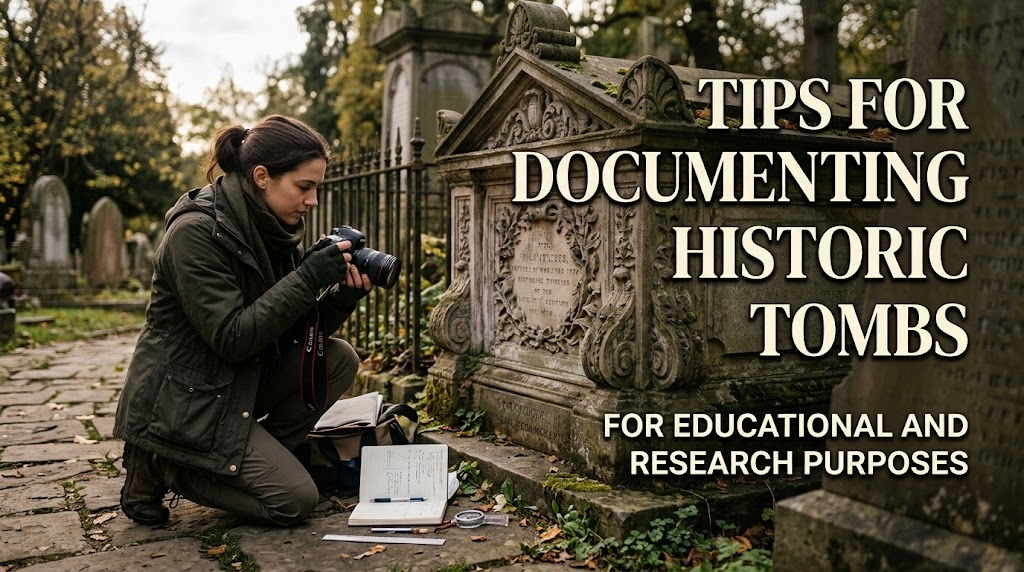
Documenting historic tombs is an important activity for education, historical research, and heritage preservation. Good documentation creates a reliable record of a site's condition, architecture, inscriptions, and surrounding environment. The information can help researchers study the past while allowing students and the public to understand the site's significance. Documentation should always be conducted carefully and respectfully because tombs can have cultural, religious, and ethical importance.
DETERMINING THE PURPOSE OF DOCUMENTATION
Before documenting a historic tomb, researchers should clearly establish the purpose of the documentation. The goal may be to support academic research, record the condition of a heritage site, create educational materials, or develop a digital archive. A clear purpose helps determine what information needs to be collected.
The documentation plan should also consider the sensitivity of the site. Some areas may have restrictions because they contain human remains, sacred objects, or culturally sensitive materials. Researchers should follow relevant regulations and obtain permission when required before beginning their work.
RECORDING BASIC INFORMATION
The first stage is to record basic information about the tomb and its location. Important details can include the site name, location, date of documentation, historical association, visible condition, and surrounding environment. Accurate records make it easier to identify and compare the site in future research.
Researchers should use consistent formats when collecting information. Notes should be clear, factual, and separated from personal opinions or assumptions. Recording the information systematically helps create reliable historical documentation that can be reviewed by other researchers.
USING PHOTOGRAPHY EFFECTIVELY
Photography is one of the simplest methods for documenting historic tombs. Researchers can photograph the overall structure, architectural details, inscriptions, decorative elements, entrances, surrounding areas, and visible damage. Taking photographs from different angles can provide a more complete visual record.
Photographs should be accompanied by useful information such as the date, location, direction, and subject being recorded. Researchers should avoid unnecessary physical contact with the tomb while taking photographs. If photography restrictions exist, they should always be followed to maintain responsible heritage research.
DOCUMENTING INSCRIPTIONS AND ARCHITECTURAL FEATURES
Inscriptions can contain valuable information about names, dates, titles, languages, religious beliefs, and historical events. Researchers should record them carefully through permitted photography, written transcription, measurements, or other appropriate methods. Difficult or damaged inscriptions should not be altered simply to make them easier to read.
Architectural features should also be described in detail. Researchers can document building materials, dimensions, decorative patterns, structural forms, and evidence of repairs or deterioration. These observations can support archaeological research and help identify changes to the site over time.
USING DIGITAL TECHNOLOGY FOR DOCUMENTATION
Modern technology can improve the accuracy and accessibility of historic tomb documentation. Digital cameras, GPS, geographic information systems, 3D scanning, and digital databases can capture information in organized formats. Depending on the site's needs and available resources, these technologies can create detailed records without requiring physical intervention.
Three-dimensional documentation can be particularly useful for recording complex structures and architectural details. Digital files can also support virtual learning, academic research, conservation planning, and online exhibitions. However, digital documentation should complement rather than replace appropriate physical conservation.
STORING AND SHARING DOCUMENTATION RESPONSIBLY
Collected information should be stored in a secure and organized system. Researchers should maintain backup copies, clear file names, accurate metadata, and consistent documentation records. This reduces the risk of losing important information and makes future research easier.
When documentation is shared publicly, researchers should consider cultural sensitivity and applicable regulations. Not every photograph, location detail, or research finding needs to be published without restriction. Responsible sharing protects both the heritage site and the communities connected to it.
CONCLUSION
Documenting historic tombs requires careful planning, accurate observation, appropriate technology, and respect for cultural values. Photography, written records, inscriptions, architectural descriptions, mapping, and digital tools can create useful records for education and research. The collected information should be stored securely and shared responsibly. Through proper documentation, important evidence about historic tombs can be preserved and made useful for future generations without causing unnecessary harm to the original site.
About the Author
Gusti Ayu Tita P
Author — STEKOM University
An active author focused on academic issues, educational technology, and human resource development in the campus environment.