TKA Is More Than A Grade, So How Does The Way You Answer Matter?
Gusti Ayu Tita P
13 Agustus 2026
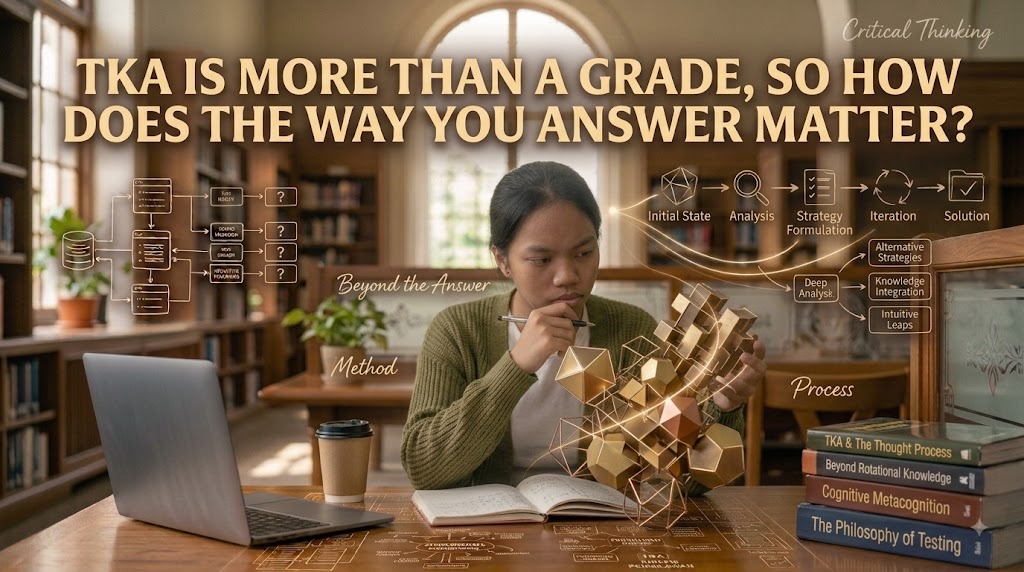
The TKA or Academic Competency Test is more than a number that appears after an examination. The way students answer questions can show how well they understand concepts, analyze information, and apply their knowledge. A student may know many facts, but effective performance also depends on the ability to use that knowledge appropriately. The process of thinking behind an answer can be just as important as reaching the correct answer.
This is why TKA preparation should not focus entirely on memorization. Students need to develop critical thinking, problem solving, analytical skills, and careful reading habits. These abilities can help them understand questions more accurately and make better decisions. Preparing in this way can also make students more confident when facing unfamiliar problems.
WHY TKA IS MORE THAN A GRADE
A TKA result can provide information about a student's academic competency, but a score does not describe every aspect of a student's abilities. The preparation process can help students develop habits that are useful beyond the examination. Understanding concepts and applying them to different situations can strengthen academic skills. The value of TKA preparation extends beyond the final number.
Students can use what they learn during preparation in future academic situations. They may need to analyze information, solve problems, and explain their reasoning in higher education. These skills are also relevant to many professional environments. A strong learning process can create benefits that continue after the test is finished.
HOW THE WAY STUDENTS ANSWER MATTERS
The way students approach a question can affect the quality of their answers. Students should first understand what the question is asking before choosing an option. They may need to identify relevant information, recognize relationships, and determine which concept applies. Careful reasoning can reduce mistakes caused by rushing or guessing.
Students should also avoid choosing answers simply because they look familiar. An option may contain information that seems correct but does not actually answer the question. Comparing the choices with the information provided can lead to better decisions. Effective answering requires attention, reasoning, and evidence.
UNDERSTANDING THE QUESTION BEFORE ANSWERING
Reading a question carefully is one of the simplest but most important TKA strategies. Students need to identify the main task and understand what the question expects. Words such as explain, compare, determine, identify, or calculate can indicate the type of response required. Understanding the task is the first step toward finding the right solution.
Students should also pay attention to important details and relationships. Long questions may contain information that is useful as well as information that is less relevant. Learning to separate these details can make questions easier to solve. Good reading skills support better reasoning and decision making.
EVALUATING ANSWER OPTIONS
Sometimes students encounter multiple options that appear reasonable. In this situation, they should compare each option with the information provided in the question. The strongest answer is usually the one that best matches the evidence and requirements of the question. Evaluation helps students avoid choosing an answer based only on familiarity.
Students can also eliminate options that are clearly inconsistent with the problem. Each elimination should have a logical reason rather than being random. This process can reduce the number of possibilities and make the final decision easier. Systematic evaluation is more reliable than guessing.
AVOIDING CARELESS MISTAKES
Not every incorrect answer comes from a lack of knowledge. Some mistakes happen because students read too quickly, overlook important details, misunderstand instructions, or make simple calculation errors. Careful reading and checking can prevent many avoidable mistakes.
Students can develop a habit of reviewing their answers when time allows. They should check whether the selected answer directly responds to the question. In calculation-based questions, they can also review important steps. A short final check can sometimes make a significant difference in accuracy.
LEARNING FROM WRONG ANSWERS
Wrong answers can provide valuable information about a student's learning process. Students should determine whether the mistake came from a lack of knowledge, misunderstanding, incorrect reasoning, or careless reading. This approach is more useful than simply memorizing the correct answer. Error analysis can reveal areas that need improvement.
Students can keep a simple record of their mistakes during practice. They can write down the topic, the reason for the mistake, and the correct approach. Reviewing this record regularly can help them recognize repeated problems. Mistakes become useful feedback when students learn from them.
MANAGING TIME WITHOUT SACRIFICING ACCURACY
Good answers require both careful thinking and effective time management. Students cannot spend too much time on one difficult question because other questions also need attention. They should learn to recognize when a question requires more time and when it is better to move forward temporarily. Efficient answering balances accuracy with speed.
Timed practice can help students develop this balance. Students can practice answering questions within a reasonable time while maintaining careful reading and reasoning. If necessary, they can return to difficult questions later. Time management allows students to use their thinking skills more effectively during the test.
HOW TO PREPARE FOR TKA EFFECTIVELY
TKA preparation should begin with a strong understanding of fundamental concepts. Students can then practice applying those concepts through different question formats. They should review their answers and analyze mistakes instead of focusing only on their score. Preparation should develop both knowledge and thinking skills.
Active recall, practice tests, discussion, and error analysis can make studying more effective. Students can also explain difficult concepts in their own words to check their understanding. Regular practice helps make careful reasoning a natural part of answering questions. Consistent preparation is generally more effective than relying only on last minute memorization.
WHY ANSWERING SKILLS MATTER BEYOND TKA
The ability to understand questions and make logical decisions is useful beyond academic testing. Students use these skills when evaluating information, making choices, solving everyday problems, and communicating ideas. Good reasoning is a life skill as well as an academic skill.
In higher education and professional environments, people often face unfamiliar problems. They need to understand information, evaluate alternatives, and choose appropriate solutions. Therefore, the habits developed while preparing for TKA can remain useful in future situations. Learning how to think carefully can provide long term benefits.
CONCLUSION
TKA is more than a grade because the preparation and answering process can develop conceptual understanding, critical thinking, problem solving, analytical skills, and decision making. The way students answer matters because they need to understand questions, identify relevant information, evaluate choices, and apply the right concepts. A correct answer becomes more meaningful when it comes from a clear and logical reasoning process.
Students should therefore focus on understanding concepts rather than memorizing answer patterns. Regular practice, careful reading, error analysis, and time management can improve the quality of their preparation. By learning how to approach questions thoughtfully, students can become more confident during TKA and develop academic skills that remain valuable beyond the examination.
About the Author
Gusti Ayu Tita P
Author — STEKOM University
An active author focused on academic issues, educational technology, and human resource development in the campus environment.