Types of Ships and Their Functions You Should Know
Gusti Ayu Tita P
11 Agustus 2026
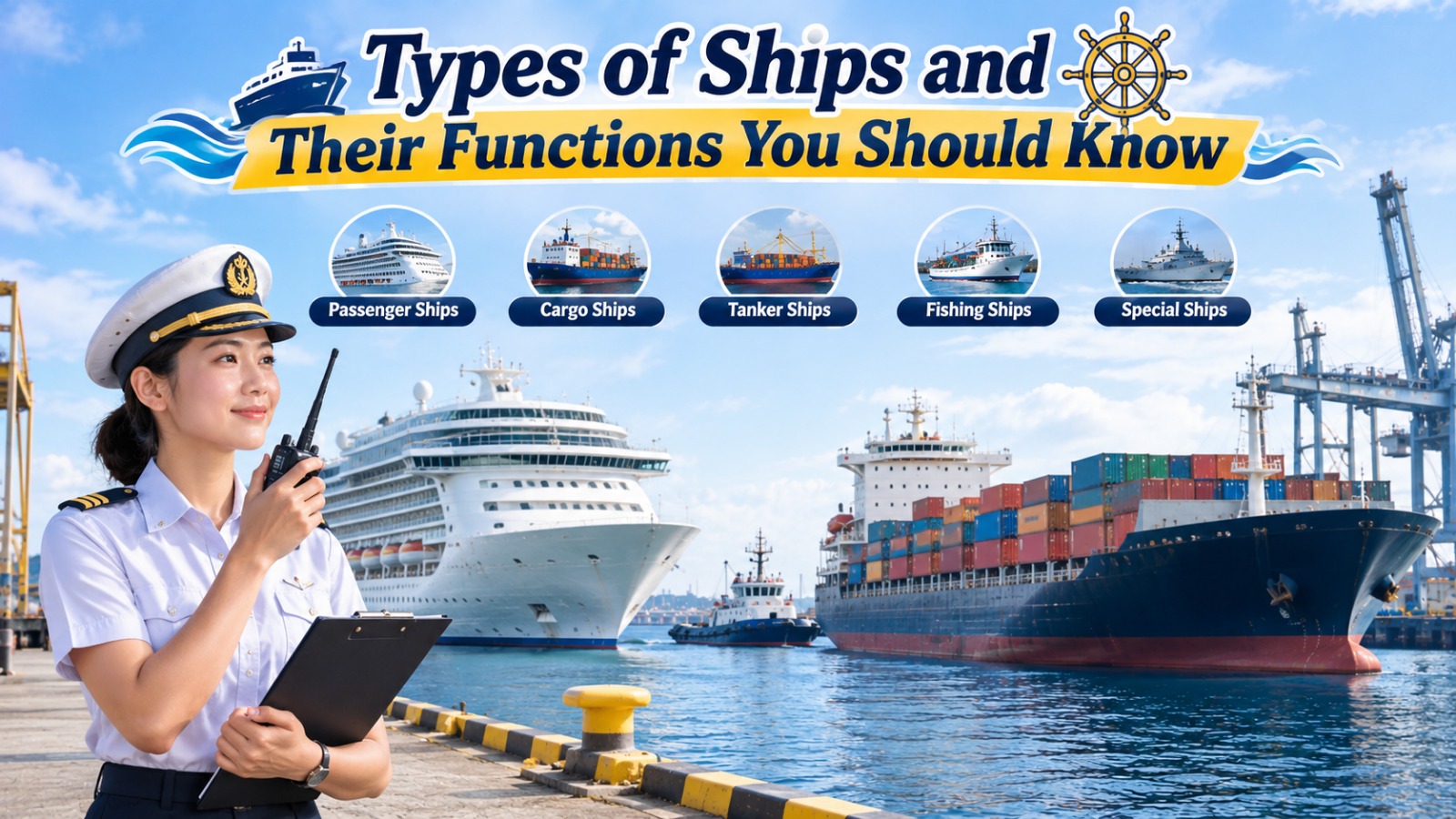
Ships are an important part of maritime transportation and play different roles in modern life. Some ships are designed to carry passengers, while others transport large quantities of cargo, fuel, vehicles, or special equipment. Their size, shape, equipment, and operating systems are generally adapted to the specific tasks they perform.
Understanding the types of ships and their functions can help passengers, students, business owners, and anyone interested in the maritime industry recognize how vessels support transportation and global trade. Each ship has unique characteristics that allow it to operate efficiently in different situations.
WHAT ARE SHIP TYPES?
Ship types are generally classified according to their function, cargo, size, design, and operating environment. A vessel used to transport people requires different facilities from a ship designed to carry petroleum or heavy machinery. This is why ships can have very different structures even though they all operate on water.
Some vessels are built for commercial transportation, while others are used for fishing, research, rescue, construction, or government operations. Choosing the right ship design is important because the vessel must be able to perform its intended task safely and efficiently.
PASSENGER SHIPS
Passenger ships are vessels specifically designed to transport people between different destinations. They may operate on short routes, such as between nearby islands, or travel long distances across seas and oceans. Depending on their purpose, passenger ships can include seating areas, cabins, restaurants, restrooms, entertainment facilities, and emergency equipment.
Ferries are one of the most common passenger vessels and are widely used to connect islands and coastal communities. Cruise ships are another type of passenger vessel, but their primary purpose is usually recreation and tourism rather than simply transportation. Both types require appropriate safety systems and facilities to accommodate passengers during their journeys.
CONTAINER SHIPS
Container ships are specially designed to carry standardized shipping containers. These containers can hold products such as electronics, clothing, food products, machinery, and other manufactured goods. Their standardized dimensions make it easier to transfer cargo between ships, trucks, and trains.
Large container ships can carry thousands of containers on a single voyage. They are therefore essential to international trade and global supply chains. Efficient container transportation allows businesses to move products between countries in large quantities and supports the distribution of goods around the world.
BULK CARRIERS
Bulk carriers transport large quantities of unpackaged dry cargo. Common cargo includes coal, grain, iron ore, cement, and other raw materials. Instead of placing these materials inside individual shipping containers, they are loaded directly into large cargo holds.
The design of a bulk carrier allows it to carry heavy materials efficiently. These vessels are particularly important for industries that require large volumes of raw materials. Their operation supports construction, manufacturing, energy production, agriculture, and other major economic sectors.
TANKER SHIPS
Tanker ships are designed to transport liquid cargo in large quantities. Depending on their purpose, tankers may carry crude oil, refined petroleum products, chemicals, or other liquids. Their cargo tanks are designed to store liquids securely during transportation.
Oil tankers are especially important to the global energy supply chain. Chemical tankers require additional safety measures because some chemical substances may be hazardous. Proper cargo handling, tank maintenance, and safety procedures are essential when operating these vessels.
GAS CARRIERS
Gas carriers are specialized ships designed to transport liquefied gases. Examples include liquefied natural gas and liquefied petroleum gas. These substances require controlled conditions because they may need to be stored at very low temperatures or under specific pressure conditions.
The design of a gas carrier includes specialized storage tanks and safety systems. Temperature and pressure control are particularly important during transportation. These ships support the international energy industry by allowing gas resources to be transported between production areas and consumer markets.
RO RO SHIPS
Ro Ro ships, short for Roll on Roll off, are designed to transport wheeled cargo. Vehicles such as cars, trucks, buses, trailers, and specialized machinery can be driven directly onto the vessel through ramps. This makes loading and unloading faster compared with some traditional cargo-handling methods.
Vehicle carriers are commonly used by the automotive industry. Their internal decks are arranged to maximize available space while protecting vehicles during transportation. Ro Ro transportation is especially useful when large numbers of vehicles need to be moved between countries or regions.
CRUISE SHIPS
Cruise ships are large passenger vessels designed primarily for tourism and recreation. Unlike regular ferries, cruise ships often function as floating resorts, providing passengers with accommodation and various entertainment facilities. They may include restaurants, swimming pools, theaters, fitness centers, shops, and recreational areas.
Cruise ships usually visit multiple destinations during a journey. Their operations combine transportation, hospitality, and tourism services. Because they carry many passengers, safety management and emergency preparedness are major priorities.
FISHING VESSELS
Fishing vessels are ships or boats designed to support commercial and industrial fishing activities. Their equipment depends on the fishing method and the type of marine species being targeted. Some vessels are relatively small, while large fishing vessels may include refrigeration and processing facilities.
Fishing vessels contribute to the seafood supply chain by catching, storing, and sometimes processing fish at sea. Modern fishing equipment can include navigation technology, fish-finding systems, refrigeration units, and specialized nets. Responsible fishing practices are important to help protect marine ecosystems and fish populations.
RESEARCH AND SURVEY SHIPS
Research ships are designed to support scientific studies and marine exploration. Scientists can use these vessels to study ocean temperatures, marine life, seabed conditions, weather patterns, and other aspects of the marine environment. Some research vessels also support geological and environmental surveys.
These ships often contain laboratories and specialized scientific equipment. Their missions can provide valuable information for ocean research, climate studies, marine biology, and environmental monitoring. The information collected can help researchers better understand changes occurring in oceans and coastal areas.
OFFSHORE SUPPORT VESSELS
Offshore support vessels provide assistance to activities taking place far from shore. They can transport workers, equipment, fuel, and supplies to offshore platforms and other marine facilities. Some vessels are also designed to support construction, maintenance, or specialized offshore operations.
These vessels are important in industries such as offshore energy and marine construction. Their designs can vary significantly depending on the specific task. Strong positioning systems and reliable equipment are often necessary because offshore operations can take place in challenging marine conditions.
RESCUE AND EMERGENCY VESSELS
Rescue vessels are designed to respond to maritime emergencies. They may assist ships experiencing mechanical problems, accidents, medical emergencies, or other dangerous situations. Some are operated by coast guards, emergency services, port authorities, or specialized organizations.
These vessels often carry rescue equipment, communication systems, medical supplies, and trained personnel. Fast response is critical during an emergency at sea. Search and rescue operations can help protect passengers, crew members, and other people in maritime environments.
MILITARY AND DEFENSE SHIPS
Military ships are designed to support national defense and security operations. Examples include patrol vessels, frigates, destroyers, amphibious ships, and aircraft carriers. Their functions can include surveillance, transportation, maritime security, and other defense-related missions.
These ships often use sophisticated communication, navigation, and detection systems. Their design depends heavily on the specific operational requirements of the navy or defense organization. Military vessels are different from commercial ships because their primary purpose is related to security and defense rather than commercial transportation.
HOW DO DIFFERENT SHIPS SUPPORT MODERN TRANSPORTATION?
Different types of ships work together to support the broader maritime transportation system. Container ships move manufactured products, tankers transport energy resources, passenger ships connect communities, and specialized vessels support industries operating at sea. Each vessel fills a particular role within the transportation network.
Ports also play an important role because ships need facilities for loading, unloading, refueling, maintenance, and passenger services. The combination of ships, ports, logistics systems, and land transportation creates an interconnected supply chain. This system allows goods and people to move efficiently across regions and countries.
CONCLUSION
There are many types of ships, and each one is designed to perform a specific function. Passenger ships transport people, container ships carry packaged goods, bulk carriers move raw materials, while tankers transport liquids and specialized vessels support research, rescue, fishing, and offshore activities.
Understanding these different vessels helps explain why ships remain essential to global trade and maritime transportation. As technology develops, ship designs and onboard systems will continue to improve. More efficient, safer, and environmentally responsible vessels will play an important role in the future of transportation.
About the Author
Gusti Ayu Tita P
Author — STEKOM University
An active author focused on academic issues, educational technology, and human resource development in the campus environment.