
Understanding the Difference Between a Cabinet and Ministries
Gusti Ayu Tita P
12 Agustus 2026
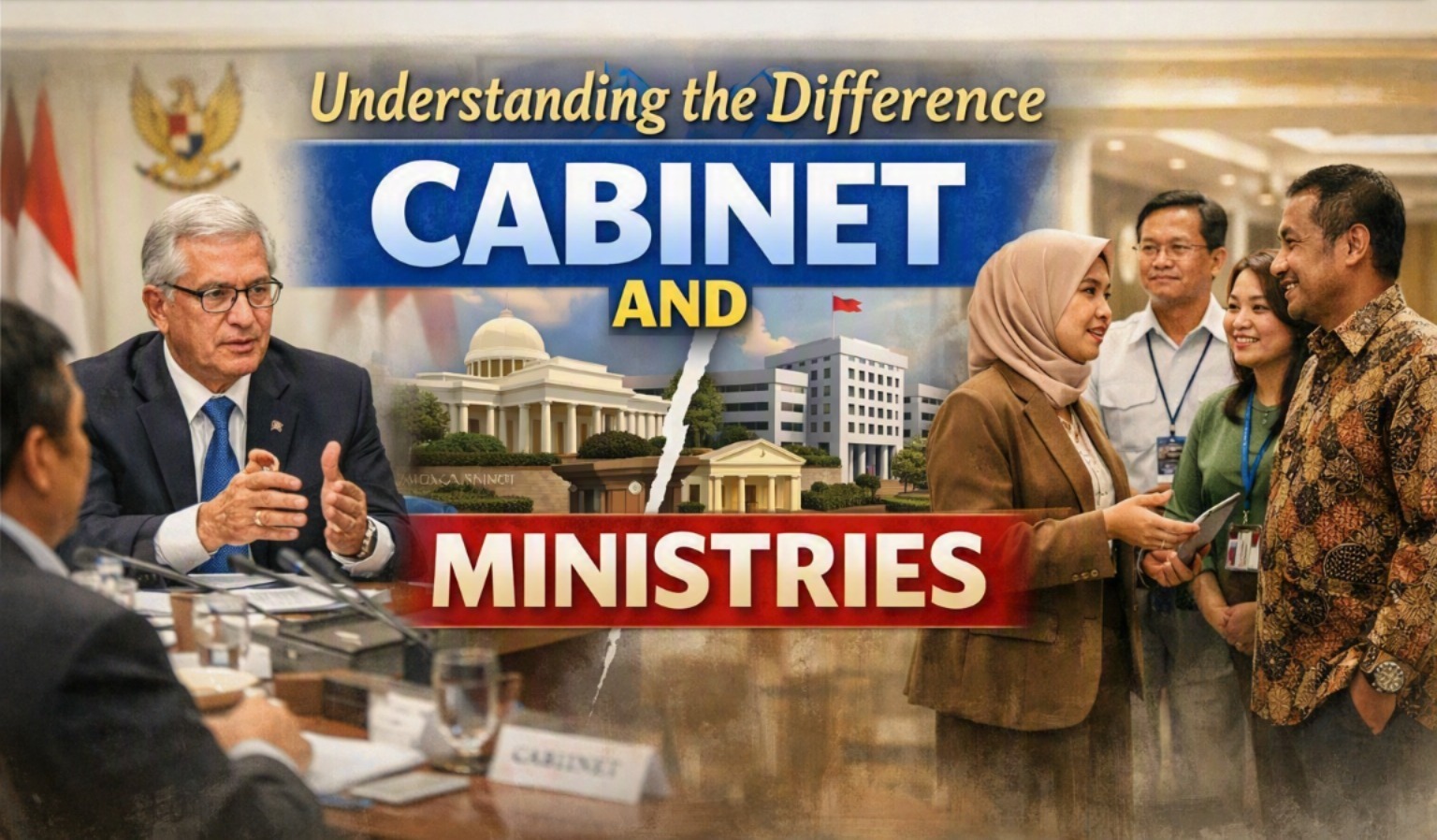
A government has many institutions that work together to manage public affairs and provide services to citizens. Two terms that are often mentioned in discussions about government are the cabinet and ministries. Although they are closely connected, they do not refer to the same thing. A cabinet generally consists of senior government ministers who help the head of government make major decisions, while ministries are government departments responsible for specific areas of public policy and administration. Understanding this difference can make it easier to understand how a government is organized and how public decisions are implemented.
WHAT IS A CABINET?
A cabinet is a group of senior government officials, usually ministers, who work closely with the president or prime minister. Its main purpose is to discuss important national issues and coordinate government policies across different areas. Cabinet members may represent different ministries, but they work collectively when dealing with major government priorities. The cabinet can therefore be viewed as a central forum for high level government coordination and decision making. Its exact powers and structure depend on the constitution and political system of each country.
Cabinet meetings can cover matters such as economic policy, national development, public security, education, health, foreign affairs, and other strategic issues. Ministers bring information and recommendations from their respective ministries to these discussions. The head of government usually provides overall direction and may use the cabinet to coordinate policies that involve several ministries. This helps prevent government institutions from working in isolation. In many systems, cabinet decisions provide broad political direction that ministries later help implement.
WHAT ARE MINISTRIES?
A ministry is a government department that focuses on a particular area of public administration. Examples can include ministries responsible for finance, education, health, transportation, foreign affairs, or defense. Each ministry normally has a minister who provides political leadership and works with professional civil servants and other government officials. The ministry is responsible for developing policies, managing programs, and carrying out government functions within its assigned area. Its responsibilities are generally defined by laws, regulations, or the country's governmental structure.
Ministries have a more specialized role than the cabinet. For example, a finance ministry may focus on public spending, taxation, and fiscal policy, while an education ministry may focus on schools, educational standards, and national education programs. Ministries also collect information, prepare policy proposals, manage public resources, and provide services or regulatory functions. Their work allows broad government priorities to be translated into specific policies and practical programs. In this way, ministries are essential to the daily operation of government.
KEY DIFFERENCES BETWEEN A CABINET AND MINISTRIES
The most important difference is their scope and function. A cabinet is primarily a collective body that brings senior ministers together to coordinate national policies and support major government decisions. A ministry, by contrast, is an administrative institution that concentrates on a particular sector or policy area. The cabinet deals with issues from a broader government perspective, while ministries handle more specialized responsibilities. Therefore, the cabinet and ministries are connected but serve different purposes.
Another difference concerns coordination and implementation. The cabinet can help establish common priorities and resolve issues that involve several government departments. Ministries then develop detailed policies, programs, regulations, and administrative actions within their respective responsibilities. For example, a national economic strategy may require cooperation between the finance, trade, labor, and industry ministries. The cabinet can provide overall coordination, while each ministry contributes according to its expertise. This relationship allows the government to combine strategic leadership with specialized administration.
HOW THE CABINET AND MINISTRIES WORK TOGETHER?
The cabinet and ministries normally operate as parts of the same government system rather than as separate institutions. A government may establish a national priority, and the cabinet can coordinate the overall approach to achieving it. Individual ministries then create and implement programs that support that priority. Ministers play an important connecting role because they participate in cabinet discussions while also leading their respective ministries. This creates a link between high level government decisions and administrative implementation.
Cooperation becomes especially important when a policy involves several sectors. A plan to improve public transportation, for instance, may require transportation authorities to work with finance, environment, infrastructure, and local government institutions. The cabinet can help coordinate these interests and provide political direction. Ministries can then handle their specific responsibilities, such as budgeting, infrastructure planning, environmental standards, or transportation regulations. Effective cooperation between the two levels can make government policies more consistent, efficient, and responsive to public needs.
WHY THE DIFFERENCE MATTERS?
Understanding the distinction between a cabinet and ministries helps citizens understand who makes decisions and who carries out government responsibilities. When a major national policy is announced, the cabinet may have been involved in setting its overall direction. However, the detailed work of preparing regulations, managing programs, and delivering services is usually handled through ministries and other government agencies. Knowing these different roles can make government structures easier to understand. It also helps people identify which institution may be responsible for a particular public issue.
The distinction is also important for government accountability. Ministers can have both a collective role in cabinet and an individual leadership role within their ministries, depending on the country's political system. Ministries are expected to operate according to laws, regulations, budgets, and established administrative procedures. The cabinet, meanwhile, provides a mechanism for senior government leaders to coordinate policies and address national priorities. Together, these structures support a system in which political leadership, policy coordination, and public administration can work toward common goals.
CABINET AND MINISTRIES IN DIFFERENT COUNTRIES
The exact meaning and authority of a cabinet or ministry can vary between countries. In a parliamentary system, such as the United Kingdom, the cabinet is closely connected to the prime minister and the governing political leadership. In a presidential system, such as the United States, the president's cabinet consists of senior officials who lead executive departments and advise the president, although the constitutional structure differs from parliamentary governments. Other countries may use different titles, organizational arrangements, or procedures. Therefore, the general distinction is useful, but the precise powers of cabinets and ministries should always be understood within the country's legal and constitutional framework.
Some countries may also have government departments that do not use the word ministry in their official names. Similarly, not every senior government official necessarily has identical cabinet status. The composition of a cabinet can change because of elections, appointments, resignations, or government reorganizations. Ministries can also be merged, divided, renamed, or given new responsibilities. These differences show that government structures are shaped by each country's constitution, laws, political traditions, and administrative needs.
CONCLUSION
The cabinet and ministries are closely related but have different roles in government. The cabinet generally serves as a collective forum for senior government leaders to coordinate policies and address major national priorities. Ministries are specialized government departments that develop and implement policies within particular sectors. The cabinet therefore focuses more on broad coordination and strategic direction, while ministries concentrate on specialized administration and implementation.
Understanding this relationship makes it easier to see how government decisions move from national priorities to practical action. Although structures differ from one country to another, the basic distinction remains useful for understanding public administration. A well coordinated cabinet can help create consistent government policies, while capable ministries provide the expertise and administrative capacity needed to put those policies into practice. Together, they form important parts of an effective government system.
About the Author
Gusti Ayu Tita P
Author — STEKOM University
An active author focused on academic issues, educational technology, and human resource development in the campus environment.















