
Understanding the Functions of Ministers in Government
Gusti Ayu Tita P
12 Agustus 2026
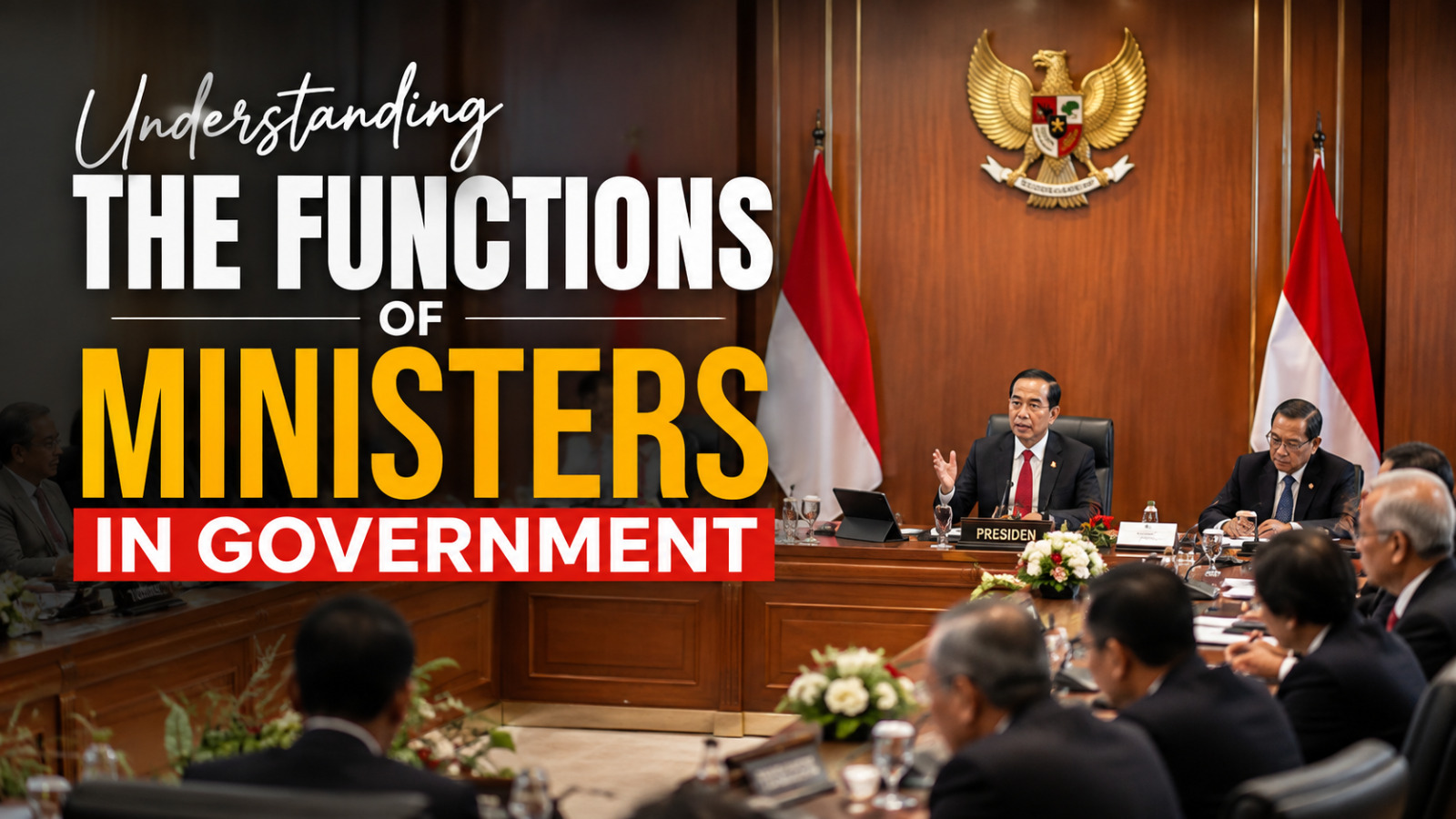
Ministers have an important function in Indonesia’s government because they assist the President in managing specific areas of national administration. Each minister leads a ministry with responsibilities based on the government affairs assigned to it. The functions of ministers include developing policies, implementing government programs, coordinating activities, and supervising their execution. These functions help ensure that government responsibilities are divided and managed systematically. Understanding these functions provides a clearer picture of how ministries contribute to the operation of government.
POLICY FORMULATION
One of the main functions of a minister is helping formulate policies within the ministry’s area of responsibility. Policies provide direction for government programs and activities. Effective policies should consider public needs, available data, legal requirements, and national priorities. Ministers work with officials and relevant institutions to develop policies that can address issues in their respective sectors.
Policy formulation also requires an understanding of changing conditions. Economic, social, technological, and public needs can influence government priorities. Ministers may use research, data, evaluations, and recommendations as references when developing policies. This process helps ensure that government decisions are based on relevant information rather than assumptions.
POLICY IMPLEMENTATION
A policy cannot achieve its purpose unless it is properly implemented. Ministers direct their ministries to turn policies into programs, activities, and services that can be carried out in practice. Implementation requires clear objectives, appropriate resources, responsible personnel, and effective management. Ministers therefore have an important role in ensuring that policies move from planning to actual execution.
During implementation, ministries may need to work with regional governments and other public institutions. Some programs also require coordination across different sectors. Ministers help establish the direction and framework for cooperation so that activities remain consistent with government objectives. Monitoring implementation allows ministries to identify difficulties and respond to them appropriately.
COORDINATION AND LEADERSHIP
Government affairs are often interconnected, meaning that one ministry may depend on or cooperate with another. Ministers therefore have a coordination function that helps align programs and responsibilities. Good coordination can reduce overlapping duties and improve cooperation between government institutions. Ministers also provide leadership to officials and organizational units within their ministries.
Leadership involves communicating priorities, assigning responsibilities, and ensuring that government employees understand their roles. Ministers need to maintain coordination within the ministry as well as with external institutions when necessary. Effective leadership can help an organization respond to challenges more efficiently. It also supports consistency in implementing government policies.
SUPERVISION AND EVALUATION
Ministers have an important role in monitoring the implementation of programs within their areas of responsibility. Supervision helps determine whether activities are being conducted according to policies, regulations, and established objectives. Evaluation provides information about the effectiveness and results of government programs. This information can then be used to identify strengths, weaknesses, and areas that require improvement.
Evaluation should be carried out regularly so that policies can adapt to changing circumstances. If a program does not achieve its intended objectives, the ministry can review its implementation and consider appropriate improvements. Supervision also supports accountability in government administration. Through continuous evaluation, ministries can improve the quality of their programs and services.
CONCLUSION
The functions of ministers are essential to the effective operation of government. Ministers help the President through policy formulation, policy implementation, coordination, leadership, supervision, and evaluation within their respective areas. Each ministry has different responsibilities, but all contribute to broader government objectives. Effective management and cooperation are necessary to ensure that government policies are implemented properly. By carrying out these functions responsibly, ministers can support efficient administration and better public services.
About the Author
Gusti Ayu Tita P
Author — STEKOM University
An active author focused on academic issues, educational technology, and human resource development in the campus environment.















