
Village BLT Amount and Distribution Mechanism for Communities
Gusti Ayu Tita P
9 September 2026
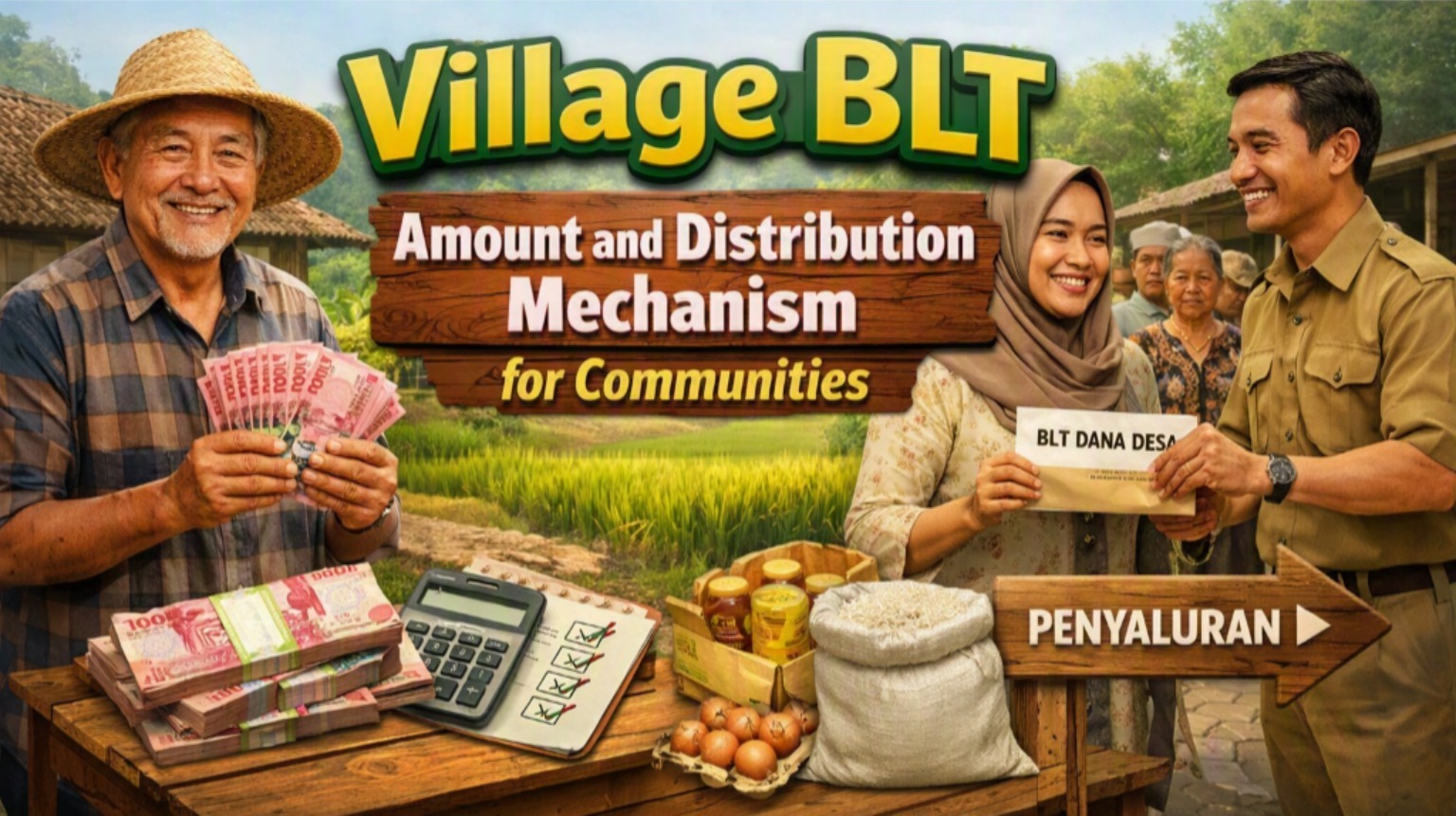
Village BLT or Bantuan Langsung Tunai Desa is a form of social protection funded through the Village Fund to help families facing severe economic hardship. In 2026, the program remains one of the priority uses of Village Fund resources for addressing extreme poverty. Under the current rules, the assistance can be provided at a maximum of Rp300,000 per eligible family per month. However, the amount and duration received by each family depend on the village budget and the results of the beneficiary selection process. The following explanation covers the Village BLT amount, recipient criteria, and distribution mechanism in simple terms. (JDIH BPK)
WHAT IS VILLAGE BLT?
Village BLT is direct cash assistance financed from the Village Fund and intended to support families considered most in need. For the 2026 budget year, addressing extreme poverty through Village BLT is listed as one of the main focuses of Village Fund use. The policy is designed to make assistance more targeted by considering government data and the actual conditions of families in the village. Therefore, not every low-income household automatically receives the assistance. The final list is determined through the village's established decision-making process. (JDIH BPK)
The program is different from centrally managed social assistance because its implementation involves the village government and community participation. Village officials work with the Village Consultative Body and community representatives when discussing eligible beneficiaries. This approach is intended to improve accuracy and ensure that families who genuinely need support can be identified. The process also provides a mechanism for updating beneficiaries when circumstances change. In this way, Village BLT is expected to function as a more targeted form of protection for vulnerable village households. (JDIH Kemendesa)
VILLAGE BLT AMOUNT IN 2026
The maximum Village BLT amount in 2026 is Rp300,000 per beneficiary family per month. This means a family cannot receive more than Rp300,000 for one month's allocation under the applicable provision. The regulation also allows payments for a maximum of three months at once, meaning a three-month payment could reach Rp900,000 when the full monthly amount is applied. The actual payment schedule can therefore differ between villages. Communities should check the schedule announced by their respective village government. (Tosari Information System)
It is also important to understand that Rp300,000 is a maximum amount, not necessarily a guarantee that every beneficiary will receive the same total amount for the entire year. The 2026 policy has moved toward a more selective approach based on family conditions and available village funding. Consequently, the number of beneficiaries and the payment period can vary from one village to another. Some villages may distribute the assistance monthly, while others may make payments for several months simultaneously in accordance with the rules. The village's approved budget and beneficiary decision remain important factors in determining implementation. (Tosari Information System)
WHO CAN RECEIVE VILLAGE BLT?
The main priority for Village BLT recipients in 2026 is families experiencing extreme poverty. Government data can be used as the main reference when identifying potential beneficiary families. However, the beneficiary list is not simply generated from a database because the village must discuss and agree on the recipients through a village deliberation process. This allows information about the family's actual circumstances to be considered. The objective is to ensure that assistance reaches households that meet the required conditions. (JDIH Kemendesa)
Potential recipients may need to be assessed based on their economic vulnerability and other relevant circumstances identified through the applicable village process. Community input can help identify whether a proposed beneficiary still meets the requirements. If a beneficiary dies or no longer meets the criteria, the village government can replace that person with another eligible family. Any replacement must go through the required village deliberation process and be formally established. This mechanism helps keep the beneficiary list relevant as household conditions change. (Scribd)
HOW ARE VILLAGE BLT RECIPIENTS SELECTED?
The selection begins with the identification of families that may qualify as Keluarga Penerima Manfaat or KPM. The village then discusses the proposed beneficiaries in a Village Deliberation, with priority given to families experiencing extreme poverty. Government data serves as an important reference during this process. After the deliberation, the final list of KPM is established through a Decision of the Village Head. The decision contains important information about the beneficiaries and is reported through the applicable government administrative channel. (Scribd)
Community participation is an important part of the process because local residents may have relevant information about the economic circumstances of families in their area. The process should be carried out carefully to reduce the possibility of inaccurate or inappropriate beneficiary selection. If there is a change in circumstances, the village can conduct another special deliberation to determine a replacement. The revised beneficiary list must then be formally established by the Village Head. This system supports transparency, accountability, and more accurate targeting of Village BLT. (Scribd)
VILLAGE BLT DISTRIBUTION MECHANISM
Once beneficiaries have been officially determined, the assistance is distributed according to the payment mechanism arranged by the village. Under the 2026 operational guidance, Village BLT payments may be made in cash or through non-cash methods. Cash distribution may take place at a designated village location or through another method arranged by the village government. Non-cash distribution can involve transferring the assistance through an appropriate account or payment channel. The chosen method should make the distribution orderly and support accurate recording of payments. (Scribd)
The payment period can also be arranged in accordance with the applicable rule that allows up to three months to be paid simultaneously. For example, if the full monthly amount of Rp300,000 is applied and three months are paid together, the beneficiary may receive Rp900,000 in one distribution. The exact timing depends on the village's implementation and approved budget. Beneficiaries should therefore follow official information from their village government rather than relying on unofficial messages. Clear communication is important so residents know the payment period, amount, location, and required administrative steps. (Tosari Information System)
HOW CAN COMMUNITIES CHECK THEIR VILLAGE BLT STATUS?
Residents who want to know whether they are included as Village BLT beneficiaries should first contact the village government. They can ask about the official beneficiary list, the payment schedule, and the mechanism used for distribution. Information may also be communicated through village information systems, public notice boards, social media, websites, or other accessible public channels. The 2026 rules emphasize the importance of publishing information related to Village Fund use so that communities can monitor its implementation. Residents should rely on official village announcements when checking their status. (Scribd)
If a household believes its circumstances qualify for assistance but its name is not included, it can communicate the situation through the appropriate village channel. Local officials can then explain the applicable requirements and verification process. It is important to remember that being economically disadvantaged does not automatically guarantee inclusion because the beneficiary list must be established through the prescribed process. Residents should also avoid paying individuals who claim they can guarantee inclusion as a beneficiary. Questions or complaints should be directed to the village government or relevant local authorities.
WHY TRANSPARENCY MATTERS IN VILLAGE BLT DISTRIBUTION?
Transparency helps communities understand how Village Fund money is allocated and who receives Village BLT. The 2026 operational guidance requires villages to publish information about Village Fund use, including relevant activities, locations, and budget amounts. Public information can help residents monitor whether programs are implemented according to the approved plan. It can also encourage greater community participation in village development. (Scribd)
Accountability is equally important because Village BLT uses public funds. Accurate beneficiary records, proper payment documentation, and reporting help reduce administrative errors and improve oversight. The village government is responsible for ensuring that the assistance reaches the approved beneficiaries according to applicable regulations. When residents understand the mechanism, they can also help identify potential problems and report them through proper channels. Ultimately, transparent distribution strengthens public trust in village social assistance programs.
CONCLUSION
Village BLT in 2026 provides a maximum assistance amount of Rp300,000 per beneficiary family per month and may be paid for up to three months at once. The program prioritizes families experiencing extreme poverty, with government data serving as an important reference for identifying potential recipients. Beneficiaries are discussed through a village deliberation process and formally established through a decision of the Village Head. Payments may be made through cash or non-cash methods, depending on the implementation arranged by the village. (Scribd)
The most important point is that Village BLT is not an automatic payment for every resident. The number of beneficiaries, payment period, and distribution schedule can differ according to the village's conditions, budget, and official decisions. Residents should check information directly with their village government and use official channels when seeking clarification. With proper targeting and transparent distribution, Village BLT can provide meaningful support to families who need assistance most.
About the Author
Gusti Ayu Tita P
Author — STEKOM University
An active author focused on academic issues, educational technology, and human resource development in the campus environment.















