
Village BLT for Low Income Communities and Recipient Requirements
Gusti Ayu Tita P
9 September 2026
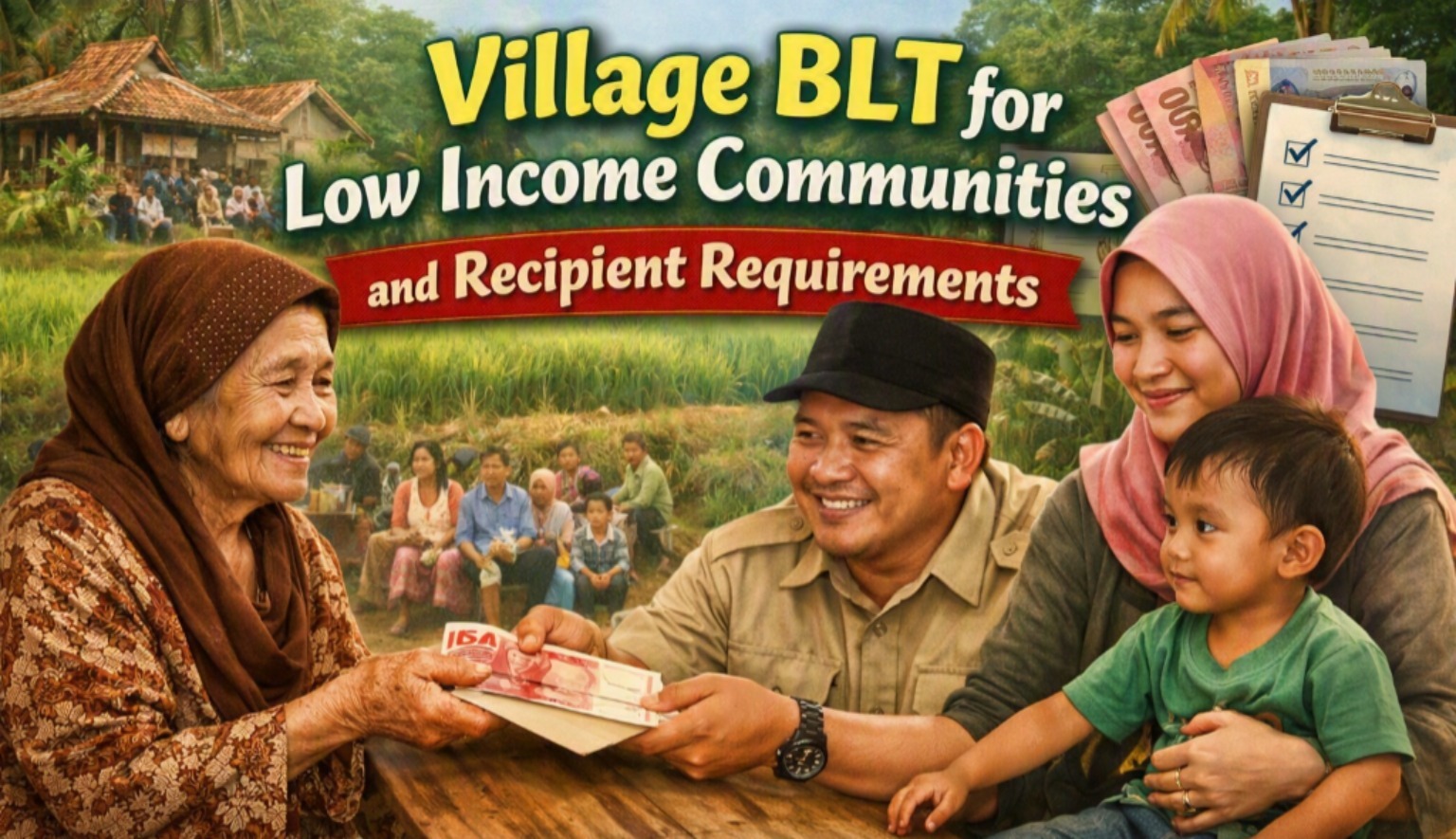
Village BLT or Bantuan Langsung Tunai Desa is a village-level social assistance program funded through the Village Fund. The program is intended to help families experiencing poverty and reduce the economic burden of households that need support. For the 2026 fiscal year, the use of Village Funds for handling poverty and extreme poverty is one of the official priorities under Minister of Villages Regulation Number 16 of 2025. (JDIH Kemendesa)
The program is not automatically given to every low-income resident. Recipient selection is carried out through a village deliberation process, using government data as an initial reference and considering the actual social and economic conditions of the village. (JDIH Rokan Hulu)
WHAT IS VILLAGE BLT?
Village BLT is direct cash assistance allocated from the Village Fund to support families facing poverty or extreme poverty. The assistance is designed to help eligible households meet essential needs and reduce financial pressure. In 2026, Village BLT remains part of the priority use of Village Funds for poverty and extreme poverty reduction. (JDIH Kemendesa)
The amount may be up to Rp300,000 per eligible family per month. The technical implementation and payment schedule can depend on the village's approved budget and implementation arrangements, including the possibility of payment for several months at once. (Desa Pandean)
WHO IS PRIORITIZED AS A RECIPIENT?
The main priority is poor or extremely poor families living in the relevant village. Government data is used as an important reference when identifying potential recipients, but the selection process still involves verification and village deliberation. This approach is intended to make the assistance more accurately targeted toward households with the greatest need. (JDIH Banyuwangi)
When suitable government data is unavailable or insufficient, potential recipients can be considered based on specific conditions. These include families that have lost their livelihood, families with members suffering from chronic or long-term illness or disability, and single elderly households. Poor families headed by women may also receive priority under the applicable criteria. (JDIH Banyuwangi)
RECIPIENT REQUIREMENTS FOR VILLAGE BLT
The recipient requirements can be summarized into several important conditions:
- Poor or extremely poor family
- Lives in the relevant village
- Lost a livelihood or main source of income
- Has a family member with a chronic or long-term illness or disability
- Single elderly household
- Poor female-headed household
- Not receiving PKH when the relevant criterion applies
- Has an NIK, where possible, to support identification and administration
The exact selection is not based on one criterion alone. The village must consider the applicable regulation, government data, verification results, and the outcome of the Village Deliberation. Therefore, being considered economically vulnerable does not automatically guarantee that a household will become a BLT recipient. (JDIH Banyuwangi)
HOW ARE VILLAGE BLT RECIPIENTS SELECTED?
The process generally starts by identifying potential beneficiary families using government data as the initial reference. The village then verifies and validates information about the household's social and economic circumstances. This step is important because household conditions can change, such as through loss of employment, illness, disability, or changes in income. (JDIH Banyuwangi)
The proposed list is then discussed through a Village Deliberation or special village deliberation. Community representatives and village institutions can participate in reviewing the proposed recipients, after which the agreed list is formally established through a decision of the Village Head. This mechanism helps promote transparency, accountability, and accurate targeting. (JDIH Rokan Hulu)
HOW MUCH VILLAGE BLT IS PROVIDED?
For 2026, the Village BLT allocation can reach Rp300,000 per KPM per month. However, the actual amount and implementation should follow the applicable village regulations and approved budget. Some villages may distribute several months of assistance together, depending on their payment mechanism. (Desa Pandean)
For example, if a village pays three months together at Rp300,000 per month, an eligible family would receive Rp900,000 for that three-month period. This is not a separate bonus but simply the accumulation of the monthly assistance. Actual payment timing should therefore be confirmed with the local village government.
CAN SOMEONE WHO RECEIVED OTHER SOCIAL ASSISTANCE GET VILLAGE BLT?
This question requires careful attention because Village BLT is not simply a program for people who have never received government assistance. Official fact-checking information has clarified that the claim that Village BLT is exclusively for residents who have never received any assistance is false. (Tribrata News)
However, one of the specific Village BLT criteria concerns not receiving PKH. Other restrictions may be reflected in local implementation documents based on the applicable rules. Because social assistance programs can have different databases and eligibility rules, residents should check their status with the village government rather than assuming that receiving another program automatically makes them eligible or ineligible. (JDIH Banyuwangi)
HOW CAN RESIDENTS CHECK THEIR BLT STATUS?
Residents who want to know whether they are included as Village BLT recipients should contact their village government or the relevant village administration. Information about the recipient list may also be communicated through village announcements or deliberation results. Some villages publish recipient decisions as part of their transparency practices. (Galih Kendal)
Residents should also ensure that their population and household information is accurate. An NIK is particularly useful for administrative identification, while supporting documents may be requested when certain conditions, such as chronic illness or disability, need to be verified. If household circumstances have changed significantly, residents can communicate the situation to the local authorities for consideration in the appropriate process. (JDIH Banyuwangi)
WHY IS VILLAGE BLT IMPORTANT FOR LOW INCOME COMMUNITIES?
Village BLT can provide immediate financial support for families struggling to meet basic household needs. For households that have lost income, experienced serious illness, or face other economic difficulties, regular cash assistance can help reduce short-term financial pressure. The program also forms part of the broader effort to address poverty at the village level. (JDIH Kemendesa)
However, Village BLT should not be viewed as a permanent solution to poverty. Its effectiveness also depends on accurate data, fair selection, transparent administration, and appropriate use of public funds. When these elements work together, assistance can reach families that genuinely require support while strengthening public trust in village programs.
CONCLUSION
Village BLT is an important form of social protection funded through the Village Fund and prioritized in 2026 for addressing poverty and extreme poverty. Low-income families, particularly those experiencing severe economic vulnerability, can be considered according to the applicable criteria and village selection process. Recipient determination is carried out through village deliberation, with government data serving as an important reference and verification helping reflect actual household conditions. (JDIH Kemendesa)
The assistance may reach Rp300,000 per family per month, although payment arrangements can vary according to the village's implementation. Residents should therefore rely on information from their local village government and official decisions rather than unverified claims circulating online. (Galih Kendal)
About the Author
Gusti Ayu Tita P
Author — STEKOM University
An active author focused on academic issues, educational technology, and human resource development in the campus environment.















