What Are the Duties of Community Night Watch Volunteers?
Gusti Ayu Tita P
18 September 2026
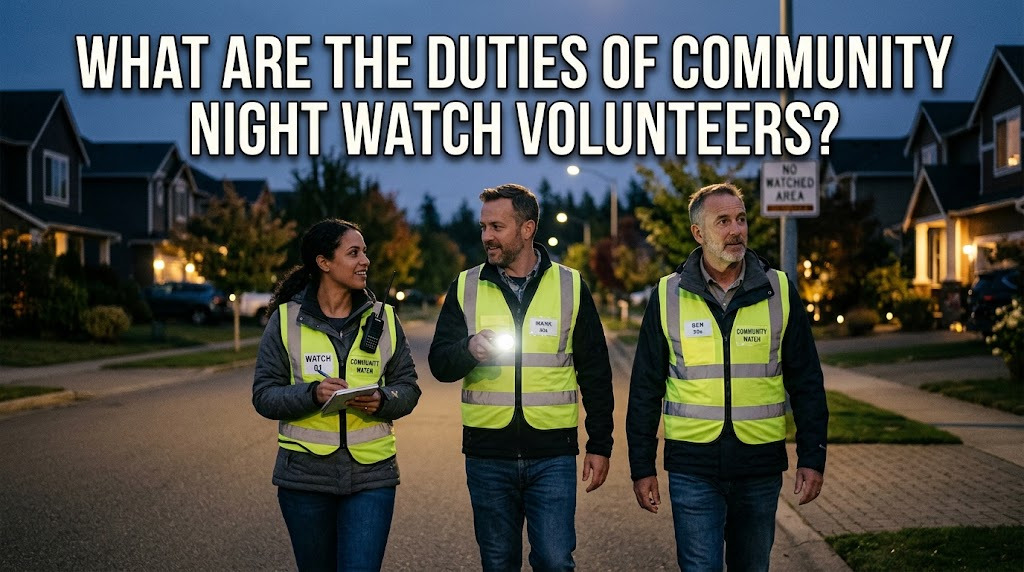
Community Night Watch volunteers play an important role in supporting safety and cooperation within a neighborhood. Their duties generally involve observing the surrounding environment, communicating with other residents, and reporting unusual situations when necessary. Volunteers do not act as law enforcement officers, so their activities should focus on safe observation and community support. Clear responsibilities can make a Neighborhood Watch program more organized and effective.
MONITORING THE NEIGHBORHOOD ENVIRONMENT
One of the main duties of Community Night Watch volunteers is monitoring general conditions around the neighborhood. Volunteers may observe streets, public areas, entrances, and other shared spaces during their assigned shifts. Regular observation can help residents become more aware of changes or unusual situations in the local environment. Their presence can also encourage greater attention to neighborhood safety.
Monitoring should be conducted calmly and responsibly without unnecessarily confronting other people. If volunteers notice something that appears dangerous or requires professional assistance, they should move to a safe location and contact the appropriate authorities. Volunteers should never put themselves at risk simply to investigate a situation. This makes observation a safer and more practical part of community watch activities.
FOLLOWING THE NIGHT WATCH SCHEDULE
Volunteers are also responsible for following the agreed night watch schedule. A clear schedule helps ensure that watch activities are carried out consistently and that responsibilities are distributed fairly among residents. Participants should arrive on time and inform the relevant community coordinator if they cannot attend their assigned shift. Good scheduling can prevent gaps in community participation.
Following the schedule also demonstrates shared responsibility among residents. When each participant takes their assigned role seriously, the program can operate more smoothly. Community leaders can create flexible arrangements when residents have work, school, or family commitments. A practical schedule can help maintain participation without placing too much pressure on individual volunteers.
COMMUNICATING WITH OTHER RESIDENTS
Communication is another important duty of Community Night Watch volunteers. During their shifts, volunteers may exchange relevant information with other participants and community coordinators. Good communication can help residents understand current neighborhood conditions and respond appropriately to local concerns. It can also strengthen community cooperation.
Volunteers should share information carefully and avoid spreading unverified rumors. When a situation requires professional intervention, the information should be communicated to the appropriate authorities through suitable channels. Clear and accurate communication can reduce confusion and help prevent unnecessary concern among residents. These habits can make Neighborhood Watch activities more responsible and trustworthy.
REPORTING AND SUPPORTING COMMUNITY SAFETY
Volunteers may also have a responsibility to report important incidents or safety concerns. Reporting should be based on observable information rather than assumptions about a person's intentions. If there is a serious or potentially dangerous situation, volunteers should prioritize their safety and seek help from the appropriate authorities. This ensures that community watch remains a supportive activity rather than an attempt to handle serious incidents independently.
In addition, volunteers can help identify general issues that affect the neighborhood, such as inadequate lighting or damaged shared facilities. These concerns can be discussed with community leaders so that appropriate solutions can be considered. Regular evaluation can also help improve the night watch schedule and other arrangements. Through responsible reporting and cooperation, volunteers can contribute to a safer and more orderly community.
CONCLUSION
The duties of Community Night Watch volunteers include monitoring the neighborhood, following assigned schedules, communicating with residents, and reporting relevant safety concerns. Each responsibility should be performed carefully and according to the abilities of the volunteers. Clear coordination can help prevent confusion and ensure that everyone understands their role. Most importantly, volunteers should prioritize personal safety and avoid direct confrontation.
A successful Neighborhood Watch program depends on cooperation between volunteers, residents, community leaders, and appropriate authorities. Fair scheduling and accurate communication can make participation easier and more sustainable. When volunteers carry out their duties responsibly, they can support greater awareness and cooperation throughout the neighborhood. In this way, community watch can become a useful part of maintaining a safe and connected local environment.
About the Author
Gusti Ayu Tita P
Author — STEKOM University
An active author focused on academic issues, educational technology, and human resource development in the campus environment.