
What Can Students Learn From Community Service In Rural Communities?
Gusti Ayu Tita P
20 Agustus 2026
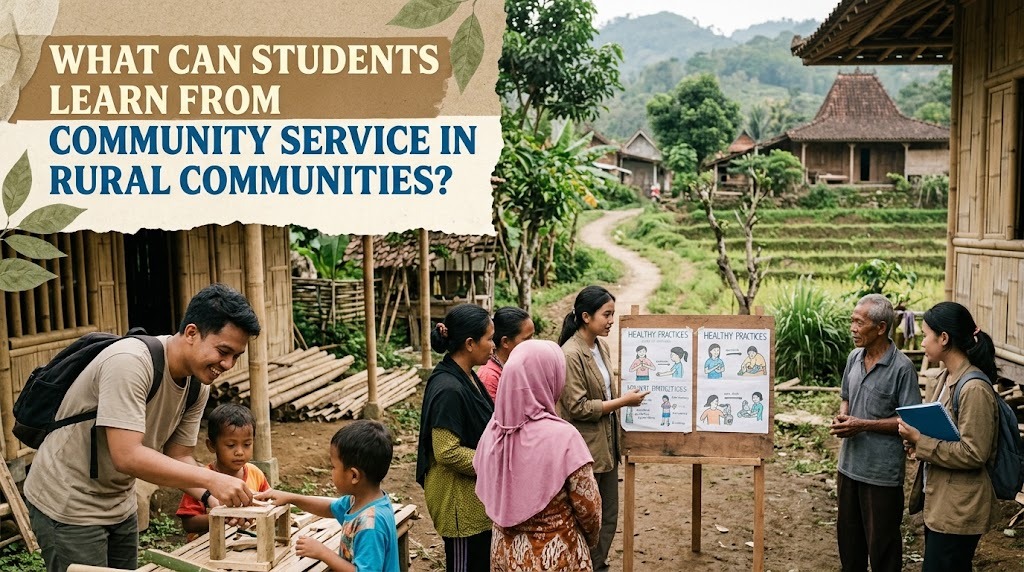
Community service in rural communities gives university students an opportunity to learn directly from people and environments outside campus. Through programs such as KKN or other community service activities, students can apply academic knowledge while responding to real community needs. Rural areas can provide different learning experiences because students may encounter local traditions, limited resources, and unique social conditions. These situations encourage students to become more observant, flexible, and responsible. More importantly, community service can help students develop practical skills and social awareness that are difficult to gain through classroom learning alone.
UNDERSTANDING RURAL COMMUNITY LIFE
One of the first lessons students can gain is a better understanding of how rural communities organize their daily lives. Students may observe local economic activities, traditions, social relationships, education, and community cooperation. These experiences can show that every community has its own strengths and challenges. Understanding local conditions helps students avoid making assumptions based only on information from textbooks. They learn to look at social issues from the perspective of the people who experience them directly.
Rural communities may also have different priorities from urban environments. Some communities may focus strongly on agriculture, small businesses, natural resources, education, or local traditions. Students need to understand these priorities before designing a community program. Local context matters because a solution that works in one location may not be suitable for another. This lesson can make students more careful when developing solutions to social problems.
DEVELOPING EMPATHY AND SOCIAL AWARENESS
Community service allows students to meet people with different backgrounds and life experiences. Direct interaction can help them understand challenges that they may never have experienced personally. Students may gain a deeper understanding of issues related to education, economic opportunities, infrastructure, or access to information. These experiences can develop empathy and social awareness. Students begin to see social problems as real human situations rather than simply academic topics.
Empathy also teaches students to listen before offering solutions. Residents understand their own environment and often have valuable ideas about how problems can be addressed. Students should therefore respect local knowledge and community experience. This approach creates a relationship based on cooperation rather than one sided assistance. Over time, students can become more sensitive to the needs of different groups in society.
LEARNING TO COMMUNICATE WITH DIFFERENT PEOPLE
Communication becomes an important part of community service. Students may interact with children, parents, farmers, business owners, community leaders, and older residents. Each group may have different communication styles and expectations. Students need to explain ideas using simple, clear, and respectful language. This experience can improve their ability to communicate with people outside the university environment.
Students also learn that effective communication involves listening. They need to ask questions, understand concerns, and confirm information before making decisions. Miscommunication can create confusion about schedules, responsibilities, or program objectives. Active listening can help students build trust with community members. These communication skills can later be useful in workplaces, organizations, and other social environments.
LEARNING RESOURCE MANAGEMENT
Community service can teach students how to work with limited resources. Students may need to manage budgets, equipment, materials, transportation, and available facilities. These limitations require careful planning and efficient resource management. Students learn to prioritize activities and avoid unnecessary spending. This can develop practical skills that are useful in both personal and professional situations.
Limited resources can also encourage creativity. Students may discover that useful programs do not always require expensive equipment or complicated technology. Simple solutions can sometimes provide meaningful benefits when they match local needs. Resourcefulness is an important skill because professional environments also involve limitations. Students learn to focus on what can realistically be achieved rather than what is ideal in theory.
BUILDING ADAPTABILITY AND INDEPENDENCE
Living and working in a rural community can require students to adjust to unfamiliar conditions. They may experience different schedules, transportation options, facilities, communication styles, and social routines. These differences encourage students to become more adaptable and independent. They learn that not every situation can be controlled according to their preferences. Instead, they need to adjust while continuing to complete their responsibilities.
Independence also develops when students have to make decisions without constant guidance. They may need to solve small problems, organize activities, and respond to unexpected situations. These experiences can increase self confidence and personal responsibility. Students gradually become more comfortable working outside their usual environment. This can prepare them for professional situations that require initiative.
CONNECTING ACADEMIC KNOWLEDGE WITH REAL NEEDS
Community service gives students a chance to apply what they have learned at university. Students from different fields can use their knowledge to support educational, economic, environmental, technological, or social programs. This process helps them understand how academic knowledge can be applied to real problems. At the same time, they may discover that theory needs to be adjusted according to local conditions. This makes learning more practical and meaningful.
For example, students with marketing knowledge may help local businesses understand basic promotion strategies. However, they still need to consider local customers, available products, production capacity, and community resources. This teaches students that effective solutions require context and practical judgment. Academic knowledge becomes stronger when combined with real experience. The lesson can also help students identify areas where they need further learning.
DEVELOPING SOCIAL RESPONSIBILITY
Community service can encourage students to think about their role in society. University education is not only about gaining qualifications but can also provide knowledge that contributes to communities. By participating in community activities, students may develop a stronger sense of social responsibility and civic awareness. They learn that even small contributions can have value when they respond to genuine needs. This perspective can influence how students view their responsibilities after graduation.
Students also learn that sustainable development requires cooperation. They cannot solve complex community problems alone within a short period. Working with residents, local organizations, and other stakeholders can create better results. Community participation and sustainability should therefore be considered when planning activities. This lesson can encourage students to think beyond temporary achievements.
REFLECTING ON PERSONAL GROWTH
One of the most important lessons from community service comes through personal reflection. Students can evaluate how their attitudes, skills, and perspectives changed during the program. They may discover strengths they did not know they had or weaknesses that require improvement. Reflection turns experience into meaningful learning. Without reflection, students may complete activities without fully understanding what they gained from them.
Students can reflect on questions such as what challenges they faced, how they responded, and what they would do differently in the future. They can also consider how their assumptions about rural communities changed after direct interaction. This process can strengthen self awareness and continuous learning. The lessons gained from community service can then be applied to academic work, organizations, and future careers.
CONCLUSION
Community service in rural communities can provide students with valuable lessons that extend beyond academic knowledge. Students can develop empathy, communication, teamwork, leadership, problem solving, adaptability, independence, resource management, and social responsibility. They can also learn to respect local culture, understand community needs, and connect university knowledge with real situations. The experience becomes more meaningful when students actively participate, listen to residents, and reflect on what they have learned. Ultimately, rural community service can help students become more capable, socially aware, adaptable, and prepared for future academic and professional challenges.
About the Author
Gusti Ayu Tita P
Author — STEKOM University
An active author focused on academic issues, educational technology, and human resource development in the campus environment.















