
What Future Trends Should Every Game Developer Know About?
Gusti Ayu Tita P
5 Agustus 2026
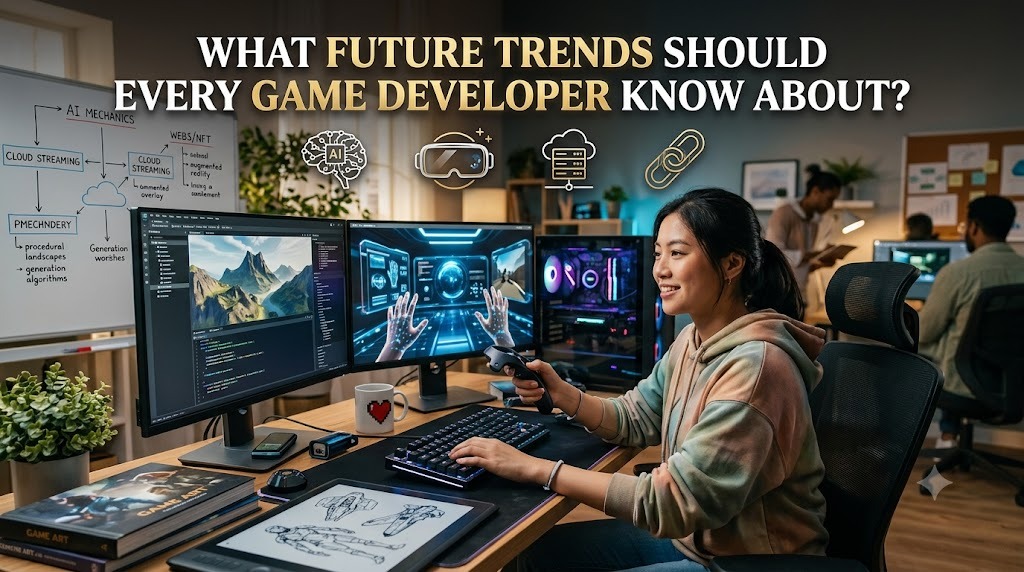
The gaming industry continues to change as technology, player expectations, and business models develop. New tools are changing how games are designed, produced, distributed, and experienced. For game developers, understanding these changes is important because future technologies can influence both creative opportunities and development workflows. Developers who keep learning can adapt more effectively to an industry that moves quickly.
Future trends do not always mean completely new technologies. Some trends involve improving existing systems, while others change how players interact with games. Important areas include artificial intelligence, real time graphics, cloud gaming, virtual reality, augmented reality, accessibility, cross platform development, and new approaches to game production. Understanding these developments can help developers make better technical and creative decisions.
ARTIFICIAL INTELLIGENCE IN GAME DEVELOPMENT
Artificial intelligence or AI is becoming increasingly relevant to game development. Developers can use AI related technologies for tasks such as assisting with coding, generating ideas, analyzing data, creating prototypes, and supporting testing. AI can also be used in games for non player character behavior, procedural systems, and adaptive experiences. However, developers still need to evaluate AI generated results carefully.
The future use of AI is likely to focus on assisting developers rather than completely replacing development teams. Human judgment remains important for game design, storytelling, artistic direction, quality control, and ethical decisions. Developers should also consider copyright, privacy, security, and transparency when using AI tools. Learning how to use these technologies responsibly can become a valuable professional skill.
REAL TIME GRAPHICS AND ADVANCED RENDERING
Graphics technology continues to improve, allowing developers to create increasingly detailed and responsive environments. Real time rendering technologies can produce realistic lighting, reflections, shadows, materials, and visual effects while the game is running. Modern graphics hardware and rendering techniques are making sophisticated visual experiences more accessible across different types of projects. Developers need to understand how these technologies affect both visual quality and performance.
Advanced graphics do not automatically make a game better. Developers must balance visual quality, performance, development cost, and platform limitations. Optimization remains important because players may use different hardware configurations. Understanding modern rendering techniques can help developers decide where advanced graphics provide meaningful value to the player experience.
CLOUD GAMING AND CLOUD TECHNOLOGY
Cloud gaming allows games to be processed on remote servers and streamed to players over the internet. This approach can reduce the need for powerful local hardware, although the quality of the experience depends heavily on network conditions and service infrastructure. Cloud technology can also support other aspects of game development and online services. Developers should understand how cloud systems can affect performance, scalability, and game architecture.
Cloud based services can be particularly useful for games that require online infrastructure, multiplayer systems, data storage, analytics, or live services. However, developers must consider server costs, security, latency, reliability, and data protection. Cloud technology is therefore not simply a way to run games remotely. It can become part of a broader infrastructure strategy for modern game development.
VIRTUAL REALITY AND AUGMENTED REALITY
Virtual reality or VR creates immersive experiences by placing players inside digitally generated environments. VR development requires developers to think carefully about movement, interaction, comfort, performance, and spatial design. Traditional game design principles may need to be adapted because players physically interact with the virtual environment in different ways. Developers should understand the specific requirements of VR hardware before designing experiences.
Augmented reality or AR combines digital content with the player's real-world environment. AR can support games that use location, cameras, physical spaces, or real-world objects as part of gameplay. Both VR and AR provide opportunities for new types of interactive experiences. Developers interested in these fields should learn about spatial interaction, performance optimization, user comfort, and platform-specific requirements.
CROSS PLATFORM DEVELOPMENT
Players increasingly expect games to be available across multiple platforms. Cross platform development allows developers to create experiences that can reach players on devices such as computers, consoles, and mobile devices. Supporting multiple platforms can increase a game's potential audience but also introduces additional technical challenges. Hardware capabilities, input methods, performance targets, and platform requirements can differ significantly.
Developers need to design systems that can adapt to these differences. Cross platform projects may require careful optimization, interface design, input handling, and testing. Cross progression and cross play can also introduce additional technical and account management requirements. Understanding platform differences will remain an important skill as players continue to use multiple devices.
CLOUD SAVING AND CROSS PROGRESSION
Players increasingly expect their progress to be available across supported devices. Cloud saving can allow game data to be stored remotely and synchronized between devices. Cross progression can make it possible for players to continue their progress when moving between supported platforms. These systems can improve convenience and encourage players to remain engaged with a game.
However, implementing these features requires careful attention to account systems, data synchronization, security, and platform policies. Developers need to prevent data conflicts and protect player information. Reliable infrastructure is essential because synchronization problems can damage player trust. As multi platform gaming grows, developers may need stronger knowledge of online services and data management.
ACCESSIBILITY AND INCLUSIVE GAME DESIGN
Accessibility is becoming an increasingly important part of game development. Developers can create options that help players with different physical, sensory, cognitive, or other needs interact with games more comfortably. Features can include subtitles, adjustable text size, remappable controls, color options, audio controls, and visual alternatives. The appropriate features depend on the game's design and target audience.
Accessibility should be considered throughout development rather than treated as a final addition. Early planning can make accessibility features easier to integrate into gameplay and interface systems. Testing with different players can help developers identify barriers that might otherwise be overlooked. Inclusive design can make games more usable while potentially expanding the number of people who can enjoy them.
PROCEDURAL CONTENT AND DYNAMIC EXPERIENCES
Procedural generation allows systems to create some game content through rules or algorithms. Developers can use procedural methods for environments, levels, objects, quests, or other elements. This approach can help create large or varied experiences without manually producing every individual asset. It is particularly useful for games that emphasize exploration and replayability.
Procedural systems need careful design because randomly generated content is not automatically enjoyable. Developers must create rules that produce coherent, balanced, and meaningful experiences. Testing is important to identify situations where generated content becomes repetitive, confusing, or unfair. The future of procedural design may combine algorithmic generation with human creative direction.
LIVE SERVICE AND COMMUNITY DRIVEN DEVELOPMENT
Some games continue to evolve after release through live service models. Developers may provide updates, events, seasonal content, balance changes, bug fixes, and other improvements. These games require teams to monitor player behavior and respond to changing community needs. Long term support can create strong relationships between developers and players when managed responsibly.
Live service development also introduces challenges. Teams must manage development resources, server infrastructure, content schedules, monetization, and community expectations. Developers need to avoid creating unsustainable workloads or excessive pressure to release constant content. A successful live service approach requires careful planning, reliable communication, and sustainable production practices.
MOBILE AND PORTABLE GAMING
Mobile and portable gaming continue to provide major opportunities for developers. Smartphones and portable gaming devices allow players to access games in different environments and situations. Developers need to consider battery usage, screen size, touch controls, performance, storage, and device compatibility. Mobile game design may also require different approaches to session length and interface design.
Portable hardware is also becoming more capable, creating opportunities for more sophisticated gaming experiences. Developers who understand scalable graphics and flexible control systems can potentially target a wider range of devices. However, performance and usability should remain priorities. A game should be designed around the strengths and limitations of its target hardware.
DATA DRIVEN GAME DEVELOPMENT
Developers can use analytics and player data to understand how people interact with their games. Data can reveal information about progression, difficulty, retention, performance, and other aspects of player behavior. When interpreted responsibly, these insights can help developers identify problems and improve game design. Data should support design decisions rather than completely replace creative judgment.
Developers must also consider privacy and responsible data practices. Players should understand what information is collected and how it is used when applicable. Data collection should follow relevant laws, platform requirements, and privacy principles. Developers who combine useful analytics with responsible data management can make better decisions while maintaining player trust.
SUSTAINABLE AND EFFICIENT GAME DEVELOPMENT
The future of game development will also involve finding ways to produce high quality games more efficiently. Development teams are exploring better workflows, automation, reusable tools, improved pipelines, and scalable production methods. These approaches can reduce repetitive work and allow developers to focus more on creative and technical challenges. Efficient workflows can be especially important for small teams with limited resources.
Sustainable development also includes the well being of development teams. Long periods of excessive overtime can negatively affect productivity, health, creativity, and staff retention. Companies that support realistic schedules, good project management, and healthy working conditions may be better positioned for long term success. A sustainable development process benefits both employees and the quality of the final game.
CONCLUSION
The future of game development will be shaped by a combination of technology, creativity, player expectations, and responsible production practices. Artificial intelligence, real time graphics, cloud technology, VR, AR, cross platform development, accessibility, procedural generation, and data analytics are among the important areas developers should understand. Not every trend will be suitable for every project, so developers should evaluate technologies based on their actual value.
The most important skill for a modern game developer is adaptability. Developers should continue learning, experimenting, testing new tools, and understanding how technology affects player experiences. At the same time, fundamental skills such as programming, game design, art, communication, testing, and problem solving remain essential. By combining these skills with awareness of future trends, developers can stay competitive and create better games for changing audiences.
About the Author
Gusti Ayu Tita P
Author — STEKOM University
An active author focused on academic issues, educational technology, and human resource development in the campus environment.















