
Why Are Literacy and Numeracy Important in ANBK?
Gusti Ayu Tita P
29 Agustus 2026
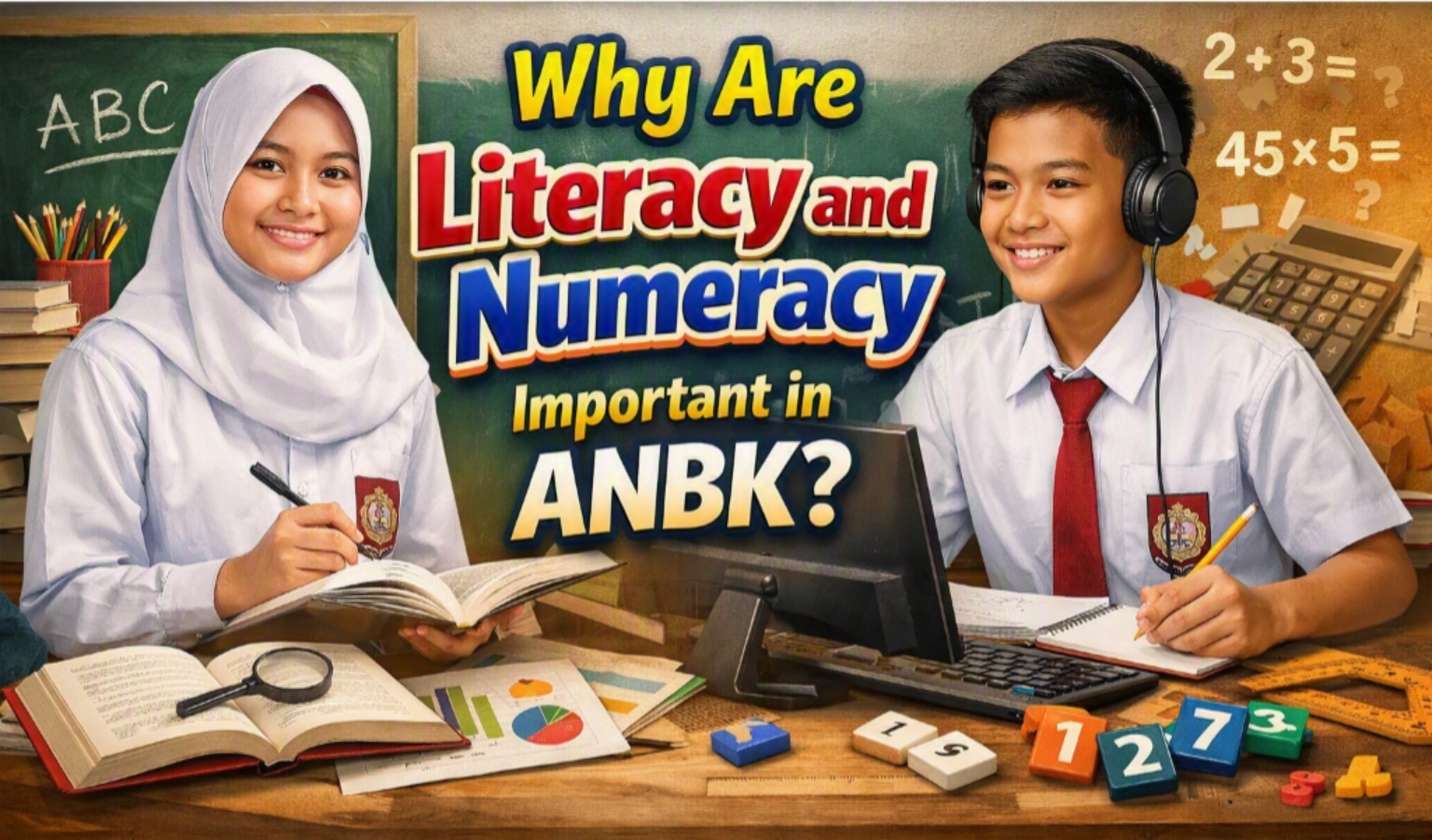
Literacy and numeracy are two important abilities assessed in the Asesmen Nasional Berbasis Komputer (ANBK). These skills are not only related to school lessons but also help students understand information, solve problems, and make decisions in everyday life. Through ANBK, students are encouraged to apply their knowledge instead of simply memorizing learning materials. Therefore, understanding the role of literacy and numeracy can help students prepare more effectively for the assessment.
UNDERSTANDING LITERACY IN ANBK
Literacy in ANBK focuses on a student's ability to understand, analyze, evaluate, and use information from various texts. Students may encounter different types of reading materials, such as stories, articles, reports, or informational texts. The questions are designed to measure whether students can identify important information and understand the meaning behind what they read. This means that literacy is more than simply being able to read words correctly.
Strong literacy skills also help students evaluate information critically. They need to distinguish important facts from less relevant details and understand relationships between ideas. These abilities are useful not only during ANBK but also when students study other subjects or encounter information on the internet. Good literacy can therefore support independent learning and critical thinking.
UNDERSTANDING NUMERACY IN ANBK
Numeracy in ANBK refers to the ability to use mathematical concepts to understand and solve problems in real-life situations. Students may need to interpret numbers, measurements, tables, graphs, percentages, or other forms of data. The questions do not simply ask students to perform calculations but require them to choose appropriate strategies and interpret the results. This makes numeracy an important part of practical problem-solving.
Numeracy is useful in many everyday activities. Students use it when managing money, comparing prices, reading schedules, understanding statistics, or interpreting information presented through numbers. In ANBK, these abilities are assessed through contextual problems that encourage students to connect mathematics with real situations. As a result, students need to understand the meaning of mathematical information rather than rely only on memorized formulas.
WHY LITERACY AND NUMERACY MATTER IN ANBK?
Literacy and numeracy are important because they represent fundamental skills needed for learning and daily life. Literacy helps students understand information, while numeracy helps them process and use quantitative information. Both skills support students when they face unfamiliar situations that require reasoning. This is why ANBK emphasizes the application of knowledge rather than memorization alone.
These abilities also contribute to higher-order thinking skills. Students may need to compare information, identify relationships, draw conclusions, or determine the best solution to a problem. By practicing these skills regularly, students can become more confident when dealing with complex questions. Strong literacy and numeracy can also provide a foundation for learning at higher levels of education.
THE ROLE OF LITERACY AND NUMERACY IN DAILY LIFE
The importance of literacy and numeracy extends far beyond ANBK preparation. Literacy allows people to understand instructions, news, educational materials, and digital information. Numeracy helps people make practical decisions involving money, time, measurements, and data. Together, these abilities support responsible decision-making in different situations.
For students, developing these skills from an early stage can make learning more effective. They can better understand questions, identify what information is needed, and select suitable ways to solve problems. These abilities are also increasingly important in a digital environment where people encounter large amounts of information every day. Therefore, literacy and numeracy should be developed as long-term learning skills, not only as preparation for an assessment.
HOW STUDENTS CAN IMPROVE LITERACY AND NUMERACY?
Students can improve literacy skills by reading different types of texts regularly and practicing how to identify main ideas, supporting information, conclusions, and the meaning of unfamiliar words. They can also discuss what they read and evaluate whether information is relevant and reliable. For numeracy, students can practice solving problems involving percentages, measurements, ratios, data, and everyday calculations. The most important point is to understand the reasoning behind an answer instead of focusing only on the final result.
Consistent practice is generally more effective than studying intensively only shortly before ANBK. Students can use everyday activities as learning opportunities, such as reading news articles, interpreting simple graphs, calculating expenses, or comparing prices. Teachers and parents can also encourage students to explain how they reach an answer. With regular practice, students can gradually develop critical thinking, problem-solving, and information-processing skills that are useful both inside and outside the classroom.
CONCLUSION
Literacy and numeracy are essential components of ANBK because they measure how well students can apply knowledge to different situations. Literacy emphasizes understanding and evaluating information, while numeracy focuses on using mathematical reasoning to solve contextual problems. Both abilities encourage students to think critically and use information effectively. They are therefore valuable skills for academic learning as well as everyday life.
Preparing for ANBK should not be limited to memorizing question patterns. Students should focus on building strong reading, reasoning, and problem-solving habits through consistent practice. By improving literacy and numeracy gradually, students can become better prepared to face ANBK and future learning challenges. These skills can ultimately help students become more independent, analytical, and confident learners.
About the Author
Gusti Ayu Tita P
Author — STEKOM University
An active author focused on academic issues, educational technology, and human resource development in the campus environment.















