
Why Do Many College Graduates Still Lack Strong Knowledge In Their Field?
Gusti Ayu Tita P
21 Agustus 2026
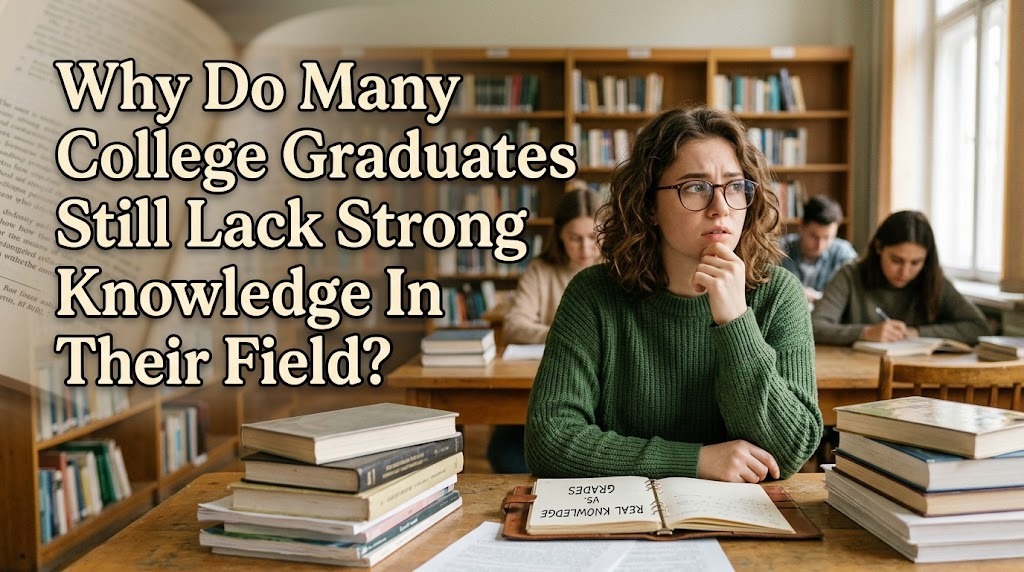
Graduating from college is often seen as proof that a person has completed an important stage of education. However, having a degree does not always mean that a graduate has deep and practical knowledge in their field. Some graduates may remember information for examinations but struggle to explain or apply it after graduation. This situation can happen because of learning habits, teaching methods, limited practical experience, and other factors. Understanding these causes can help students and educational institutions improve the quality of learning.
GRADES CAN BECOME MORE IMPORTANT THAN UNDERSTANDING
One reason graduates may lack strong knowledge is that students sometimes focus heavily on grades and examinations. When academic success is measured mainly through tests and assignments, students may prioritize completing requirements rather than developing deep understanding. Memorizing information can help students pass examinations, but memorized knowledge may not remain useful for a long time. After the examination is finished, some information may be quickly forgotten.
A stronger learning approach encourages students to understand why concepts work and how they can be applied. Students should be encouraged to ask questions, solve problems, discuss ideas, and connect theories with practical situations. Understanding should be treated as an important part of academic success, not simply as a secondary benefit of earning good grades.
TOO MUCH THEORY AND LIMITED PRACTICAL EXPERIENCE
College courses often provide important theoretical foundations, but theory alone may not prepare students for every workplace situation. Some students have limited opportunities to apply what they learn through internships, projects, laboratories, fieldwork, or professional activities. As a result, they may understand concepts academically but struggle when faced with practical problems.
Practical experience helps students discover how theories work in real environments. It also teaches them how to make decisions, communicate with others, manage unexpected situations, and adapt to changing conditions. Combining classroom education with meaningful practical activities can create stronger professional competence.
PASSIVE LEARNING HABITS
Students who depend heavily on lectures and textbooks may become passive learners. They may listen to information, copy notes, memorize important points, and wait for examination questions without actively exploring the subject. This approach can make learning easier in the short term but may not encourage deep understanding.
Active learning requires students to participate in the educational process. They can conduct research, discuss difficult concepts, explain topics to classmates, solve case studies, and work on independent projects. These activities encourage students to think rather than simply receive information. Active learning can therefore help students build knowledge that is easier to apply and remember.
LIMITED READING BEYOND COURSE MATERIALS
Another factor is that some students rely only on materials provided during lectures. Course materials are important, but they may not cover every development or perspective within a field. Students who rarely read academic journals, professional publications, research papers, and specialized books may have a limited understanding of current issues.
Reading beyond the syllabus can expose students to different theories, debates, and real-world developments. It also helps them recognize that knowledge is constantly changing. Students should learn to compare reliable sources and evaluate evidence instead of accepting every piece of information without question. Independent research is an important part of developing deeper expertise.
CURRICULUM MAY NOT ALWAYS MATCH INDUSTRY NEEDS
The relationship between education and the workplace can also affect graduate knowledge. Industries change because of technology, economic developments, new regulations, and changing consumer needs. If academic programs do not regularly update their courses, students may graduate with knowledge that does not fully reflect current professional practices.
Educational institutions can respond by reviewing curricula, collaborating with industry professionals, and providing opportunities for practical learning. Guest lectures, internships, industry projects, and updated technology can help students understand current workplace expectations. However, students also have a responsibility to continue learning beyond graduation because professional knowledge changes over time.
LACK OF CRITICAL THINKING
Knowing facts is not the same as understanding how to use them. Graduates may have difficulty solving unfamiliar problems if they have not developed strong critical thinking skills. Critical thinking involves analyzing information, evaluating evidence, identifying assumptions, comparing alternatives, and making reasoned conclusions.
These skills are especially important in professional environments. Employees rarely receive problems that look exactly like examination questions. They often need to decide what information matters, identify possible solutions, and respond to unexpected circumstances. Developing problem solving ability during college can therefore make graduates more capable in real work situations.
STUDENTS MAY NOT HAVE CLEAR LEARNING GOALS
A lack of clear learning goals can also reduce the depth of a student's education. If students attend college mainly because it is expected by their families or society, they may focus on obtaining a degree rather than understanding what they want to learn. Without personal objectives, academic activities can feel like requirements that must simply be completed.
Students do not need to know their entire future when they enter college. However, they can set smaller goals, such as mastering a specific skill, understanding an important subject, or gaining experience in a particular area. Clear and flexible goals can encourage students to take greater responsibility for their education. Purposeful learning can make college more meaningful and productive.
WEAK CONNECTION BETWEEN LEARNING AND CAREER DEVELOPMENT
Students may also struggle to build strong field knowledge when they do not understand how academic concepts connect to their future careers. If students cannot see the practical value of what they are studying, they may have less motivation to explore the subject deeply. Career activities can help bridge this gap.
Internships, professional organizations, mentoring, career workshops, and project-based learning can show students how their knowledge is used in real workplaces. They can also help students identify skills they still need to develop. Building a connection between education and career readiness can encourage students to learn with greater purpose.
HOW COLLEGE STUDENTS CAN BUILD STRONGER KNOWLEDGE
Students can take several steps to strengthen their knowledge before graduation. They can combine classroom learning with practical experience, read beyond required materials, participate actively in discussions, and practice solving real problems. Creating personal learning goals can also help them stay focused on development rather than only grades. Students should regularly review what they know and identify areas where their understanding remains weak.
It is also important to continue learning outside formal classes. Online courses, professional communities, workshops, research activities, and conversations with experienced professionals can provide additional perspectives. Students should not wait until graduation to begin preparing for the workplace. Continuous learning can help them develop knowledge that remains useful as their field changes.
CONCLUSION
Many college graduates may lack strong knowledge in their field because academic achievement does not always equal deep understanding. Factors such as excessive focus on grades, limited practical experience, passive learning, insufficient reading, outdated curriculum, and weak critical thinking can contribute to the problem. Students can address these challenges by becoming more active learners and connecting academic concepts with real situations. Universities can also strengthen practical education and maintain stronger connections with industry needs. Ultimately, a college degree becomes more valuable when it is supported by deep knowledge, practical competence, critical thinking, and a commitment to lifelong learning.
About the Author
Gusti Ayu Tita P
Author — STEKOM University
An active author focused on academic issues, educational technology, and human resource development in the campus environment.















