Why Does Inner Conflict Often Occur When Desires Do Not Match Reality?
Gusti Ayu Tita P
21 September 2026
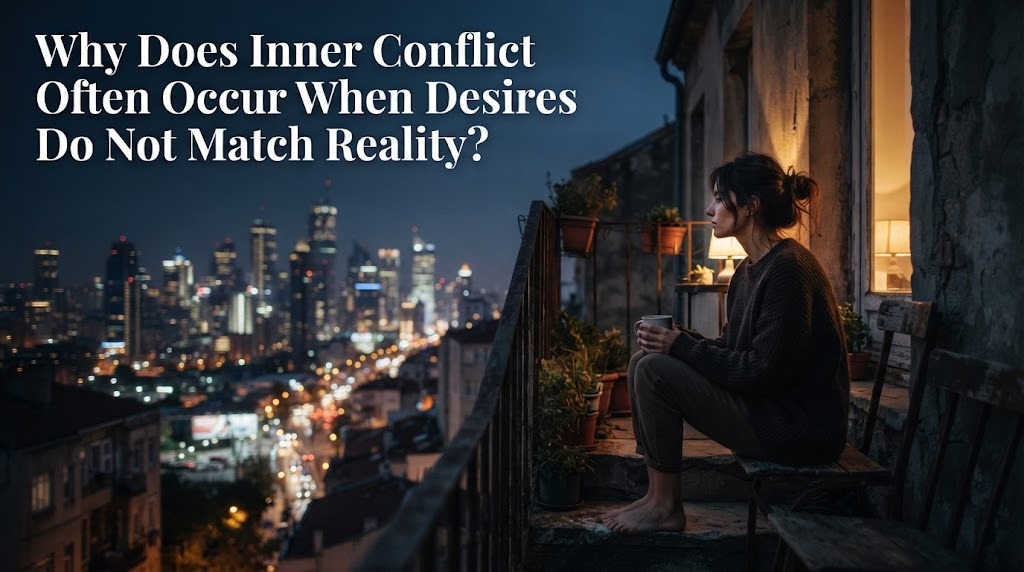
People often have expectations about how they want their lives to develop. However, reality does not always match personal desires, and this difference can create emotional tension. Someone may want a certain career, relationship, lifestyle, or achievement but face circumstances that make the goal difficult to reach. The gap between what a person wants and what actually happens can lead to inner conflict, disappointment, frustration, and uncertainty. Understanding why this happens can help people respond to reality without completely abandoning their goals.
WHAT IS INNER CONFLICT BETWEEN DESIRES AND REALITY?
Inner conflict occurs when a person's wishes, expectations, or beliefs do not fit their actual circumstances. For example, someone may strongly desire a particular job but discover that the available opportunities do not match their qualifications. Another person may want a relationship to develop in a certain way while the other individual has different expectations. These situations can create tension between what someone hopes for and what they experience.
This conflict becomes stronger when the desired outcome has significant emotional meaning. A person may have invested time, effort, or hope into achieving something, making an unexpected result difficult to accept. The mind may continue comparing reality with the preferred situation. As a result, accepting reality can become emotionally challenging even when the circumstances cannot be immediately changed.
WHY DO UNREALISTIC EXPECTATIONS CREATE INNER CONFLICT?
Unrealistic expectations can make the gap between desires and reality appear larger. People sometimes imagine that success, relationships, careers, or personal goals should develop according to a specific timeline. When events happen differently, they may feel that something has gone wrong even when the situation is actually normal. These expectations can come from personal beliefs, past experiences, social media, or comparisons with other people.
Expectations are not necessarily negative because they can motivate people to work toward meaningful goals. The problem occurs when expectations become so rigid that any different outcome feels like failure. Developing realistic expectations allows people to maintain ambition while accepting that progress may take different forms. This balance can reduce unnecessary emotional tension.
HOW DOES FEAR OF DISAPPOINTMENT INTENSIFY INNER CONFLICT?
Fear of disappointment can make the difference between desire and reality more emotionally difficult. When people strongly want a particular outcome, they may imagine how happy or successful they will feel after achieving it. If reality does not meet those expectations, the emotional contrast can be painful. This may lead to frustration, sadness, self-doubt, or repeated questioning.
Fear can also cause people to resist accepting an unwanted situation. They may repeatedly think about what could have happened differently instead of focusing on what can be done now. Emotional acceptance does not mean giving up on personal goals. It means recognizing the current situation clearly so that future actions can be based on reality rather than expectations alone.
CAN SOCIAL COMPARISON MAKE THE CONFLICT WORSE?
Yes, social comparison can increase inner conflict when people measure their reality against someone else's achievements. Social media can make this especially noticeable because people often see carefully selected images of other people's careers, relationships, lifestyles, or accomplishments. Someone may therefore feel that their own progress is too slow or that their life should look different. This comparison can create dissatisfaction even when their actual situation is reasonable.
It is important to remember that people have different circumstances, opportunities, resources, and timelines. Comparing a personal reality with another person's visible results does not provide the complete picture. Focusing on individual progress can help reduce unnecessary pressure. Personal goals become more meaningful when they are based on one's own values and circumstances rather than constant comparison.
HOW DOES INNER CONFLICT AFFECT EMOTIONAL WELL BEING?
When the gap between desires and reality remains unresolved, it can contribute to emotional stress and overthinking. A person may repeatedly ask why things did not happen as expected or imagine alternative outcomes. This mental cycle can consume attention and make it harder to focus on present responsibilities. Over time, persistent frustration may affect motivation and general emotional well-being.
Not every disappointment creates a serious emotional problem. Temporary frustration is a normal response when important expectations are not met. The concern becomes greater when emotional distress is persistent or begins interfering with daily functioning, relationships, work, or education. Recognizing this difference can help people determine whether they need new coping strategies or additional support.
HOW CAN YOU MANAGE THE GAP BETWEEN DESIRES AND REALITY?
The first step is to separate what you can control from what you cannot control. You may not be able to change another person's decision, an unexpected event, or an opportunity that has already passed. However, you can often control how you respond, what you learn, and what action you take next. This distinction can transform inner conflict into a more practical process.
It is also useful to adjust goals without completely abandoning them. A person can create smaller objectives, explore alternative paths, or change a timeline when circumstances require it. Flexibility and self-awareness can help people remain motivated while accepting reality. Instead of asking why reality is not exactly what was desired, it can be more productive to ask what can realistically be done from the current situation.
CONCLUSION
Inner conflict often occurs when personal desires do not match reality because people naturally develop expectations about how they want their lives to unfold. When circumstances differ from those expectations, fear, disappointment, social comparison, and overthinking can create emotional tension. The solution is not necessarily to stop having goals or desires, but to develop realistic expectations and greater flexibility. By accepting current circumstances, focusing on controllable actions, and adjusting goals when necessary, people can reduce unnecessary conflict between their wishes and reality. Learning to balance personal desires with real-life circumstances can lead to clearer thinking and healthier emotional responses.
About the Author
Gusti Ayu Tita P
Author — STEKOM University
An active author focused on academic issues, educational technology, and human resource development in the campus environment.