
Why Employers Value Critical Thinking Skills from Social Sciences Graduates?
Gusti Ayu Tita P
13 Agustus 2026
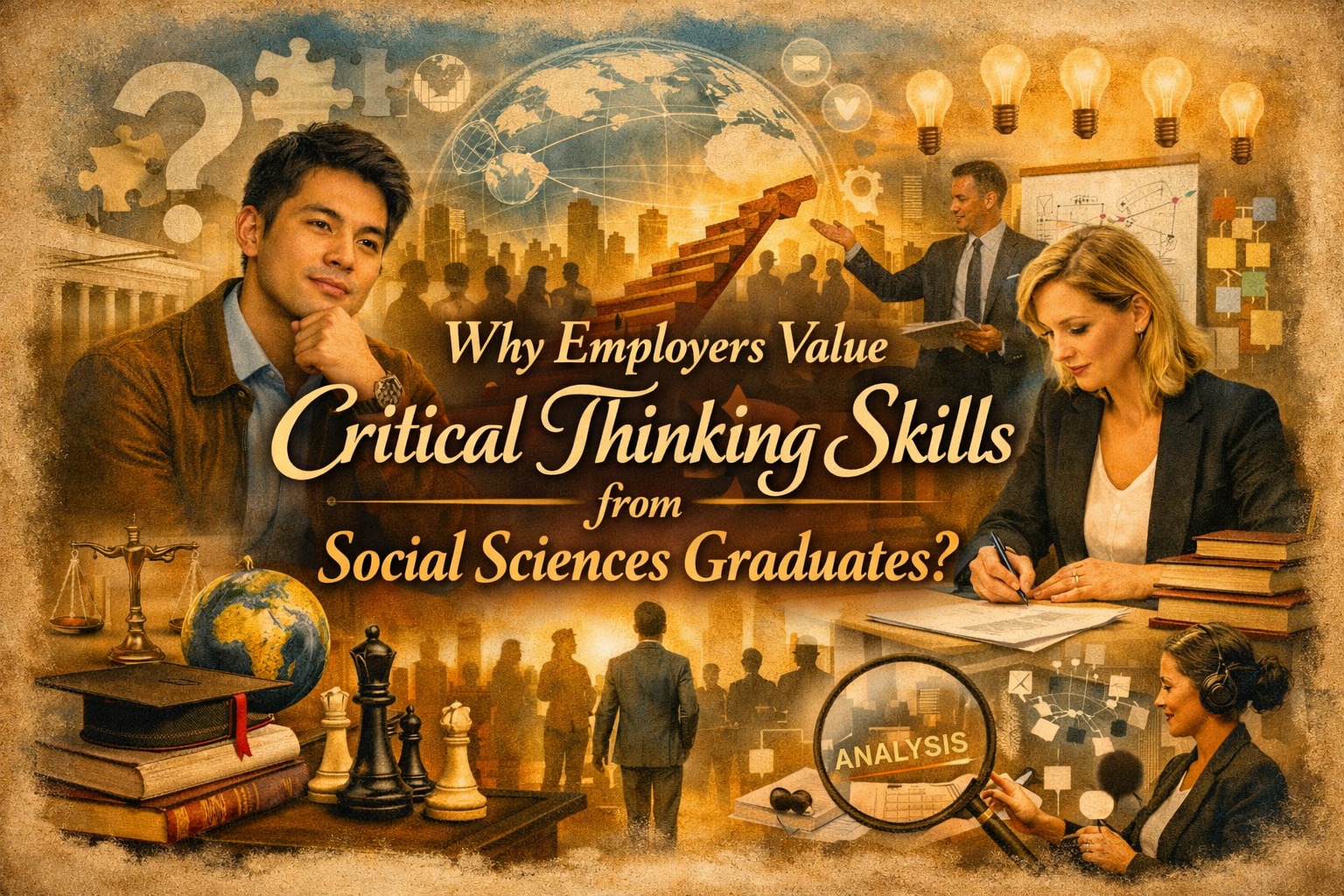
Critical thinking skills are one of the most important competencies developed in social sciences graduates during their academic journey. These skills involve the ability to analyze information, evaluate evidence, and make reasoned decisions based on logic rather than assumptions. In fields such as sociology, psychology, political science, and anthropology, students are constantly trained to question perspectives and interpret complex human behavior. This makes social sciences graduates highly adaptable in understanding real-world problems. As a result, critical thinking skills in social sciences education become a strong foundation for future careers. Employers increasingly recognize that graduates with this background are capable of handling complex situations with clarity and precision.
In today’s fast-changing job market, the demand for individuals who can think independently continues to grow. Organizations need professionals who do not only follow instructions but also evaluate situations critically. This is why critical thinking skills for employability are considered essential across industries. Social sciences programs naturally build this ability through research projects, case studies, and analytical writing. Therefore, graduates enter the workforce with a strong mindset for problem-solving and decision-making.
WHY EMPLOYERS PRIORITIZE CRITICAL THINKING SKILLS
Employers highly value critical thinking skills because they directly impact productivity and decision-making quality. In many workplaces, problems are rarely straightforward, and solutions require deep analysis rather than quick assumptions. This is where social sciences graduates stand out, as they are trained to examine issues from multiple perspectives. Companies see these individuals as assets because they can identify risks, evaluate data, and propose effective solutions. In addition, employers value critical thinking skills because they reduce errors and improve strategic planning. These abilities are especially important in leadership roles and project management positions.
Another reason employers prioritize these skills is the increasing complexity of modern industries. With the rise of digital transformation, businesses must interpret large amounts of data and human behavior patterns. Analytical skills in the workplace help organizations stay competitive and innovative. Social sciences graduates bring strong reasoning abilities that support better teamwork and communication. This combination of logic and empathy makes them highly valuable in collaborative environments.
KEY SKILLS DEVELOPED BY SOCIAL SCIENCES GRADUATES
During their studies, social sciences graduates develop a wide range of skills beyond theoretical knowledge. One of the most important is problem solving skills, which allow them to approach challenges systematically. They also gain strong analytical skills through research-based assignments and data interpretation tasks. These abilities help them break down complex issues into manageable parts. Additionally, students are trained in evaluating sources critically, which strengthens their decision-making accuracy.
Another key competency is communication skills, which are essential for expressing ideas clearly and effectively. Social sciences education encourages students to present arguments, write reports, and engage in discussions. This improves both written and verbal communication in professional settings. Combined with critical thinking skills, these abilities make graduates highly effective in teamwork and leadership roles. Employers often see this combination as a strong indicator of workforce readiness.
HOW CRITICAL THINKING IMPROVES WORKPLACE PERFORMANCE
In the workplace, critical thinking skills play a major role in improving overall performance and efficiency. Employees who can analyze situations logically are better at identifying problems before they escalate. This leads to faster and more accurate decision-making. Social sciences graduates are especially effective in roles that require research, planning, and evaluation. Their ability to interpret information objectively helps organizations avoid bias-driven decisions.
Furthermore, problem solving skills in the workplace contribute to innovation and continuous improvement. Employees who think critically are more likely to suggest creative solutions and improve existing processes. This enhances productivity and strengthens team collaboration. Employers also appreciate that individuals with strong analytical thinking can adapt quickly to new challenges. As industries evolve, critical thinking in professional environments becomes a key driver of long-term success.
CAREER IMPACT AND LONG TERM BENEFITS
The long-term career benefits of critical thinking skills are significant for social sciences graduates. These skills increase employability across various sectors such as education, business, government, and media. Professionals with strong analytical abilities often advance faster in their careers due to their decision-making capabilities. Employers trust them with more responsibility because they can evaluate situations independently. This leads to better career stability and growth opportunities.
In addition, employability skills for social sciences graduates continue to remain relevant even as industries change. Unlike technical skills that may become outdated, critical thinking remains valuable in every field. It also supports lifelong learning and adaptability in dynamic work environments. Graduates who master these skills are more likely to succeed in leadership positions. Ultimately, critical thinking skills in the workplace serve as a foundation for long-term professional success.
CONCLUSION
In conclusion, critical thinking skills are a vital asset that makes social sciences graduates highly valuable to employers. These skills enhance decision-making, problem-solving, and communication in professional environments. Employers prioritize individuals who can think independently and adapt to complex challenges. As industries continue to evolve, the importance of analytical skills, problem solving skills, and workforce readiness will only increase. Therefore, developing strong critical thinking abilities is not just an academic advantage, but also a long-term career investment.
About the Author
Gusti Ayu Tita P
Author — STEKOM University
An active author focused on academic issues, educational technology, and human resource development in the campus environment.















