
Why Is the 1945 Constitution the Foundation of Indonesian Law?
Gusti Ayu Tita P
4 Agustus 2026
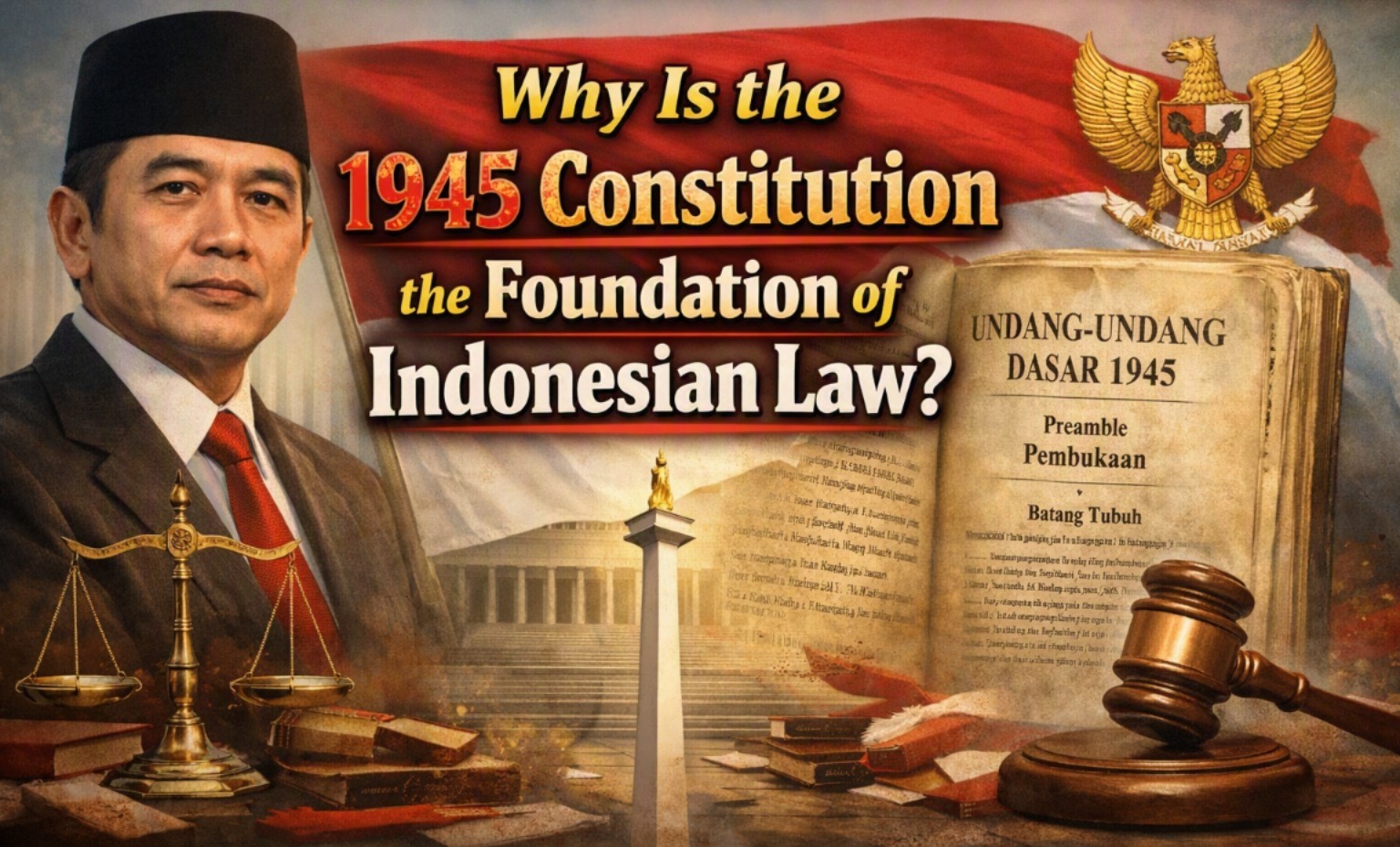
The 1945 Constitution of Indonesia (Undang-Undang Dasar 1945 or UUD 1945) is the highest legal authority in the country and serves as the foundation of the Indonesian legal system. Since its adoption on August 18, 1945, the Constitution has guided the nation's governance, protected the rights of its citizens, and established the principles that every law and regulation must follow. It is more than just a legal document because it reflects Indonesia's national identity, democratic values, and commitment to justice.
Understanding why the 1945 Constitution is the foundation of Indonesian law helps citizens appreciate the importance of the rule of law and constitutional governance. Every regulation, policy, and government decision must align with the Constitution to ensure fairness, legal certainty, and national stability.
THE 1945 CONSTITUTION AS THE HIGHEST LAW
The 1945 Constitution occupies the highest position in Indonesia's legal hierarchy. All national laws, government regulations, presidential regulations, and regional regulations must be consistent with its principles. If a law contradicts the Constitution, it can be reviewed and declared invalid through the constitutional review process conducted by the Constitutional Court.
As the supreme legal document, the Constitution provides the basic framework for how the country is governed. It defines the structure of government, the distribution of powers among state institutions, and the relationship between the government and citizens. This ensures that public authority is exercised according to clear legal standards rather than personal interests.
ESTABLISHING THE STRUCTURE OF GOVERNMENT
One of the most important functions of the 1945 Constitution is establishing Indonesia's system of government. It explains the roles and responsibilities of the President, the People's Consultative Assembly (MPR), the House of Representatives (DPR), the Regional Representative Council (DPD), the judiciary, and other state institutions.
By clearly defining the authority of each institution, the Constitution promotes checks and balances. This system prevents the concentration of power in one institution and supports accountability, transparency, and democratic governance. It also ensures that each branch of government works within its constitutional limits.
PROTECTING THE RIGHTS OF CITIZENS
The 1945 Constitution guarantees many fundamental rights for Indonesian citizens. These include the rights to education, freedom of religion, equality before the law, freedom of expression, social welfare, and legal protection. These constitutional rights provide a strong legal foundation for protecting human dignity and promoting justice.
The Constitution also places responsibilities on both citizens and the government. Citizens are expected to respect the law and contribute to national development, while the government must protect constitutional rights and deliver public services fairly. This balance helps strengthen trust between the people and the state.
GUIDING THE CREATION OF NATIONAL LAWS
Every law passed in Indonesia must be based on the principles outlined in the 1945 Constitution. Lawmakers use the Constitution as the primary reference when drafting legislation to ensure consistency with national values and constitutional provisions. This process helps maintain legal certainty across the country.
The Constitution also reflects the values of Pancasila, which serves as Indonesia's philosophical foundation. By integrating constitutional principles with national ideology, Indonesia develops laws that support democracy, social justice, national unity, and respect for diversity. This approach creates a legal system that is both stable and adaptable to changing societal needs.
CONCLUSION
Although Indonesia has experienced political, economic, and social changes, the 1945 Constitution continues to serve as the cornerstone of national governance. Constitutional amendments have strengthened democratic institutions while preserving the Constitution's essential principles. These improvements demonstrate the Constitution's ability to evolve without losing its fundamental purpose.
Today, the Constitution remains essential because it ensures legal certainty, protects human rights, supports democratic governance, and promotes national stability. As Indonesia continues to develop, the 1945 Constitution provides the legal foundation needed to balance progress, justice, and the rule of law for future generations.
About the Author
Gusti Ayu Tita P
Author — STEKOM University
An active author focused on academic issues, educational technology, and human resource development in the campus environment.



