
Why TKA Is More Than Memorization And Tests The Way Students Think?
Gusti Ayu Tita P
13 Agustus 2026
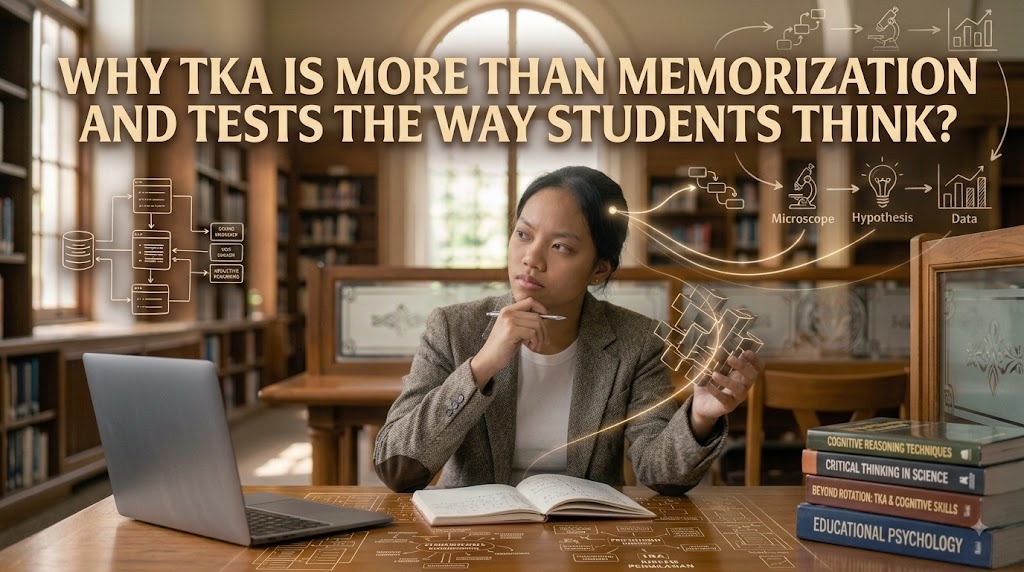
The TKA or Academic Competency Test is not simply about remembering information and choosing an answer. Students may need to understand concepts, analyze information, compare alternatives, and determine the most logical solution. These abilities show how students use their knowledge to solve problems, not just how much information they can recall. This makes the learning process behind TKA preparation just as important as the final test result.
Memorization still has a role in academic learning. Students need to remember basic concepts, formulas, definitions, and important terms before they can use them effectively. However, memorization becomes more useful when it is combined with understanding and reasoning. TKA encourages students to move from simply knowing information toward understanding how and when to use it.
UNDERSTANDING WHAT TKA MEASURES
TKA can encourage students to demonstrate academic competencies through questions that require understanding and application. A student may know a concept but still need to determine how that concept relates to a particular problem. This requires more than recalling information from memory. Students need to interpret, analyze, and apply what they have learned.
The way students approach a question can reveal their learning habits. Students who understand the underlying concept can adapt when the question uses a new example or different wording. Meanwhile, students who rely heavily on memorized patterns may find unfamiliar questions more challenging. Understanding creates greater flexibility in academic problem solving.
WHY MEMORIZATION ALONE IS NOT ENOUGH
Memorization is useful for building a foundation of knowledge. Students may need to remember mathematical formulas, scientific terms, vocabulary, definitions, or important principles. However, knowing information does not automatically mean knowing how to use it. A memorized fact becomes more valuable when students understand its meaning and application.
For example, a student may remember a formula but still need to identify which information should be included in the calculation. In reading questions, a student may know many vocabulary words but still need to interpret the meaning of a passage. These situations require students to think beyond recall. Application and reasoning turn knowledge into practical academic skills.
HOW TKA TESTS THE WAY STUDENTS THINK
Questions that require reasoning can encourage students to examine information before making a decision. Students may need to identify the main problem, find relevant details, and determine which concept is appropriate. They may also need to compare answer choices and evaluate whether each option is supported by evidence. The thinking process becomes an important part of reaching the correct answer.
This approach can also make students more aware of how they learn. Instead of asking only whether they got an answer right, they can ask why their answer was correct or incorrect. Such reflection helps students understand their strengths and weaknesses. Learning becomes a process of thinking, checking, and improving.
LEARNING FROM MISTAKES
Mistakes can reveal how students approach problems. An incorrect answer may result from misunderstanding the concept, overlooking important information, choosing the wrong strategy, or making a careless calculation. Instead of simply memorizing the correct answer, students should identify the reason for the mistake. Understanding errors can lead to better learning.
A simple mistake log can help students track recurring problems. Students can record the topic, their incorrect reasoning, and the correct approach. Reviewing this information regularly can show which areas require additional practice. Error analysis turns mistakes into useful feedback.
PRACTICING DIFFERENT TYPES OF QUESTIONS
Students should not practice only one question format. Different questions can test interpretation, comparison, calculation, application, or evaluation. Practicing varied questions encourages students to decide which strategy is appropriate for each situation. Variety helps students become more adaptable thinkers.
Students should also practice questions that use unfamiliar examples. This can reveal whether they truly understand the concept or have simply memorized a particular pattern. When students successfully apply a concept to a new situation, it demonstrates stronger understanding. Transfer of knowledge is an important sign of meaningful learning.
BALANCING MEMORIZATION WITH CRITICAL THINKING
Moving beyond memorization does not mean abandoning it completely. Basic information is still necessary because students need knowledge before they can analyze and evaluate it. The important difference is how that information is used. Memorization should provide the foundation, while critical thinking helps students use that foundation effectively.
Students can first memorize essential facts and then practice applying them. For example, after learning a formula, they can solve problems with different conditions. After learning a definition, they can identify real examples and non-examples. Combining memory with application creates stronger academic understanding.
HOW TO PREPARE FOR TKA EFFECTIVELY
Students can begin preparation by identifying the most important concepts in each subject. They should understand the basic principles before spending significant time on practice questions. After that, they can use different questions to test their ability to apply what they have learned. Preparation should focus on both knowledge and thinking skills.
Regular review is also important. Students can use active recall, practice tests, discussion, and error analysis to strengthen their learning. Timed practice can help them develop efficient decision making without sacrificing accuracy. Consistent preparation is generally more useful than relying on last-minute memorization.
WHY THESE SKILLS MATTER BEYOND TKA
The thinking skills developed during TKA preparation can be useful in many areas of life. Students can use analytical thinking when evaluating information, making decisions, solving daily problems, and considering different perspectives. These abilities can also help them become more independent learners. Critical thinking is not limited to academic examinations.
Higher education and future careers also require people who can understand information and make reasonable decisions. Students may need to analyze data, solve problems, communicate conclusions, and adapt to new situations. Therefore, developing these abilities can provide benefits long after the TKA is completed. The real value of learning is the ability to use knowledge effectively.
CONCLUSION
TKA is more than memorization because it encourages students to understand concepts, analyze information, use evidence, apply knowledge, solve problems, and evaluate possible answers. Memorization remains an important foundation, but it should not become the only learning strategy. Students need to understand how their knowledge can be used when questions change context or require deeper reasoning.
The most effective preparation combines conceptual understanding, critical thinking, logical reasoning, practice questions, and error analysis. Students should evaluate not only whether an answer is correct but also why it is correct. By developing these habits, students can become more confident and flexible learners while gaining skills that remain valuable in higher education, professional life, and everyday decision making.
About the Author
Gusti Ayu Tita P
Author — STEKOM University
An active author focused on academic issues, educational technology, and human resource development in the campus environment.















