Why TKA Tests Reasoning Skills Beyond Simple Memorization?
Gusti Ayu Tita P
13 Agustus 2026
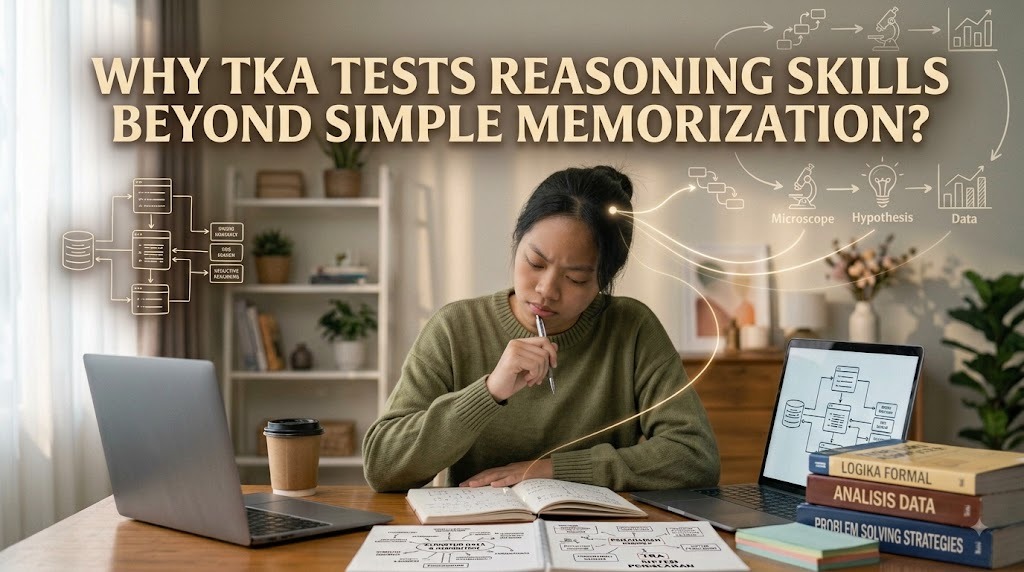
The TKA or Academic Competency Test is designed to assess students' academic abilities through questions that require them to understand and use knowledge. Preparing for TKA is therefore not simply about memorizing definitions, formulas, or previously seen answers. Students may need to analyze information, recognize relationships, evaluate choices, and determine logical solutions. These abilities are closely connected to reasoning skills.
Memorization still has a useful place in learning. Students need to remember basic concepts, terminology, formulas, and important information before they can apply them. However, memorization alone may not be enough when a question presents information in an unfamiliar context. Reasoning allows students to use what they know instead of simply repeating what they have memorized.
UNDERSTANDING REASONING IN TKA
Reasoning is the ability to use information and knowledge to reach a logical conclusion. Students use reasoning when they identify relationships, compare possibilities, interpret evidence, and determine what solution makes the most sense. In an academic test, reasoning helps students understand what a question requires before selecting an answer. Good reasoning connects knowledge with decision making.
A student may know a particular formula but still need to decide whether that formula is appropriate for a specific problem. Similarly, knowing a definition does not automatically mean the student can recognize the concept when it appears in a new situation. This is why students need to understand the principles behind what they learn. Reasoning turns stored information into usable knowledge.
WHY MEMORIZATION ALONE IS NOT ENOUGH
Memorization can help students remember important information quickly. However, memorized information may not be useful if students do not understand how or when to apply it. A question can change its wording, context, or presentation while still testing the same underlying concept. Students who depend only on memorized patterns may struggle when the question looks different.
For example, remembering a mathematical formula is only the first step. Students still need to identify the information provided, determine what is being asked, and select the correct method. The same principle applies to science, reading, and other academic subjects. Understanding the process behind an answer is more flexible than memorizing an answer itself.
HOW TKA ENCOURAGES DEEPER THINKING
TKA preparation can encourage students to think about why an answer is correct. Instead of immediately selecting a familiar option, students need to examine the information provided in the question. They may have to identify the main idea, determine relevant details, and connect different pieces of information. This process encourages deeper academic thinking.
Questions can also require students to apply concepts in different situations. A familiar topic may be presented through a new example or problem. Students who understand the concept can adapt their knowledge to the new situation. Conceptual understanding makes reasoning more effective when question formats change.
ANALYZING INFORMATION BEFORE MAKING A DECISION
Reasoning begins with careful analysis of the available information. Students should identify what they already know, what they need to find, and which details are relevant. This prevents them from becoming distracted by unnecessary information. Information analysis helps students approach questions systematically.
Students can also compare the information with the answer choices. If an option contradicts the evidence or concept, it can be eliminated. If several choices seem possible, students can examine which one has the strongest logical support. Careful comparison reduces dependence on guessing.
HOW PRACTICE QUESTIONS BUILD REASONING SKILLS
Practice questions give students opportunities to apply their knowledge repeatedly. However, students should avoid focusing only on the number of questions completed. A smaller number of questions with careful analysis can sometimes provide more learning value than completing many questions without reviewing them. Quality practice should include reasoning and reflection.
Students should try different question types and difficulty levels. They can practice questions that require interpretation, comparison, calculation, evaluation, and application. This variety helps students become more flexible in their thinking. Different question formats train students to recognize which reasoning strategy is appropriate.
MANAGING TIME WHILE USING REASONING
Reasoning requires careful thought, but students also need to manage their time during the test. Spending too long on one difficult question can reduce the time available for other questions. Students can practice identifying the main task quickly before deciding how much time a question deserves. Efficient reasoning combines accuracy with appropriate time management.
If a question is unusually difficult, students can move to another question and return later when possible. This prevents one problem from affecting the entire test. Regular timed practice can help students become more comfortable with this strategy. The goal is not simply to think quickly but to think clearly within the available time.
HOW STUDENTS CAN PREPARE FOR REASONING BASED TKA QUESTIONS
Students should begin by strengthening their understanding of fundamental concepts. They can then practice applying those concepts to different situations rather than repeatedly memorizing identical examples. Explaining solutions in their own words can also reveal whether they genuinely understand the material. Conceptual learning should be combined with active practice.
Students can also use active recall, question analysis, discussion, and error review as part of their preparation. Before checking an answer, they should try to explain why they selected it. If their reasoning is unclear, they can return to the relevant concept and try again. Consistent practice builds stronger reasoning habits over time.
WHY REASONING SKILLS MATTER BEYOND TKA
Reasoning skills are useful far beyond academic tests. Students use them when evaluating information online, making decisions, solving everyday problems, and considering different perspectives. Strong reasoning can help them avoid accepting information without checking whether it makes sense. Critical and logical thinking are valuable life skills.
These abilities are also important in higher education and professional environments. University students often need to analyze information independently, while workers may need to evaluate problems and choose practical solutions. Therefore, developing reasoning through TKA preparation can provide long term benefits. The skills developed during academic preparation can remain useful throughout a student's education and career.
CONCLUSION
TKA tests reasoning skills beyond simple memorization because students need to understand information, analyze problems, evaluate evidence, apply concepts, and reach logical conclusions. Memorization remains useful for basic knowledge, but it becomes much more valuable when combined with understanding and application. Students who develop reasoning skills are better prepared to handle questions that use unfamiliar contexts or different formats.
The best preparation involves conceptual learning, problem solving, practice questions, evidence based reasoning, and error analysis. Students should focus not only on whether an answer is correct but also on why it is correct. By developing these skills consistently, students can approach TKA with greater confidence while building thinking abilities that will remain valuable in higher education, work, and everyday life.
About the Author
Gusti Ayu Tita P
Author — STEKOM University
An active author focused on academic issues, educational technology, and human resource development in the campus environment.