Will AI Replace Animators? Understanding the Future of Animation Careers
Gusti Ayu Tita P
31 Agustus 2026
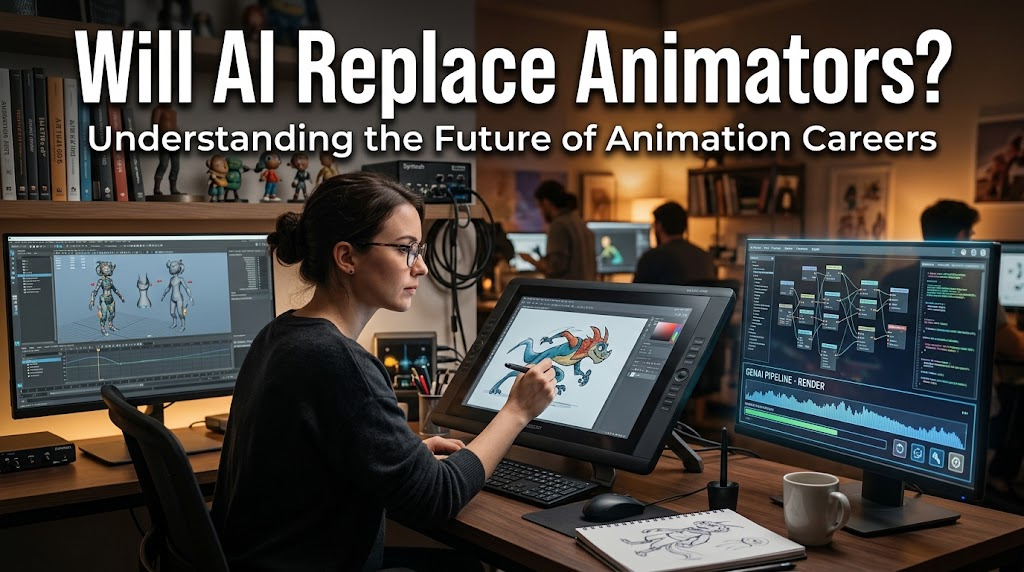
Artificial intelligence is changing many parts of the creative industry, including animation. Modern AI animation tools can help generate images, create movement, develop characters, produce backgrounds, and assist with video production. These capabilities allow creators to complete certain tasks faster than traditional workflows. As AI technology continues to improve, concerns about whether AI will replace animators have naturally become more common.
However, animation involves much more than producing moving images. Professional projects require storytelling, artistic direction, character development, visual consistency, emotional expression, and collaboration between different specialists. AI can automate some repetitive tasks, but human creativity and decision-making remain important throughout the production process.
WHAT TASKS CAN AI ALREADY HELP ANIMATORS WITH?
AI can assist animators with several production activities. Depending on the software and workflow, AI may help with concept development, image generation, motion assistance, lip synchronization, background creation, video editing, and visual experimentation. These capabilities can reduce the time spent on certain repetitive processes and allow artists to concentrate on more creative decisions.
For example, an animator can use AI to generate early visual concepts before developing the final design manually. AI can also help create variations of a background or provide reference material for a particular scene. Instead of treating these technologies only as competitors, many professionals can use them as creative assistants that support their existing skills.
WHY HUMAN ANIMATORS ARE STILL IMPORTANT
Animation requires artistic judgment that cannot always be reduced to a simple automated process. An animator needs to understand timing, emotion, movement, composition, character acting, storytelling, and audience expectations. These elements determine whether a scene feels convincing and meaningful rather than simply technically impressive.
Human animators also make creative decisions based on context. A character's movement may need to communicate fear, excitement, sadness, humor, or subtle personality traits. Understanding those emotions and translating them into appropriate movement requires interpretation and artistic sensitivity. AI can generate possibilities, but human artists remain responsible for choosing, refining, and directing those possibilities.
HOW AI MAY CHANGE ANIMATOR JOBS
Rather than eliminating every animation position, AI is more likely to change the responsibilities of animators. Some repetitive production tasks may become increasingly automated, allowing artists to spend more time on creative direction and complex animation work. This could change how animation teams are structured and how long certain projects take to complete.
Future animators may need to understand both traditional animation principles and modern AI workflows. Skills such as prompt writing, AI-assisted production, visual editing, storytelling, character design, and quality control could become valuable additions to traditional animation abilities. Professionals who learn how to combine these skills may have more flexibility as production methods evolve.
NEW CAREER OPPORTUNITIES CREATED BY AI ANIMATION
Technological changes can also create new roles within the animation industry. As companies adopt AI-assisted production, they may need professionals who understand how to integrate AI into creative workflows. Potential areas include AI animation direction, prompt development, creative supervision, AI-assisted character design, visual quality control, and animation pipeline management.
AI may also make independent animation production more accessible. A small creative team can potentially produce content that previously required larger resources by combining AI tools with conventional software and human expertise. This could create opportunities for independent animators, freelancers, content creators, and small studios to experiment with projects that would otherwise be difficult to produce.
SKILLS ANIMATORS SHOULD DEVELOP FOR THE FUTURE
Animators who want to remain competitive should focus on skills that complement AI rather than competing directly with automated processes. Strong knowledge of animation fundamentals, storytelling, character acting, composition, cinematography, and visual design will continue to be useful. These abilities help professionals evaluate AI-generated results and improve them when necessary.
Technical adaptability is equally important. Animators can learn how different AI animation software and creative tools fit into workflows for concept development, production, editing, and post-production. At the same time, professionals should develop communication and collaboration skills because animation projects often involve directors, writers, designers, editors, producers, and clients. The ability to understand a creative brief and turn it into a strong visual result can remain highly valuable.
THE CHALLENGES OF AI REPLACING ANIMATION WORK
There are several reasons why completely replacing animators with AI remains difficult. AI-generated content can sometimes contain inconsistent character details, unnatural movement, visual errors, or continuity problems. Longer and more complex productions also require consistency across many scenes, which can be difficult to maintain automatically.
There are also important questions surrounding copyright, originality, consent, and creative ownership. Professional studios need reliable workflows that meet legal and commercial requirements while maintaining quality. Human oversight is therefore likely to remain important even as AI becomes more capable. Instead of removing people from the process entirely, AI may increasingly shift where human expertise is needed.
THE FUTURE OF ANIMATION CAREERS
The future of animation careers will likely involve greater cooperation between humans and AI. Animators may spend less time performing repetitive technical tasks and more time directing characters, designing scenes, developing stories, and reviewing generated material. This could make some workflows faster while also increasing expectations for creative and technical skills.
For students and aspiring animators, the most practical approach is to learn both traditional animation principles and AI-assisted production. Understanding how movement, storytelling, design, and emotion work will provide a foundation that remains useful regardless of which software becomes popular. At the same time, learning new AI tools can help future professionals adapt to changing production environments.
CONCLUSION
So, will AI replace animators? It is unlikely that AI will simply eliminate the need for all human animators. Instead, AI is more likely to automate selected tasks and transform how animation is produced. The professionals who understand how to combine human creativity, animation expertise, and AI technology may be better prepared for the changing industry.
The future of animation will depend not only on technological capabilities but also on the ability to create meaningful stories and memorable visual experiences. Animators who continue learning, experiment with new tools, and strengthen their creative judgment can treat AI as an opportunity rather than only a threat. AI may change the animator's job, but human creativity remains a central part of compelling animation.
About the Author
Gusti Ayu Tita P
Author — STEKOM University
An active author focused on academic issues, educational technology, and human resource development in the campus environment.