A Guide To Choosing Yoga Exercises Based On Your Ability And Goals
Gusti Ayu Tita P
1 September 2026
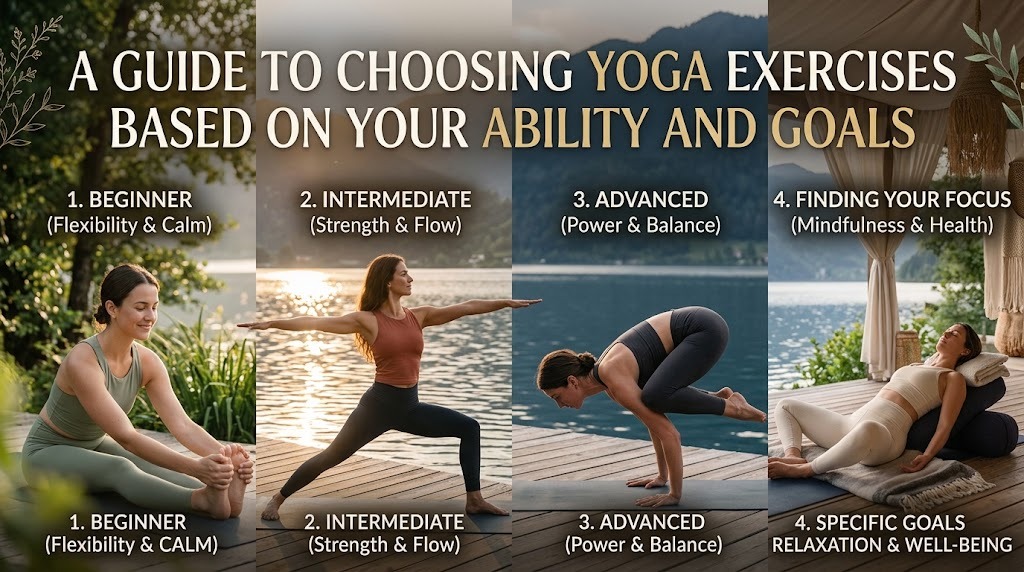
Yoga offers many types of exercises, poses, and techniques that can be adjusted to different abilities and personal goals. Some people practice yoga to improve flexibility and balance, while others want to build strength, reduce stress, or support relaxation. Choosing the right exercises is important because every person's physical condition and experience level is different. A suitable routine can make yoga safer, more comfortable, and easier to maintain. Therefore, understanding how to choose yoga exercises based on your ability and goals can help you get better results.
UNDERSTANDING YOUR CURRENT ABILITY
The first step in choosing yoga exercises is understanding your current physical ability. Beginners should start with simple movements that allow them to learn basic alignment and breathing techniques. People with more experience may be comfortable with more challenging poses or longer sessions. Flexibility, balance, strength, and coordination can vary greatly between individuals. Your routine should match your current condition instead of being based on the performance of other people.
It is also important to pay attention to how your body responds during practice. Mild stretching can be normal, but sharp or persistent pain should not be ignored. If you have an injury or a specific health concern, professional guidance may be appropriate before starting certain exercises. Knowing your limitations is an important part of safe yoga practice.
CHOOSING YOGA FOR FLEXIBILITY
If your main goal is to improve flexibility, choose poses that gently stretch major muscle groups. Movements such as Cat-Cow, Child's Pose, seated forward folds, and gentle standing stretches can be included in a beginner-friendly routine. The movements should be slow and controlled rather than forced. Regular practice can gradually improve your comfort and range of motion. Flexibility usually develops over time, so immediate results should not be expected.
It is important to avoid pushing the body beyond its comfortable range. A deeper position is not necessarily a better position. Consistency and proper technique are more important than reaching the deepest stretch. Using modifications or yoga props can also make certain poses more accessible.
CHOOSING YOGA FOR STRENGTH
Yoga can also support muscular strength, especially when poses require the body to hold a stable position. If strength is your goal, poses such as Plank, Chair Pose, Warrior poses, and Bridge Pose can be useful options. These movements can engage the core, legs, arms, shoulders, and other muscle groups. Beginners should focus on proper form before increasing the duration or difficulty. Gradual progression can help the body adapt to the physical demands of the practice.
Strength-focused yoga should still include adequate rest and recovery. Holding a pose for too long may cause unnecessary fatigue, especially for beginners. Quality of movement should come before intensity. A balanced routine can combine strengthening poses with mobility and relaxation exercises.
CHOOSING YOGA FOR BALANCE
People who want to improve balance can include standing poses that challenge stability and body awareness. Tree Pose, Warrior III, and other supported balance poses can be adapted for different experience levels. Beginners can practice near a wall or use a stable surface for additional support. The goal is to develop better control rather than holding a pose perfectly from the beginning. Regular practice can help improve awareness of body position and movement.
Balance exercises should be introduced gradually because they can be more challenging than they appear. It is normal to lose balance occasionally while learning. Using support is not a sign of failure, but a practical way to practice safely. As confidence improves, support can gradually be reduced.
CHOOSING YOGA FOR STRESS RELIEF
If your main goal is relaxation and stress management, choose a slower style of practice. Gentle yoga, restorative poses, breathing exercises, and mindful movement can create a calmer practice environment. Poses that can be held comfortably for several breaths may help you focus on the present moment. Controlled breathing and relaxation are especially important when the goal is to reduce physical and mental tension.
A stress-relief routine does not have to be long. Even a short session can provide an opportunity to slow down and reconnect with your breathing. Practicing in a quiet environment may also make relaxation easier. The quality of attention matters more than the number of poses performed.
CHOOSING YOGA FOR BETTER FOCUS
Yoga can be adapted for people who want to develop concentration and body awareness. Slow movements combined with controlled breathing require attention to posture and physical sensations. Balance poses can also encourage practitioners to focus on maintaining stability. Meditation or simple breathing exercises may complement a physical yoga routine. Mindful practice can help create a stronger connection between movement and attention.
When practicing for concentration, avoid rushing through poses. Try to remain aware of your breathing throughout each movement. Reducing distractions can also make it easier to maintain attention. Over time, a consistent routine may become a useful part of a broader approach to daily focus and relaxation.
CHOOSING YOGA FOR GENERAL FITNESS
Some people simply want yoga to become part of a healthy and active lifestyle. In this situation, a balanced routine can include flexibility, strength, balance, mobility, and relaxation exercises. Combining different types of poses can prevent the practice from becoming too repetitive. The intensity should still match your experience and physical condition. A balanced yoga routine should be realistic and sustainable.
Yoga can complement other forms of physical activity rather than replacing every type of exercise. Walking, cycling, swimming, strength training, or other activities can provide different physical benefits. A varied routine can help support overall fitness. The most suitable combination depends on individual goals, preferences, and schedule.
ADAPTING YOGA TO YOUR EXPERIENCE LEVEL
Yoga exercises should become more challenging only when your body is ready. Beginners can focus on basic poses, breathing, and simple transitions before attempting advanced variations. Intermediate practitioners may gradually increase session duration or explore more demanding movements. Experienced practitioners can work on technique, control, and more complex sequences. Progress should be gradual and purposeful.
There is no universal timeline for becoming better at yoga. Two people can practice for the same amount of time and develop different abilities. Factors such as previous physical activity, body structure, consistency, and recovery can influence progress. Choosing exercises according to your own development can make the practice more enjoyable and sustainable.
USING YOGA PROPS AND MODIFICATIONS
Yoga props can make exercises more accessible and help practitioners maintain better alignment. Blocks, straps, bolsters, blankets, and walls may be useful depending on the pose and individual needs. Props are especially helpful when flexibility or balance is still developing. They can also provide additional support during restorative exercises. Using a modification does not make the practice less effective.
Instead of forcing the body into a difficult position, practitioners can select a variation that feels stable and controlled. As ability improves, the modification can be adjusted or removed if appropriate. Adaptation is an important part of personalized yoga practice. The focus should always remain on safe and controlled movement.
CREATING A PERSONAL YOGA ROUTINE
After identifying your ability and goals, create a routine that fits your daily life. Start with a manageable frequency and choose exercises that directly support your main objective. For example, someone focusing on flexibility may prioritize gentle stretching, while someone seeking strength may include more weight-bearing poses. A person looking for relaxation can emphasize slower movements and breathing exercises. The best routine is one that you can practice consistently.
Keep track of how you feel before and after each session. This can help you identify which exercises feel beneficial and which ones may need modification. Your goals can also change over time, so your yoga routine does not have to remain the same forever. Personalization, patience, and consistency can make yoga a more useful part of a healthy lifestyle.
CONCLUSION
Choosing yoga exercises based on your ability and goals can make each practice safer and more meaningful. Start by assessing your strength, flexibility, balance, experience, and personal objectives. Then select exercises that match what you want to achieve, whether that means improving flexibility, building strength, reducing stress, enhancing balance, or supporting general fitness. Avoid comparing your progress with others and increase difficulty gradually. With a realistic routine and proper body awareness, yoga can become a sustainable activity that supports long-term physical and mental well-being.
Tentang Penulis
Gusti Ayu Tita P
Penulis — Universitas STEKOM
Penulis aktif yang berfokus pada isu-isu akademik, teknologi pendidikan, dan pengembangan sumber daya manusia di lingkungan kampus.